

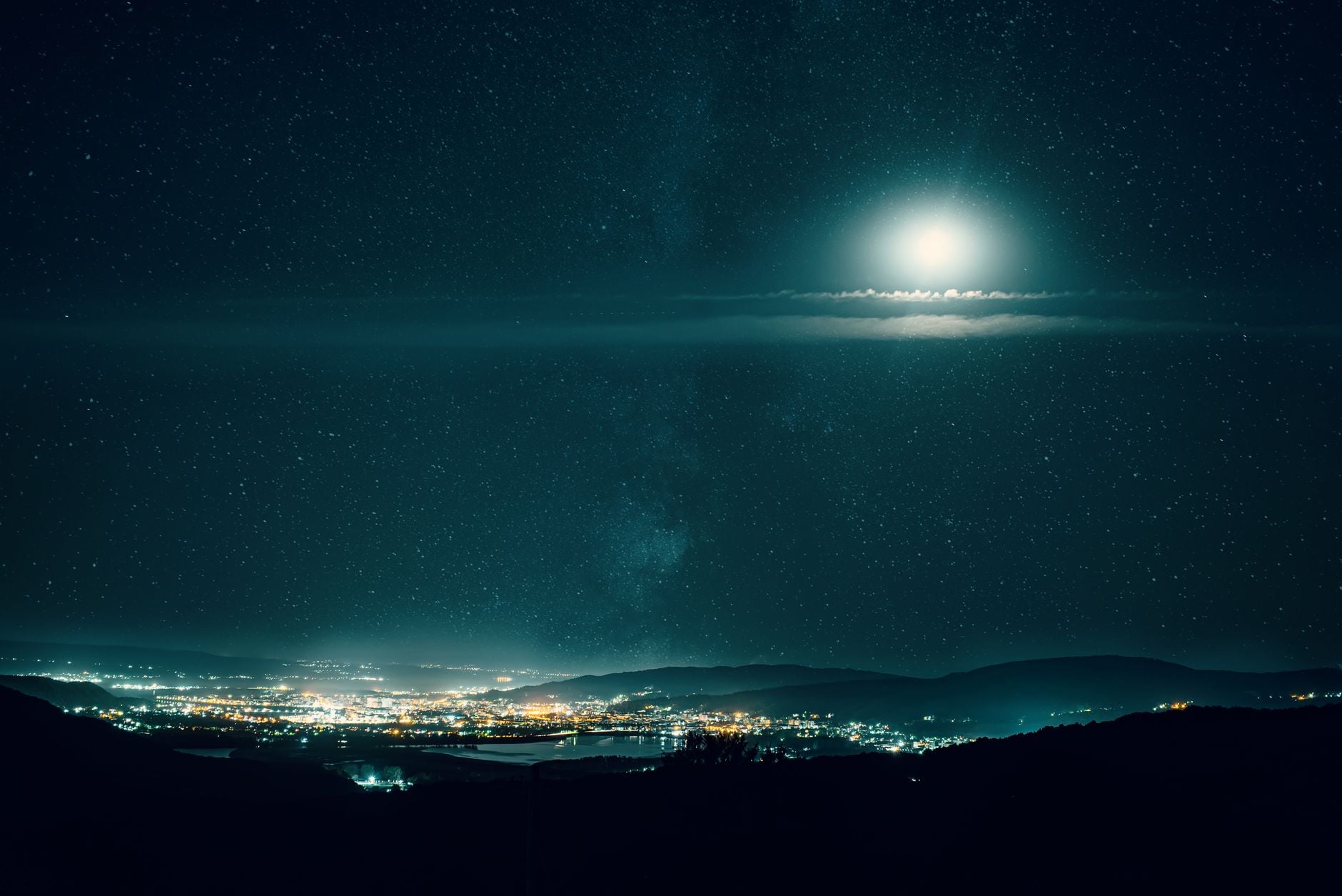
A third of humanity cannot see the Milky Way from where they live. The statistic is real, but it needs a date and a definition attached to it.
It comes from the 2016 New World Atlas of Artificial Night Sky Brightness, not from a survey in which billions of people were asked to look up. Researchers combined satellite observations, ground measurements, a model of how light scatters through the atmosphere and population data to estimate who lived under skies bright enough to erase the galaxy’s pale band.
No newer study has yet replaced it with an equivalent global headcount. More recent research shows that artificial light at night is still changing, often quickly, but those measurements do not translate directly into a new percentage of humanity that can or cannot see the Milky Way.
The one-third figure was published in 2016
The New World Atlas was published in Science Advances by Fabio Falchi and an international team. Its headline results were stark: more than 80 percent of the global population lived under light-polluted skies, while more than 99 percent of people in the United States and Europe did.
The threshold for losing the Milky Way was higher than the threshold for merely experiencing some artificial skyglow. Under the atlas model, the galaxy was hidden from more than one-third of humanity, including about 60 percent of Europeans and nearly 80 percent of North Americans.
Space Daily reported those findings when the atlas appeared. The number has remained in circulation because the atlas is still the most complete population-weighted global estimate of this specific loss.
Researchers mapped skyglow rather than counting people looking up
The atlas used low-light observations from the Visible Infrared Imaging Radiometer Suite aboard the Suomi NPP satellite. Those measurements showed light emitted upward from towns, roads and industrial areas.
A propagation model then estimated how that light would scatter through a standard clear atmosphere and return toward an observer as skyglow. Thousands of calibrated measurements made on the ground were used to check the model. Finally, the brightness map was combined with population data.
The result was not a prediction for every night. Clouds can amplify urban skyglow, while moonlight, haze, snow, altitude, season and the observer’s eyesight can all change what is visible. The atlas instead described modeled clear-sky conditions at the zenith using consistent assumptions, which made places comparable.
A zoomable version maintained by the Cooperative Institute for Research in Environmental Sciences shows how light from cities spreads beyond their built boundaries. A person can live well outside a city center and still look through its luminous dome.
A later study used human eyes as sensors
Satellite instruments are excellent at mapping emitted light, but they do not see the night exactly as a dark-adapted person does. A 2023 study approached the problem from the ground.
Researchers analyzed 51,351 naked-eye observations submitted to the Globe at Night citizen-science project between 2011 and 2022. Participants compared the stars they could see with a sequence of charts under cloudless, moonless conditions.
The study found that the decline in visible stars at the observed locations was consistent with artificial sky brightness increasing by 7 to 10 percent per year in the human-visible band. Its central estimate was 9.6 percent.
That does not mean every place on Earth brightened by 9.6 percent each year. The observations were concentrated in Europe and North America and were biased toward inhabited locations. The authors explicitly noted that the sample did not represent the average distribution of either land area or global population.
It therefore cannot be applied to the 2016 total like compound interest to produce a new global headcount.
Why a satellite can miss light that hides stars
The difference between satellite and naked-eye trends is partly about direction. An orbiting sensor mainly detects light traveling upward. Skyglow is the result of light scattering back down toward people on the ground, and horizontally emitted light can make a large contribution.
Color matters too. The widely used VIIRS day-night instrument is relatively insensitive to shorter blue wavelengths. Human night vision is more sensitive to that part of the spectrum, and blue light scatters efficiently in the atmosphere. A city switching from orange sodium lamps to broad-spectrum white LEDs can therefore change the visible sky in ways the satellite record does not fully capture.
This does not make satellite measurements wrong. It means upward radiance and the brightness perceived by a person looking at the sky are related but different quantities.
A 2026 analysis found both brightening and dimming
A separate Nature study published in 2026 analyzed more than 1.16 million daily satellite images from 2014 through 2022. It found a net 16 percent rise in global artificial-light radiance over that period.
The global total concealed movement in both directions. Brightening added radiance equivalent to 34 percent of the 2014 baseline, while dimming elsewhere offset 18 percent. Urbanization and electrification drove many increases, especially in Asia, while energy policy, conflict, economic disruption and lighting changes produced reductions in other regions.
The authors also stressed that their satellite measurement was not the same as downward skyglow. It was especially sensitive to upward light after midnight within a limited range of wavelengths. That makes it valuable for tracking how Earth’s illuminated surface changes, but it still cannot provide an updated Milky Way visibility percentage by itself.
The old estimate may be dated, but it is not obsolete
It is reasonable to suspect that the 2016 figure is now conservative in many growing urban regions. Ground observations show stars disappearing faster than earlier satellite trends suggested, and the 2026 analysis found a net rise in emitted light. Yet some places have dimmed, and the world’s population has moved as well as grown.
The defensible statement remains precise: the best global atlas found that more than a third of humanity lived where artificial skyglow hid the Milky Way under its modeled conditions. Newer work shows continued and uneven change, not a replacement population fraction.
Space Daily recently examined what losing routine access to a star-filled sky may mean psychologically. The measurement story adds a quieter lesson: we cannot protect what we do not measure carefully.
The good news is that skyglow is not permanent contamination. The US National Park Service recommends using light only where and when it is needed, choosing fully shielded fixtures, keeping output to the minimum necessary and favoring warmer colors. Unlike many environmental changes, turning down unnecessary light can improve the view that same night.