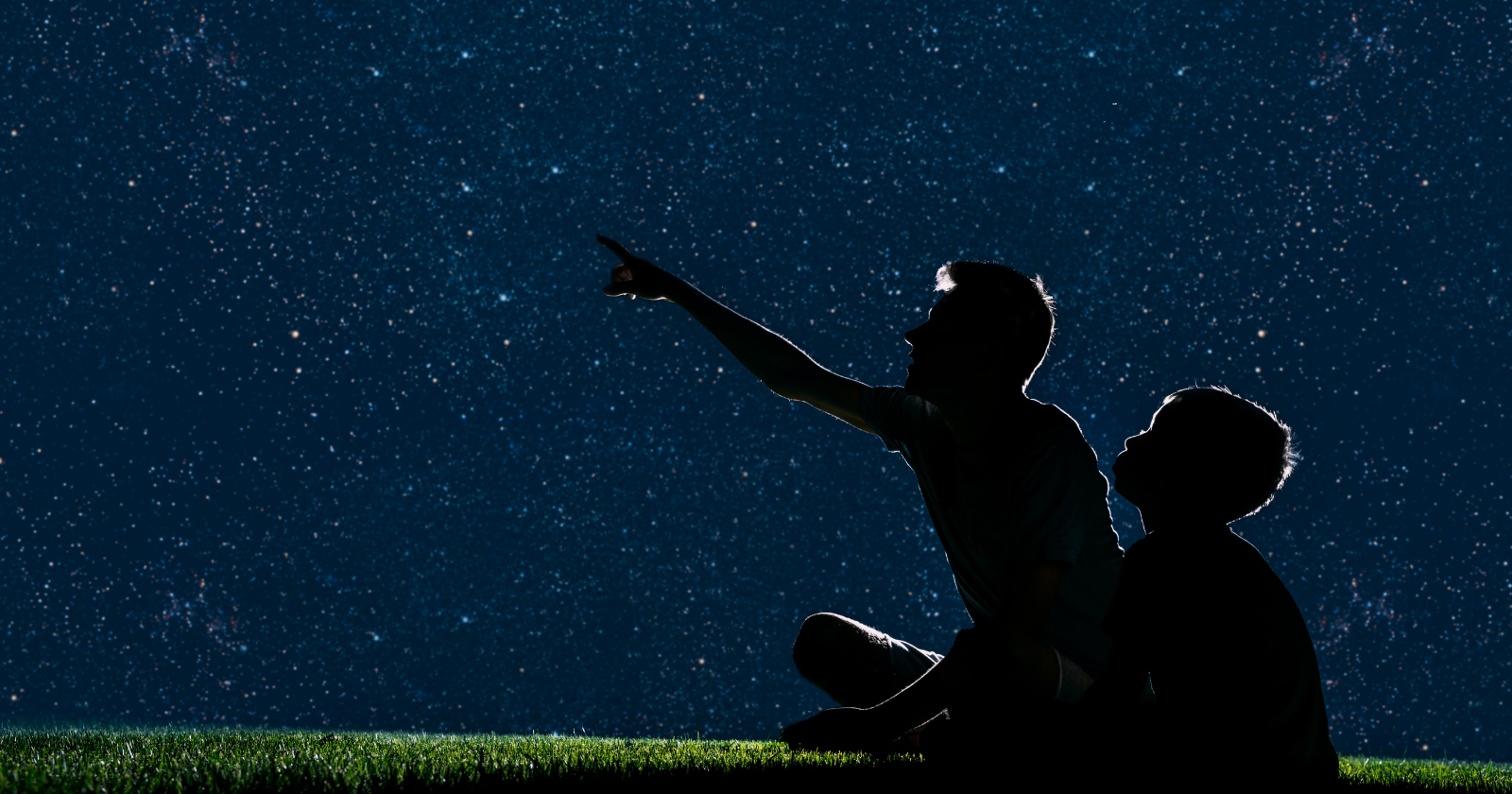
There is a fact about the night sky in 2026 that does not get mentioned in most space coverage, even though it is one of the more consequential things about how humans currently relate to the universe. For the first time in the species’ history, most of us live under skies we cannot see.
The figure comes from the 2016 World Atlas of Artificial Night Sky Brightness, published in Science Advances by Fabio Falchi and colleagues. It remains the most comprehensive global study of light pollution that has been done. The headline finding is that more than 80 per cent of the world’s population, and more than 99 per cent of the US and European populations, live under skies that satellite-calibrated measurements classify as light-polluted. The Milky Way, visible to every human being until roughly four generations ago, is now hidden from more than a third of humanity, including 60 per cent of Europeans and nearly 80 per cent of North Americans.
These are not numbers we routinely sit with. They appear in a paper, get covered briefly at publication, and then return to the background. What we keep coming back to in our reading of the literature is the harder question underneath them. The astronomers can show, with unusual precision, what has been lost. They have a much weaker grip on what comes with that loss.
The rate is accelerating
In January 2023, Christopher Kyba and colleagues at the GFZ German Research Centre published a follow-up paper in Science, drawing on 51,351 naked-eye observations submitted by citizen scientists to a programme called Globe at Night. The paper estimated that artificial sky brightness, as perceived by the human eye, has been increasing by between 7 and 10 per cent per year over the period from 2011 to 2022. The headline figure was 9.6 per cent annually.
As Kyba put it in the press release accompanying the paper, a child born in a location where 250 stars were visible would be able to see roughly 100 of them by the time they turned 18. The rate of change exceeds what satellite measurements alone had captured. Part of the gap is explained by the shift from sodium street lighting to white LED lighting. Even where surface light emission is decreasing, the scotopic-band brightness of the sky overhead, as perceived by a dark-adapted human eye, is increasing faster than the satellites can detect.
The result is that the Falchi 2016 numbers are already conservative. The picture in 2026 is darker than the atlas mapped, in the specific sense that the sky is brighter.
What the psychology research is starting to show
The astronomers have done their part. They have measured the brightening and quantified the loss. The psychological literature on what that loss means has been slower to develop, but a small and growing body of research is beginning to suggest the loss is not psychologically neutral.
The clearest of these papers is a 2024 study in Scientific Reports by Rodolfo Cortes Barragan and Andrew Meltzoff at the University of Washington. The authors combined state-level light pollution data from the Falchi atlas with a 35,071-person Pew Research Center survey, which had asked respondents how often they felt “a deep sense of wonder about the universe”. The correlation between low light pollution and reported wonder, at the state level, was r = 0.50. The association held against three control measures (gratitude, spiritual well-being, sense of meaning), none of which showed any significant relationship with light pollution. The authors then showed that this wonder mediated a separate association between low light pollution and eight different measures of behavioural interest in astronomy, including Google searches, citizen-science participation, FOIA-released NASA astronaut application rates by state, and subscriptions to the NASA newsletter.
The authors are careful about what the paper does and does not show. It is a state-level correlational study, not an individual-level causal one. The direction of causality cannot be settled from the data. It is possible, the authors note, that people with an existing interest in astronomy choose to live in places with less light pollution rather than the other way around. What the paper does establish is that the association is robust, that wonder mediates it, and that the loss of the visible night sky correlates with a measurable dampening of the public’s interest in one of humanity’s oldest sciences.
A second piece of evidence comes from a 2018 paper by Jacob Benfield and colleagues at Penn State, published in the Journal of Environmental Psychology. The team used virtual-reality simulations of three US national parks at varying simulated light-pollution levels, and tested the effect on visitor mood. Higher levels of simulated light pollution decreased mood, decreased scenic evaluations, and decreased night-sky evaluations. The effect was consistent across all three parks. Even a screen-mediated, virtual experience of a brighter night sky produced a measurable mood cost.
These are two papers. The literature is small. The effect sizes are modest. But the direction of the findings is consistent. Exposure to dark skies correlates with measurable psychological states that the absence of dark skies does not produce.
Why the substitutes don’t quite substitute
There are, on paper, replacements. Planetariums are operating in larger numbers than at any previous point in their history. The James Webb Space Telescope has produced images of galaxies that no human standing in a field has ever or will ever see directly. International Dark Sky Places, certified by the organisation DarkSky International, have grown from a handful of sites in the early 2000s to more than 220 worldwide.
These do work, in some sense. Visitors to dark-sky preserves report meaningful experiences. Planetariums measurably move audiences. The Webb images are looked at, in passing, on phones and laptops, by millions of people.
What none of these substitutes provide is the routine character of the original. The night sky used to be there every clear night. It was a default condition, not a destination. The work to get to a Dark Sky Place is real work, and the people who do it are self-selecting. The planetarium is a forty-minute show with a ticket. The deep-field image on the screen is a moment of looking before something else takes the attention. None of these has the architectural feature of the thing they have replaced, which is that for every previous generation, the sky was simply available.
This shows up, in our reading, as the unstated assumption in most of the dark-sky-protection literature. The argument tends to be made in terms of biodiversity, melatonin disruption, road safety, and energy efficiency. These are the parts of the case that have moved policy. They are also a flattening of what is happening.
What is harder to measure
What is harder to measure, and is rarely measured, is the kind of attention that the night sky used to support.
Until the widespread electrification of the late nineteenth century, the night sky was the single most reliable source of stimulus for thinking about scale, time, and the limits of human knowledge that any person in any culture would routinely have access to. Every ancient calendar, every system of long-distance navigation, every cosmology, and most early metaphysics took the night sky as the base material. It was the only thing visible to the human eye that obviously could not be touched, was obviously enormous, and obviously moved on its own terms.
What has happened in roughly four generations is that this stimulus has, for most of the species, been removed. The wonder-and-interest research is beginning to put numbers on one downstream effect of that removal. The kind of attention the sky used to support, however, is harder to capture in a Pew survey or a VR simulation.
The honest position is that nobody knows what happens to a species that has lost a stimulus that was foundational for every culture that preceded it. The condition is new. Most humans alive today have lived their whole lives without routine access to the night sky, but their parents and grandparents did have access, and the cultural products of those earlier generations, from religion to philosophy to most of the world’s metaphor systems, are still in circulation. We are living through a transitional moment whose downstream consequences are not yet legible.
What we are left with, for now, is a small empirical record gesturing at something larger. The numbers tell us that the sky is brightening at close to ten per cent a year. They tell us that fewer people can see the Milky Way than at any point in human history. They tell us that exposure to dark skies correlates with mood, with curiosity, with reported wonder.
What they do not yet tell us is what happens to the human imagination after several generations without routine access to the thing.