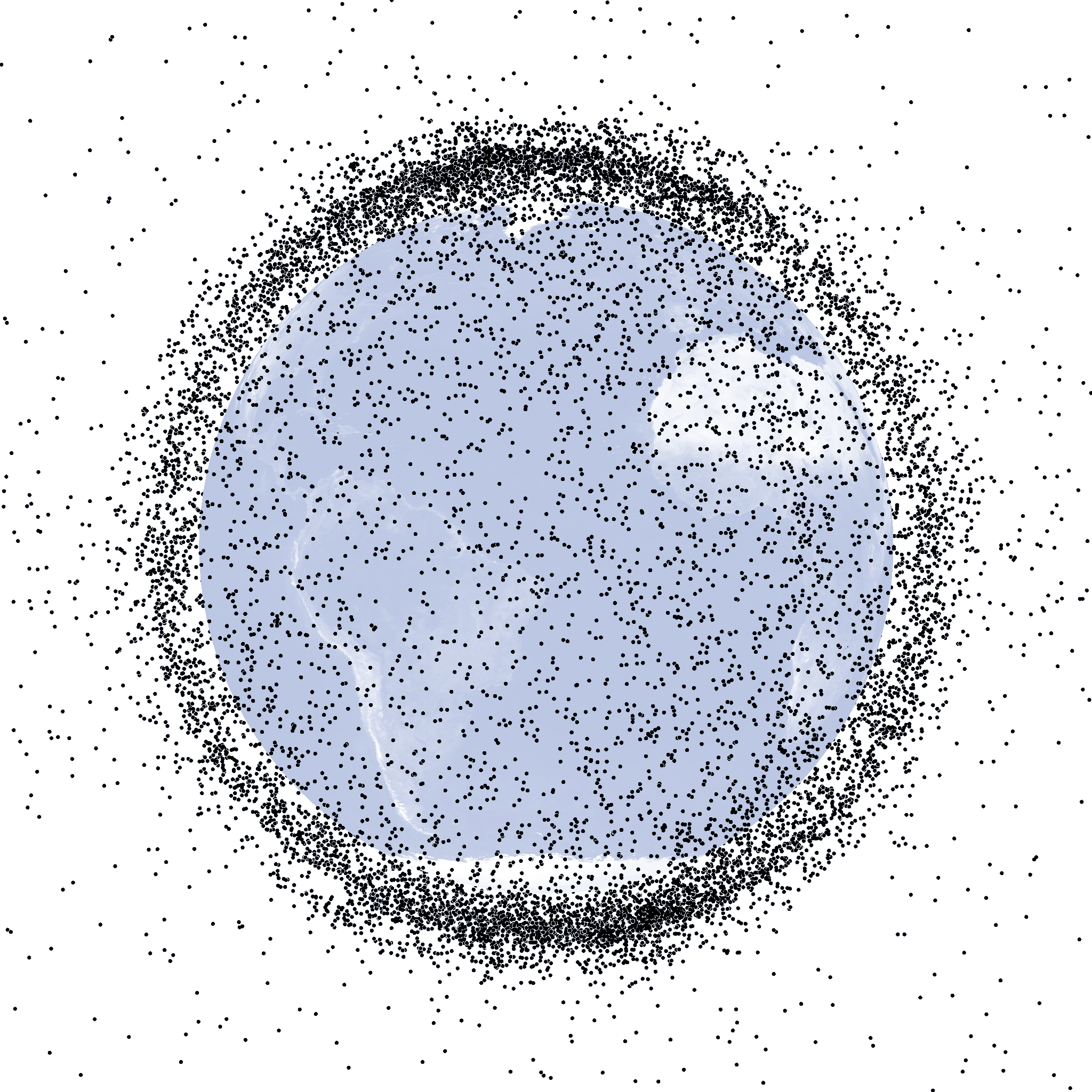
Earth orbit is not full in the ordinary sense. Most of it is empty. Yet empty space is not the same thing as safe space when thousands of objects repeatedly cross the same useful altitude bands at several kilometres per second.
ESA’s statistics, updated on 31 July 2026, list about 46,160 objects regularly tracked around Earth. Roughly 16,000 are functioning satellites. The remainder include dead spacecraft, spent rocket bodies, hardware released during missions and fragments from more than 660 break-ups, explosions, collisions and other anomalous events.
The danger is not that every fragment is destined to find another satellite. It is that every long-lived fragment adds another recurring opportunity for a collision. If two large objects meet, the number of opportunities can jump by thousands in seconds.
The catalogue is only the visible part
The 46,160 figure includes active satellites as well as debris, so it should not be described as 46,160 pieces of junk. Subtracting the roughly 16,000 working satellites nevertheless leaves about 30,000 tracked objects that are not functioning spacecraft.
Even that is not the population. ESA’s MASTER model estimates 54,000 objects larger than 10 centimetres, including about 9,300 active payloads. It estimates another 1.2 million pieces of debris between one and 10 centimetres, and 140 million between one millimetre and one centimetre.
Tracking is partly a size problem. Surveillance networks can maintain useful orbits for many larger objects. Smaller debris can be sampled by radar or inferred from impacts on returned spacecraft surfaces, but usually cannot be followed reliably enough for an operator to plan a manoeuvre around each piece.
Visualisations make the region look like a solid shell because every dot must be enlarged to remain visible. It is not. The risk comes from speed, repeated orbital crossings and the consequence of the rare impact, not from satellites scraping shoulders on every circuit.
One collision has already shown the arithmetic
On 10 February 2009, the working Iridium 33 communications satellite and the dead Russian Kosmos 2251 satellite collided 776 kilometres above Siberia. Their relative speed was 11.7 kilometres per second.
ESA records that the impact generated more than 2,300 trackable fragments, along with smaller debris below routine tracking thresholds. It was the first accidental collision between two intact satellites and remains the clearest real demonstration of how two catalogue entries can become thousands.
The fragments did not remain in a compact cloud around the crash site. Each inherited a slightly different velocity and orbit. Over time they spread around Earth, turning one collision above Siberia into long arcs of risk that repeatedly pass through other longitudes.
By February 2024, a NASA visualisation still showed about 500 trackable objects from the Iridium-Kosmos collision in orbit. A few seconds of contact had created a hazard measured in decades.
Speed makes small objects consequential
I recently wrote about orbit as the act of falling sideways at roughly 28,000 kilometres per hour. That speed is why a small fragment is not equivalent to a small hazard.
Objects in crossing or opposing orbits can meet at relative speeds of many kilometres per second. ESA says a 10-centimetre object can catastrophically fragment a typical satellite, while a one-centimetre object can disable one. Millimetre-scale debris can destroy exposed subsystems.
Not every piece produced by a break-up is large enough to destroy another satellite. Not every fragment occupies an orbit that crosses a valuable spacecraft. The premise becomes more accurate when stated probabilistically: a collision creates many new chances for later damage, some of them catastrophic.
The objects that do intersect a busy shell return again and again, often for decades or centuries. A miss today is not necessarily a permanent miss. Both objects keep moving.
Kessler syndrome is a process, not a single bad afternoon
Kessler syndrome is often imagined as one collision instantly sealing Earth behind an impenetrable wall. The actual idea is slower and more local.
In a sufficiently dense orbital region, collisions create debris faster than atmospheric drag removes it. New fragments raise the chance of later collisions, which create still more fragments. The feedback can continue even if launches stop.
That does not mean every altitude becomes unusable at once. Density, inclination, object size and atmospheric drag all matter. Lower objects tend to re-enter sooner. Debris around 700 to 1,000 kilometres can persist much longer, placing some heavily used bands under greater pressure than others.
The distinction reminds me of my article on spacecraft crossing the mostly empty asteroid belt. Sparse-looking regions can have completely different collision risks because their objects, paths and timescales differ. Space is not one uniform volume.
ESA’s 2026 environment report says current trends would put the long-term risk from fragmentation and collision at four times its proposed sustainability threshold. A threshold is a modelled benchmark, not a prediction that a particular crash will occur on a particular day. It is still an uncomfortable direction of travel.
Operators already spend fuel to keep probability small
Collision avoidance begins with conjunction warnings: predictions that two catalogued orbits will pass unusually close. Operators weigh the estimated probability, uncertainty and consequences before deciding whether to move.
ESA says its satellites in low-Earth orbit average two collision-avoidance manoeuvres per spacecraft each year. Its Sentinel satellites move more frequently, around once every three months.
In April 2025, the International Space Station raised its orbit to avoid a fragment associated with a Chinese rocket launched in 2005. NASA estimated the object could otherwise have passed within about 0.4 miles of the station.
A manoeuvre is a success, but it is not free. It consumes fuel, interrupts planning and depends on seeing the threat early enough. A spacecraft cannot dodge an object that is too small to track.
The safest fragment is the one never created
Prevention starts before launch. Spacecraft and rocket stages can be passivated at the end of their missions by venting residual propellant, discharging batteries and removing other stored energy that might later cause an explosion.
Operators can lower spacecraft so atmospheric drag brings them home, conduct controlled re-entries or move satellites out of protected regions. NASA’s 2026 review of deorbit systems describes propulsion, drag sails, tethers and active removal among the available or developing approaches.
This is also why NASA’s plan to retire the International Space Station deliberately matters. In my earlier article on steering the ISS towards a controlled break-up over the South Pacific, the dramatic part was the 400-tonne structure. The quieter principle applies to every mission: an object should not be abandoned in a useful orbit merely because its useful work has ended.
Mitigation alone may not stabilise the most congested regions. ESA argues that selected large derelict objects must also be removed, because they contain the mass from which a future collision could manufacture thousands of new fragments.
I find that a more useful way to think about orbital debris than the usual image of a junkyard around Earth. A junkyard is stationary. Orbital debris is inherited motion. Every abandoned object continues circling, crossing and returning, carrying decisions made decades ago into the path of machines not yet launched.
The problem is not that a collision cascade is certain tomorrow. It is that probability can accumulate while responsibility remains divided. Earth orbit is large, but the useful paths through it are finite. Keeping them open is less a heroic rescue than a long discipline of leaving less behind.