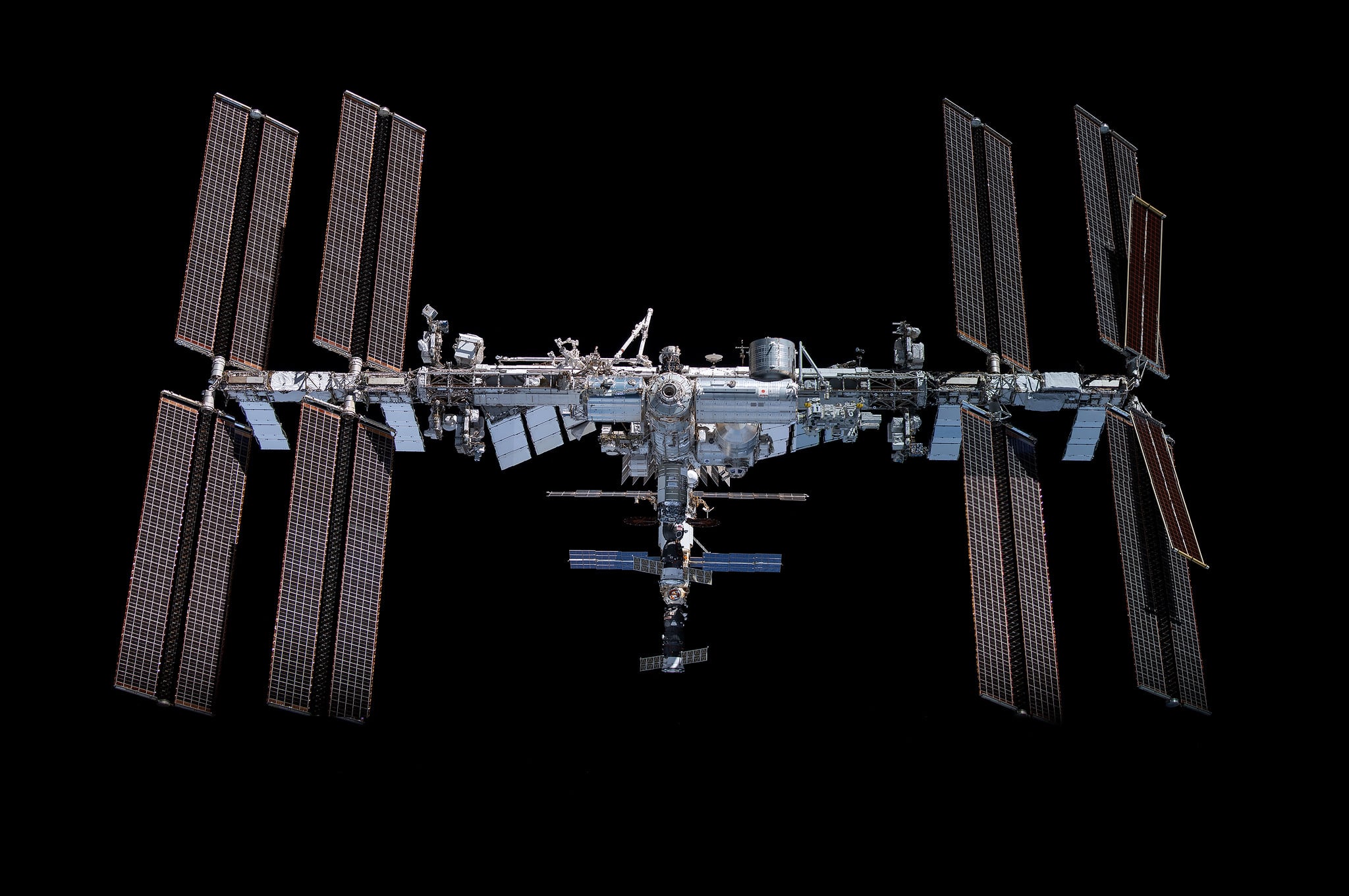
There is an uncomfortable practical question inside every permanent-looking human project: who turns off the lights? For the International Space Station, the answer is now being built.
NASA has contracted SpaceX to develop a U.S. Deorbit Vehicle, a heavily modified Cargo Dragon that will eventually dock with the station and supply the final push that takes it out of orbit. The current plan is for a controlled re-entry in late 2030, after the final crew has departed.
At about 430 tonnes, the ISS is too large to be allowed to fall wherever atmospheric drag happens to take it. Operators will instead steer its debris footprint towards an uninhabited part of the South Pacific.
That region is often reduced to one irresistible name: Point Nemo, the place in the ocean farthest from land. The truth is slightly less cinematic and considerably more interesting. Point Nemo is a coordinate. A disintegrating space station creates a long footprint. NASA promises a remote ocean target, not a bullseye on that exact point.
The station’s final mission is not really about destruction. It is about keeping control until there is nothing left to control.
NASA has bought a spacecraft whose mission is an ending
NASA selected SpaceX in June 2024 under a firm-fixed-price contract worth up to $843 million. The company will develop and deliver the vehicle; NASA will take ownership and operate it. The launch service is being procured separately.
The project has since moved beyond the award announcement. According to NASA’s fiscal year 2027 budget request, its cost and schedule baselines were approved in February 2026, formally placing it in development. Delivery is scheduled for late 2028.
The design is based on Cargo Dragon, but its trunk will be enlarged and fitted with additional Draco thrusters. It must dock, help control the station’s attitude and finally perform the orbit-shaping and re-entry burns.
It is a strange spacecraft to contemplate. Most missions are justified by where they will go, what they will carry or what they might discover. This one is being built to end another spacecraft’s life without letting the ending become an accident.
Deorbiting the ISS is not the same as dropping it
In my earlier article about orbital speed, I described orbit as falling sideways quickly enough to keep missing Earth. Deorbiting reverses that arrangement. The vehicle must change the station’s velocity just enough that the next fall intersects the atmosphere at a planned place.
NASA’s transition-plan FAQ describes a staged descent rather than one dramatic shove. Atmospheric drag will do as much work as possible. Existing propulsion will help lower and shape the orbit. Once every astronaut is safely home, operators will line up the final ground track and command the deorbit vehicle’s large re-entry burn.
The station’s current systems and docked Progress vehicles provide a contingency, but not the margin NASA wants. The new vehicle has to move a structure vastly heavier than itself without exceeding the limits of ageing modules and trusses. Its job is not to overpower 430 tonnes, but to make precise changes and let gravity and the atmosphere do the rest.
Point Nemo is real, but the astronauts are not always overhead
NOAA locates Point Nemo at 48 degrees 52.6 minutes south, 123 degrees 23.6 minutes west. It is about 2,688 kilometres from the nearest land in three directions: Ducie Island, Motu Nui and Antarctica’s Maher Island.
The much-repeated claim that astronauts are its nearest humans contains a clever comparison, but it needs a clock attached. The ISS flies roughly 400 kilometres above Earth, and its 51.6-degree inclination takes it across Point Nemo’s latitude. When the station passes sufficiently close to overhead, its crew can indeed be far nearer than any person on land. Minutes later, the station has crossed a continent’s worth of ocean and they are not.
I wrote recently about how the ISS crew experiences 16 sunrises and sunsets in an ordinary working day. The same orbital speed that produces that rhythm makes the Point Nemo comparison fleeting.
There is a second correction worth making. NASA’s public plans do not say the station will strike Point Nemo itself. Headlines turn a remote ocean region into a dot because a dot is easy to picture. Flight planners have to think in terms of a debris footprint, uncertainty and a corridor chosen much closer to the event.
The station cannot simply be saved for a museum
The urge to preserve the ISS is understandable. Its first element launched in 1998. People have lived aboard continuously since November 2000. It is laboratory, home, machine and political agreement made physical.
But the station was designed to be assembled in orbit, not dismantled and returned. NASA says construction required 27 shuttle flights, multiple partner missions, 13 years and 161 spacewalks. The shuttle’s large cargo bay no longer exists, and no current spacecraft can bring whole modules home.
Even ownership is distributed among the partners. Power, cooling, guidance, laboratories and living spaces depend on each other. What looks like one silver vehicle is closer to a small town whose utilities cross every property line.
Boosting it higher is not an easy preservation option. NASA calculates that a century-long parking orbit would require more than twice the velocity change of a controlled deorbit, while placing the structure in a harsher debris environment. Preservation would become a promise that future generations must maintain a 430-tonne object they did not put there.
The melancholy answer is also the responsible one: some smaller objects may return for museums, but the station itself has to be treated as a machine with an end of life.
Most of the ISS will become atmosphere, but not all of it
NASA expects the breakup to occur as a sequence. Solar arrays and radiators should separate first. Intact modules and truss sections will then come apart, followed by fragmentation as module skins melt and internal hardware is exposed to rapid heating.
Most of the station should melt, burn or vaporise. Dense and heat-resistant components are expected to survive and reach the ocean, which is why a controlled corridor is necessary in the first place. Calling the event a burn-up can make it sound cleaner and more complete than the engineering predicts.
Earlier stations provide imperfect precedents. Skylab returned uncontrollably in 1979 and scattered debris over Western Australia. Mir was deliberately guided into the South Pacific in 2001. NASA’s history of those two re-entries explains why Mir’s controlled ending is the closer operational model, although the ISS is substantially heavier.
The plan is more layered than “SpaceX will deorbit the ISS” suggests. April 2026 advisory committee minutes describe a strategy using the U.S. vehicle and two Russian Progress spacecraft. NASA and Roscosmos have signed technical and contingency protocols because no single agency operates the whole station.
The final departure will turn a place back into an object
Since Expedition 1 arrived on 2 November 2000, there has always been at least one human living off Earth. NASA marked 25 years of continuous presence in 2025. Anyone born after that first arrival has never experienced a day on which every living human was on the planet.
If a commercial station is operating before the ISS closes, that unbroken presence may continue somewhere else. If not, the final undocking will end it.
The last crew will close hatches, leave sleeping quarters and laboratories behind, and watch the station recede knowing that nobody will enter it again. It will continue circling Earth, but it will no longer be a human place. The deorbit vehicle is the mechanism that turns that place back into an object.
A responsible mission includes its own ending
There is a parallel with my article on NASA deliberately flying Cassini into Saturn. Cassini was destroyed to prevent a future accidental collision with potentially habitable moons. The ISS will be destroyed to prevent an uncontrolled re-entry over people.
The reasons differ, but the principle is the same. A mission is not fully responsible merely because its useful years were productive. Responsibility includes retaining enough authority to choose what happens after the work is over.
Late 2030 remains a plan, not an immutable appointment. NASA’s deorbit analysis leaves open the possibility of extending operations if commercial replacements are not ready and the partners agree. The vehicle can wait on the ground until a final decision.
Yet the contract changes the ending from an abstraction into hardware. Somewhere on Earth, engineers are designing a spacecraft whose success will be measured not by how far it travels, but by how precisely it makes the largest object humanity has assembled in space disappear.