Every 45 minutes or so, the light outside the International Space Station changes sides.
A blue line gathers at Earth’s edge. The Sun appears. Shadows sharpen across the station’s modules and solar arrays. Then, before an ordinary meeting on the ground would have finished, the Sun drops behind the planet again.
This is reporting on spaceflight operations and sleep research, not individual sleep or medical advice.
The station completes an orbit in roughly 90 to 93 minutes, which gives its crew about 16 sunrises and 16 sunsets in each 24-hour period. But the human body cannot use 16 mornings. Astronauts still need one waking period, one evening and one night.
The usual shorthand is that the ISS solves this by running on Greenwich time and keeping the window shades down. That is partly right and mostly too simple. The station does use a single Earth-based clock, generally described operationally as Coordinated Universal Time, or UTC. Its windows can be covered when darkness is needed. Yet astronauts also use the Cupola, photograph cities at night and watch orbital dawns on purpose.
The deeper solution is more interesting. Inside a vehicle flooded by the wrong sunrise every 45 minutes, engineers have built a different Sun.
The orbital Sun has been removed from the clock
On Earth, daylight does several jobs at once. It lets us see, tells us roughly what time it is and helps synchronize the body’s circadian system with the 24-hour day. Sunrise is therefore both illumination and information.
Orbit separates those functions. The light is real, but its timing is almost useless to a human nervous system. If an astronaut treated each appearance of the Sun as morning, breakfast would arrive before the previous meal had been digested.
This is another version of a distinction I have returned to in writing about planetary time. In my article on the four clocks of Venus, the solid planet, the Sun and the racing atmosphere all kept different schedules. In the story of Mercury’s double sunrise, orbital motion briefly makes the Sun reverse direction in the sky. A visible sunrise is not always a useful definition of a day.
The ISS makes that fact personal. Its orbital period is a property of flight. Its crew day is a property of human operations. The two are deliberately disconnected.
The European Space Agency describes the crew schedule as a 24-hour Earth day synchronized to Greenwich Mean Time. NASA documentation generally uses UTC, also called GMT or Zulu time in operational contexts. Strictly speaking, GMT and UTC are not identical standards, but for the daily life of the station they provide the same essential thing: one shared clock for an international crew and control centres spread around the world.
A schedule can define noon, but it cannot make the body believe
UTC tells an astronaut when the planning conference begins. It tells Houston, Huntsville, Munich, Tsukuba and Moscow which event everyone is discussing. It allows a crew member from Japan and another from the United States to say “06:00” without first negotiating time zones.
That solves coordination. It does not, by itself, solve biology.
The human circadian system is adjusted by environmental cues, especially the timing, brightness and colour spectrum of light. Light rich in shorter blue wavelengths can suppress melatonin and promote alertness. Dimmer, warmer light produces a weaker alerting signal. The effect depends on when the light reaches the eyes, not merely whether the clock on the wall says morning or evening.
For much of the station’s life, its interior was lit mainly by fluorescent General Luminaire Assemblies. They made the cabin visible, but visibility was not the same as a carefully designed day. A laboratory that never really changes colour can be psychologically and biologically flat, even if everybody inside agrees on the time.
NASA therefore replaced many of those fixtures with Solid State Lighting Assemblies. A NASA technical presentation on the system describes three operating modes. General light is a neutral 4500 kelvin. Pre-sleep light shifts warmer, to 2700 kelvin. An alertness and phase-shifting mode uses a cooler 6500-kelvin spectrum.
The numbers matter less than the principle. Morning, working day and evening can now be expressed as different kinds of electric light. The crew does not simply consult UTC. The station changes around them so UTC has a physical signal.
Morning is a lighting programme
On the ISS, an ordinary day has a deliberately ordinary shape. NASA sleep-shifting research describes a stable nominal schedule with wake time around 06:00 GMT and bedtime around 21:30. Between those points are planning meetings, maintenance, experiments, exercise, meals and private time.
Lighting helps turn that timetable into something the body can read. Neutral light supports routine work. Blue-enriched light can be used after waking, for alertness or when the sleep period must be shifted. Warmer, blue-depleted light is used in the two hours before bed.
NASA’s fatigue-management guidance for station crews is unusually specific. It lists default intensities for each mode, advises when different spectra should be used and treats personal devices as another source of light that may need managing before sleep. Eye masks, blue-blocking glasses, earplugs and the private darkness of a crew quarter are parts of the same system.
ESA has been testing a further refinement. Its Circadian Light experiment uses a lamp in an astronaut’s crew cabin that changes across the day in step with the sleep schedule. The spectrum can vary gradually and from day to day. Instead of choosing among three fixed impressions of morning, work and evening, the light can behave more like a continuous artificial sky.
This does not mean a lamp can reproduce everything daylight does, or guarantee good sleep in orbit. It means that “morning” on the station has become an engineered condition. The Sun outside may have risen seven times since breakfast. The meaningful dawn is the one the cabin produces once.
The window shades are not simply kept down
The image of astronauts living behind permanently covered windows survives because it sounds like the cleanest answer. If orbital daylight is disruptive, block it.
Actual practice is based on timing rather than permanent deprivation. The Cupola is an observation room, a photography platform and a work site for operating the station’s robotic arm. Astronauts use its seven windows to monitor visiting spacecraft, study Earth and take photographs that support research and disaster response. The view also has personal value in a confined environment.
NASA’s own fatigue guidance makes the distinction clear. It does not tell crews never to enter the Cupola. It advises them to avoid the Cupola for two hours before bed, or to wear day/night glasses there. The problem is not the existence of the view. It is bright, blue-rich light arriving when the body is being prepared for night.
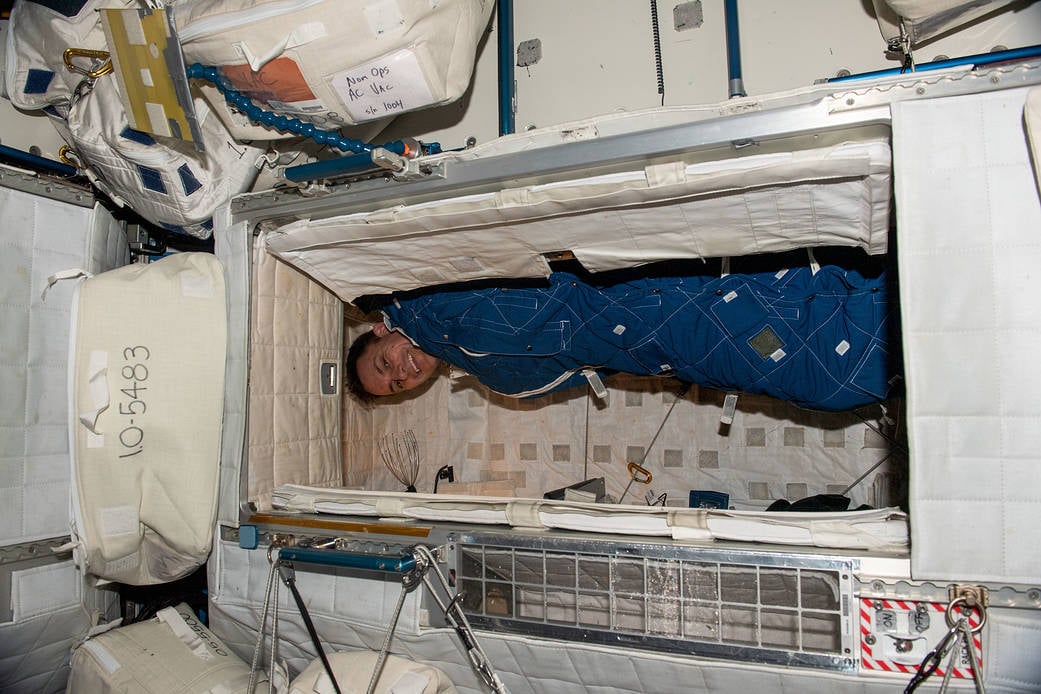
Inside the individual crew quarters, darkness is easier to control. The compartments are roughly the size of a phone booth and contain a sleeping bag attached to a wall, ventilation, a laptop and personal items. There is no mattress because there is no weight pressing the body into one. A shade or closed hatch helps make that small volume into night, while an eye mask can remove the remaining light.
So the station does not ignore all 16 sunsets. Astronauts can watch them, photograph them and attach meaning to them. What the station refuses to do is let those sunsets dictate bedtime.
The artificial day still produces short nights
The engineered clock is sophisticated, but sleep aboard the ISS has historically remained shorter than planners would like.
A 2014 observational study in The Lancet Neurology used wrist activity monitors and daily logs to examine sleep in 64 space shuttle astronauts and 21 ISS astronauts. The ISS group averaged 6.09 hours of sleep during flight. Twelve of the 16 station crew members who provided medication data reported using sleep-promoting drugs at least once.
This is one observational study, not settled consensus, and its ISS data came from missions between 2006 and 2011, before the newer solid-state lighting system was fully deployed. It cannot tell us how every current astronaut sleeps, nor can it isolate orbital sunrises from workload, noise, temperature, discomfort or individual differences.
It does establish an important limit on the tidy explanation. Assigning UTC and turning down the lights did not automatically produce a full night’s sleep.
More recent NASA work still begins from the finding that astronauts have often averaged around six hours a night. A study of sleep-shifting strategies using data from 19 ISS crew members notes that schedules have become more stable, but visiting vehicles and unplanned operational events can still force astronauts to move or split their sleep.
That is the part no lamp can eliminate. A cargo vehicle may need to dock at a time set by orbital mechanics. A spacewalk may require an early start. A technical problem may not wait until morning. In those moments, the shared artificial day has to bend around the machinery that keeps the station alive.
The station sometimes has to move night
NASA calls some of these changes sleep shifts. A crew might go to bed earlier across several days, stay awake later than usual or divide sleep into two shorter opportunities around an operational event. The 2024 analysis found that split schedules could include one short sleep in the afternoon, a night awake and another sleep the following morning.
The physics of orbit therefore returns through the back door. The crew may refuse to set its daily rhythm by sunrise, but a visiting spacecraft still has to meet the station at the right place and time. Mission control can choose UTC as the language of the timetable. It cannot choose when two trajectories intersect.
This is why the station’s schedule resembles an Earth workplace without ever becoming one. There are weekdays and weekends, morning conferences and evening meals. Yet the office is moving at about 7.7 kilometres per second, and the consequences of fatigue extend into spacecraft maintenance, robotics and spacewalks.
The achievement is not that astronauts become immune to changing light. They do not. It is that a layered system keeps a biologically recognizable day intact despite an environment that offers no naturally useful one.
Future spacecraft will have to carry their own sunrise
The ISS is close enough to Earth for crews to share UTC with the people supporting them. Future missions will make that relationship less obvious.
A lunar station will experience orbital and surface lighting unlike the terrestrial day. A crew travelling to Mars will live for months inside a vehicle whose windows show no recurring Earth sunrise at all. Once on Mars, settlers will encounter a solar day about 39 minutes longer than ours. In every case, time will be partly an engineering choice.
That choice will shape more than clocks. Lighting, workload, meal timing, exercise, communications and private space all tell the body what part of the day it is. If those signals disagree, the crew carries the disagreement in sleep and alertness. If they align, a metal cabin can offer something resembling morning even when the nearest natural sunrise is operationally meaningless.
NASA’s account of current space-station research treats circadian lighting as part of a wider question about cognitive performance and wellbeing during long missions. The research is still evolving. No lighting profile turns a spacecraft into Earth, and newer studies should not be used to erase the limits of the older sleep data.
Persistent sleep problems on Earth deserve discussion with a qualified health professional, not self-experimentation with astronaut fatigue procedures.
The station crosses the terminator hundreds of times in a month. Each passage is physically real and visually extraordinary. But none of those horizons gets to decide when an astronaut’s day begins.
That authority belongs to a clock agreed upon on Earth, a work schedule built across several continents and a lamp in orbit slowly changing colour.