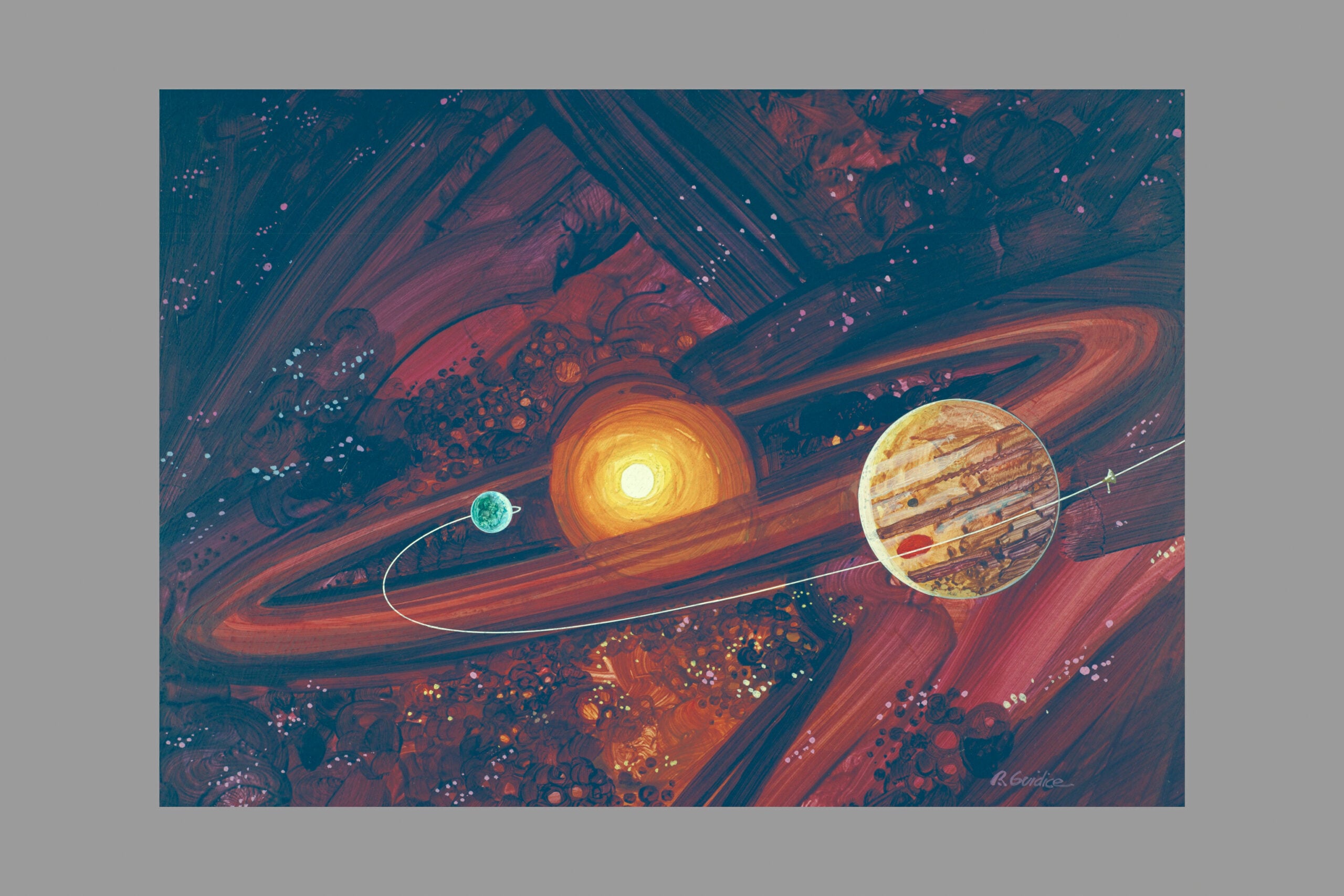
The asteroid belt is not an obstacle course. It is a broad population of objects following separate orbits around the Sun, with so much room between the larger bodies that a spacecraft can spend months crossing the region without coming close enough to see one.
Pioneer 10 entered the belt on 15 July 1972 and emerged in February 1973. It was the first spacecraft to make the passage, at a time when mission planners still had real questions about the amount of damaging dust and debris along the route. Every successful crossing since then has made the same point: the belt looks crowded because a useful diagram cannot draw emptiness to scale.
The 99.9 per cent figure in the title should be read as a conservative shorthand, rather than a formally measured fill factor. The share occupied by solid asteroids is vastly smaller under any reasonable definition. The more revealing numbers are the belt’s dimensions and the distances between its members.
The diagram has to cheat
A textbook artist faces a simple problem. Draw the solar system to scale and most asteroids disappear. Enlarge them enough to show, and the result resembles a ring of gravel.
I have written before about how a tidy solar-system diagram compresses distances and enlarges objects. The asteroid belt suffers more from that compromise than almost any other region. The dots must be visible, but their visibility creates the false impression that they sit close together.
NASA’s Dawn mission FAQ uses an approximate main-belt range of 2.2 to 3.2 astronomical units from the Sun, extending about half an astronomical unit above and below the plane of Earth’s orbit. One astronomical unit is the average Earth-Sun distance, about 150 million kilometres. On those assumptions, the belt occupies roughly 16 cubic astronomical units.
Its ring begins well beyond Mars. Measured across the Sun, even the inner boundary is about 4.4 astronomical units wide, more than twice the diameter of Earth’s orbit. The outer boundary spans about 6.4 astronomical units. It is a region, not a narrow lane.
What “empty” looks like in numbers
NASA estimates that the main belt contains between 1.1 million and 1.9 million asteroids larger than one kilometre, plus millions of smaller bodies. That sounds crowded until those objects are placed inside the belt’s volume.
Marc Rayman, Dawn’s chief engineer at NASA’s Jet Propulsion Laboratory, offered a useful scale calculation. If two million asteroids at least one mile wide were distributed through the approximate 16-cubic-AU region, the average separation would be about 1.9 million miles, or roughly 3.1 million kilometres. That is nearly eight times the average Earth-Moon distance.
The calculation is deliberately simplified. Asteroids are not spread evenly. They gather in families, while orbital resonances with Jupiter create depleted regions known as Kirkwood gaps. Smaller rocks and dust are much more numerous than kilometre-wide bodies. None of that turns the belt into the packed field shown in fiction.
The mass is concentrated, too. Ceres alone accounts for about a quarter of the belt’s total mass, and Vesta for almost another nine per cent. All the asteroids combined contain less mass than Earth’s Moon. A large number of bodies can still occupy a negligible fraction of a very large volume.
Pioneer 10 tested the route when the dust risk was uncertain
NASA’s mission history records that Pioneer 10 travelled about 435 million kilometres while passing through the asteroid belt. The large known asteroids were never the main worry. Their orbits could be charted and avoided. The uncertain part was the population of grains and small particles that telescopes could not count from Earth.
Pioneer did register some small particle impacts during the crossing, fewer than mission planners had expected. That detail keeps the headline honest: spacecraft are struck by dust and micrometeoroids in space, but no belt-crossing mission has accidentally collided with an asteroid in the ordinary sense of a substantial rocky body.
The spacecraft’s safe exit changed an unknown engineering hazard into a measured one. Pioneer 11 followed, then the two Voyagers.
Crossing the belt became routine
NASA’s Basics of Space Flight lists Pioneer 10 and 11, Voyager 1 and 2, Ulysses, Galileo, Cassini, New Horizons and Juno among the spacecraft that crossed the main belt. Galileo made the passage twice. None accidentally discovered an asteroid by running into it.
Several missions did see asteroids, but because controllers planned the encounters. Galileo flew past Gaspra and Ida. Cassini imaged Masursky from a great distance. Dawn went further, entering orbit around Vesta in 2011 and Ceres in 2015. Deliberate encounters require careful targeting precisely because a random close pass is unlikely.
Navigation teams still track known objects and design trajectories with margins. Spacecraft also carry protection against small high-speed particles. Safe crossings do not mean the environment contains nothing; they mean the meaningful risks occur on a much smaller scale than textbook dots suggest.
The belt is sparse, but not static
Asteroid collisions do occur, though rarely for any individual body. Across millions of years, those impacts break objects apart and create families of fragments. Jupiter’s gravity also changes the architecture of the belt, clearing resonant gaps and sometimes shifting fragments onto paths that leave the region.
That history is why the belt matters scientifically. Its objects preserve different pieces of the early solar system, including material that never became part of a planet. The space between those pieces is what lets spacecraft reach Jupiter and beyond with little danger from the bodies themselves.
The next probe crossing the main belt will not weave between rocks. Unless its route includes a planned asteroid encounter, the most likely view outside will be the same one Pioneer 10 carried through in 1972: dark space, a distant Sun, and no asteroid visible nearby.