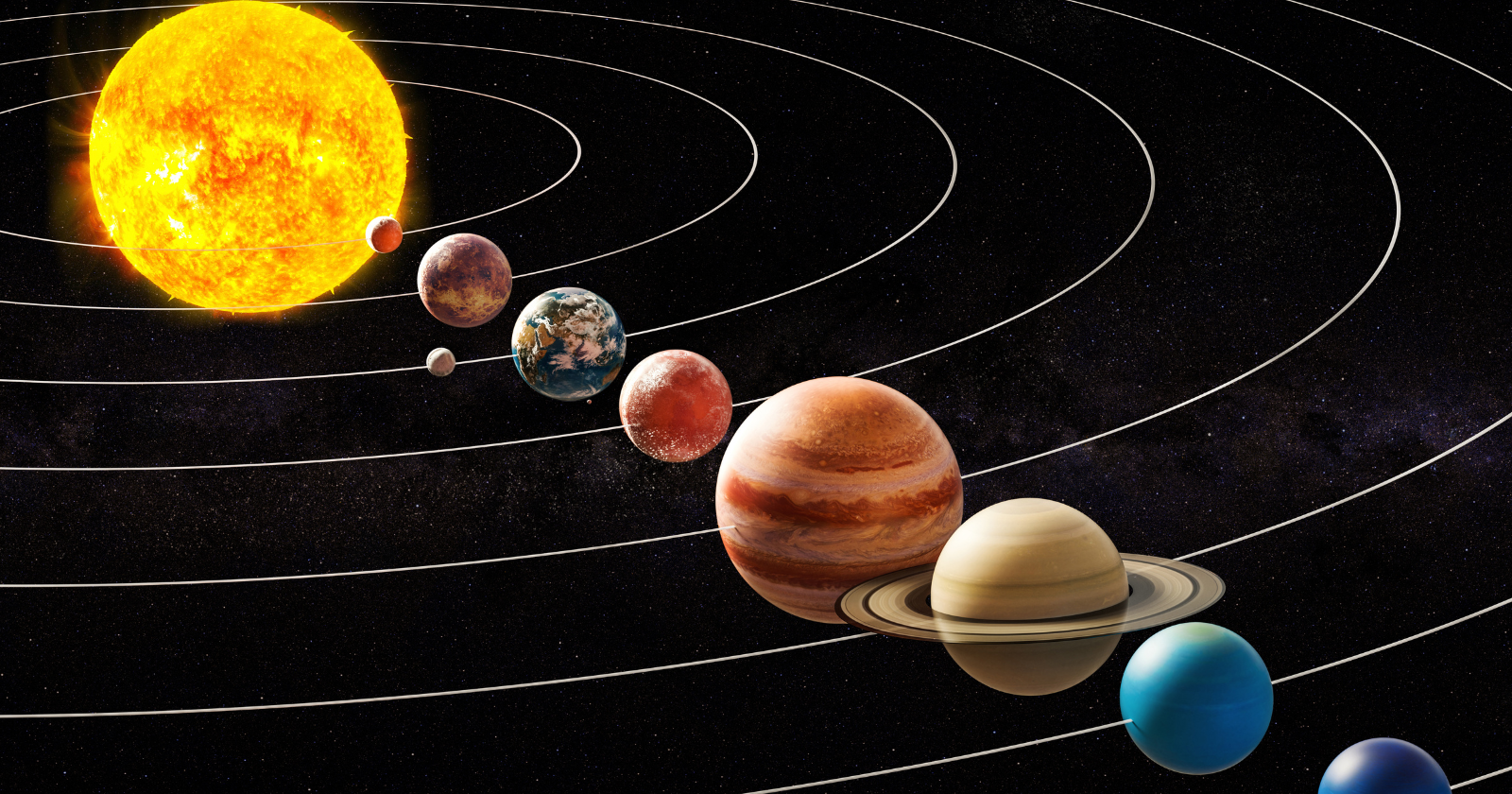
The diagram we all grew up with, a tidy row of planets strung out like beads at neat intervals, is one of the most misleading pictures in science. It gets almost everything about scale wrong, and in doing so it hides what the solar system actually is: one overwhelming star surrounded by a great deal of nearly empty space.
The more honestly you draw it, the stranger and more interesting it gets.
I am a writer with a long interest in this beat, not an astronomer, so treat this as a careful tour of what the science says rather than expert testimony.
It is mostly the Sun
Start with mass, because it settles everything else. The Sun holds about 99.86 per cent of all the matter in the solar system. Every planet, moon, asteroid and comet combined is the remaining sliver, and most of that sliver is Jupiter. Earth barely registers.
That single fact explains the whole arrangement. The planets do not follow their paths because they are important. They follow them because one object is so dominant that its gravity dictates the motion of everything within light-years. The solar system is not a family of equals with a star in the middle. It is the Sun, and then some rounding errors.
It is mostly empty
The other thing the diagram ruins is distance. Sunlight takes about eight minutes to reach Earth and roughly four hours to reach Neptune. The gaps between the planets are so large that any picture fitting them onto a page has to compress the spacing beyond recognition.
If you shrank the Sun to the size of a beach ball, Earth would be a peppercorn tens of metres away, and Neptune would be a smaller grain the better part of a kilometre off. Between those specks is essentially nothing. The solar system is not crowded. It is a handful of tiny objects adrift in an enormous, dark volume.
So where does it actually end?
This is where it gets genuinely hard, because the solar system has more than one reasonable edge.
The planets stop at Neptune, about thirty times Earth’s distance from the Sun. But the Sun’s influence reaches much further. Out at around 120 times Earth’s distance lies the heliopause, the boundary where the wind of particles streaming off the Sun finally loses out to the thin gas between the stars. In 2012 the Voyager 1 spacecraft crossed that boundary and became the first human-made object in interstellar space, followed by Voyager 2 in 2018. You can read NASA’s account of that interstellar mission, which is still returning data from more than 24 billion kilometres away.
Yet even that is not the true edge. The Sun’s gravity holds sway over a vast outer shell called the Oort Cloud, thought to be a sphere of icy bodies beginning far beyond the planets and stretching outward for a large fraction of the distance to the next star. Estimates put its outer reaches at up to a couple of light-years away. Even travelling at the speed of light, you would need more than a year to cross from the inner cloud to its edge.
It is worth being honest that nobody has ever seen the Oort Cloud directly. Its existence is inferred from where long-period comets come from, plunging in on enormous orbits from every direction. It is a well-founded deduction rather than a photograph, and its exact boundary is genuinely unknown.
Still being mapped
The far reaches are not just empty guesswork. Beyond Neptune sits the Kuiper Belt, a broad ring of icy worlds that includes Pluto, which turned out to be far stranger and more active than anyone expected when New Horizons flew past it in 2015.
And there may be more out there. In 2016 the Caltech astronomers Konstantin Batygin and Mike Brown proposed a ninth planet, roughly six times the mass of Earth, orbiting hundreds of times further out than Earth. They put it forward to explain why a group of distant icy objects have orbits that appear oddly clustered together, as if shepherded by something large and unseen.
It is important to be clear that Planet Nine has not been found. It is a hypothesis, and a contested one. Some astronomers suspect the clustering is an illusion created by where we have happened to point our telescopes rather than a real signal. The search continues, and the honest position is that we do not yet know whether a large planet is hiding in the dark out there.
The picture worth keeping
Set the classroom poster aside and the real solar system comes into focus. It is a single dominant star, a scattering of tiny worlds huddled close in, and then a vast, mostly empty sphere reaching out towards the neighbouring stars, most of which we have never seen and are still slowly charting.
We have mapped the inner rooms in fine detail and sent two ageing spacecraft stumbling out through the doorway. Nearly everything beyond that door remains to be explored.