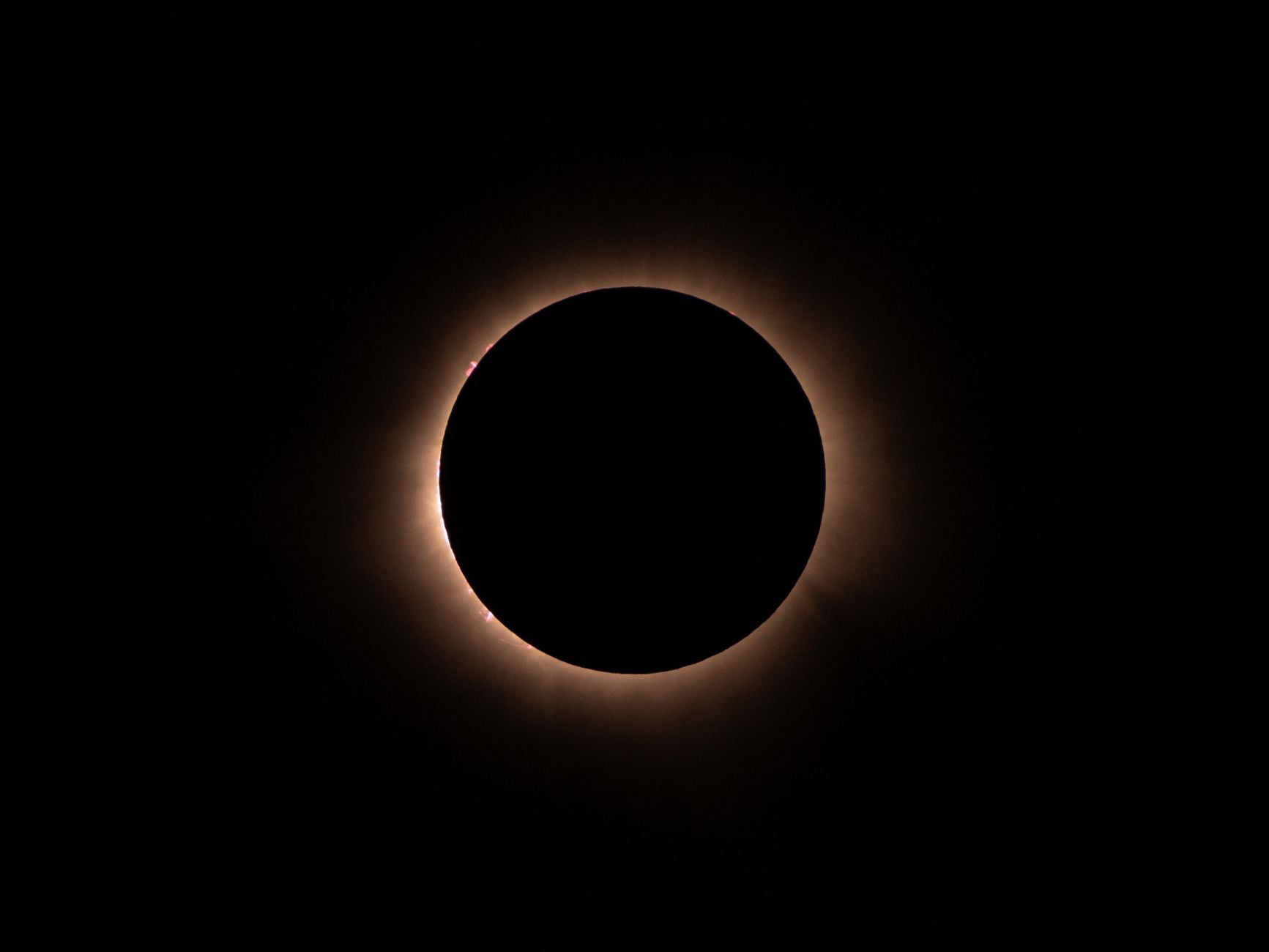
For a few minutes during a total solar eclipse, the Moon covers the Sun’s bright disc and a pale, uneven crown becomes visible around it.
That crown is the corona, the outer atmosphere of the Sun. Its ordinary temperature is roughly 1 to 2 million degrees Celsius. Active regions can become hotter still. The photosphere beneath it, the layer we usually call the visible surface, is about 5,500 degrees Celsius.
The comparison appears to run backwards. Energy is produced in the Sun’s core and works its way outward, yet the atmosphere above the surface is hundreds of times hotter than the surface itself.
The corona is not literally visible only during totality. Coronagraphs make artificial eclipses, and space telescopes observe it in ultraviolet and X-ray light every day. A total eclipse is the rare circumstance in which an unaided observer on Earth can see the white-light corona around the blocked Sun.
The temperature problem emerged in stages rather than in one moment. But 1939 is a reasonable place to mark its beginning, because that was when German astronomer Walter Grotrian connected one of the corona’s mysterious spectral lines to iron stripped of many electrons. The identification implied an atmosphere far hotter than anyone expected.
The mystery was hiding in a green line
During the total solar eclipse of 1869, astronomers Charles Augustus Young and William Harkness independently recorded a bright green line in the corona’s spectrum at a wavelength near 530.3 nanometres.
No known element seemed to produce it. The line was attributed to a hypothetical substance called coronium, in much the same spirit that an unfamiliar solar line had led to the discovery of helium.
Coronium survived as an idea for decades because the line could not be reproduced convincingly in an ordinary laboratory source. The corona is so thin that atoms and ions can remain in long-lived energy states that would be interrupted almost immediately in denser gas. These so-called forbidden transitions are not violations of physics. They are transitions that occur very slowly and therefore become visible in an extremely sparse plasma.
Grotrian noticed in 1939 that a known transition in highly ionised iron matched a red coronal line. Swedish physicist Bengt Edlén then made a systematic identification of several coronal lines, including the famous green line from iron missing 13 of its 26 electrons.
Producing and maintaining ions such as Fe XIV requires violent particle collisions. A historical review of coronal heating and its spectroscopic evidence explains that later ionisation calculations placed much of the corona in the 1 to 2 million kelvin range. The spectroscope had turned a faint halo into a thermometer.
I find the sequence useful because it corrects the tidy version of the story. Grotrian supplied a decisive clue in 1939. Edlén established the atomic identifications over the following years. The modern temperature range came from further work on how iron ions populate different charge states. The paradox was assembled from several discoveries.
A million-degree plasma is not a million-degree furnace
Temperature measures the average kinetic energy of particles. It does not by itself tell us how much total thermal energy a volume contains or how quickly that energy will transfer to an object placed inside it.
The photosphere is dense enough to radiate enormous power. The corona is extraordinarily tenuous. Its electrons and ions move with energies corresponding to millions of degrees, but there are far fewer of them in each cubic metre.
This distinction explains an apparent engineering contradiction. Parker Solar Probe can fly through million-degree coronal plasma while the Sun-facing side of its heat shield reaches a much lower temperature, around 1,400 degrees Celsius at design conditions. The sparse plasma cannot deliver heat like dense air in an oven. Direct sunlight is the larger thermal load on the shield.
In an earlier Space Daily article, I looked closely at how Parker’s carbon shield keeps its instruments near room temperature. The spacecraft does not disprove the coronal temperature. It shows why temperature, density and heat transfer have to be kept separate.
The same care applies to the headline comparison. The corona does not contain more total heat than the whole photosphere. Its individual particles have much greater average kinetic energy.
The energy cannot be ordinary heat leaking upward
If the solar atmosphere were heated only by thermal conduction from below, temperature would generally fall with distance from the hotter interior. Instead, the atmosphere passes through a thin transition region where the measured temperature rises abruptly from tens of thousands to hundreds of thousands and then beyond a million degrees.
Some additional energy is being carried upward and converted into particle motion above the photosphere.
Solar physicists broadly agree about the original reservoir. Boiling motion in the convection zone shifts the footpoints of magnetic fields anchored near the surface. Those motions bend, twist and shake the field. The difficult question is how that stored magnetic and mechanical energy travels into the corona and becomes heat at the required rate.
Any successful explanation has several jobs. It must supply enough energy to offset radiation and conduction. It must work across quiet regions, active loops and open-field coronal holes. It must explain why different ion species can reach different temperatures and why some particles are accelerated into the solar wind.
This is why “the coronal heating problem” is really a family of connected problems. NASA’s overview of Parker Solar Probe’s science divides the leading ideas into two broad families: waves and impulsive magnetic reconnection. They need not be rivals.
Waves can carry energy before breaking into turbulence
The Sun’s churning surface can shake magnetic field lines and launch disturbances called Alfvén waves. In a plasma, the field and charged particles move together, allowing the disturbance to carry energy outward.
A wave does not heat the corona merely by existing. Its organised energy must be converted into disordered particle motion. Reflections, interactions between waves travelling in different directions and a cascade towards progressively smaller scales can produce turbulence. At sufficiently small scales, that energy can be absorbed by particles.
The process is difficult to reconstruct from Earth because the signal changes while the solar wind expands. Parker Solar Probe and Solar Orbiter created an unusual measurement in February 2022 by sampling the same fast solar-wind stream at different distances.
Parker measured a slower flow near the Sun containing strong magnetic switchbacks, abrupt folds associated with Alfvénic fluctuations. Solar Orbiter encountered the evolved stream later, after it had accelerated and heated while much of the wave energy had diminished.
A 2024 study in Science, summarised by NASA, found that the lost wave energy was sufficient to account for the measured heating and acceleration of that fast solar-wind stream.
That is strong evidence for Alfvénic energy transfer in the fast wind. It is not a complete solution for every closed coronal loop or active region. Open magnetic fields in coronal holes and closed loops above magnetically complex terrain are physically different environments.
Nanoflares release magnetic energy in brief bursts
The other major family of explanations begins with magnetic reconnection. Field lines stressed by surface motion can change connectivity, releasing stored magnetic energy into heat, waves and accelerated particles.
Large reconnection events produce solar flares. Eugene Parker proposed that a huge population of far smaller events, later called nanoflares, could heat the corona even when no large flare is visible.
The name can be misleading. “Nano” describes the event relative to a major solar flare, not something small by human standards. One event contributes little to the energy budget of the whole Sun. A sufficiently large number occurring throughout the corona could contribute a great deal.
Finding them is hard because the corona is full of overlapping structures along the line of sight. A brief brightening may represent reconnection, a wave, a change in density or some combination of these. The most useful observations look for a chain of consequences rather than one flash.
NASA’s IRIS observatory recorded narrow, sideways-moving brightenings called nanojets during a coronal rain event. Modelling linked them to reconnection and showed associated plasma reaching several million degrees. NASA described the work as a possible complete observation of a nanoflare sequence, with the word “may” doing important work.
Solar Orbiter has found another scale of activity. Its Extreme Ultraviolet Imager detected more than 1,500 short-lived brightenings nicknamed campfires. They lasted roughly 10 to 200 seconds and extended from hundreds to a few thousand kilometres.
Simulations of seven of the brighter model events found that small-angle magnetic reconnection could release enough energy locally to maintain coronal temperatures. ESA was careful to describe those campfires as a clue rather than a settled global budget.
The outstanding arithmetic is frequency. Tiny events can dominate the total only if they become abundant quickly enough as their individual energy decreases. Observatories see progressively smaller brightenings as resolution improves, but extrapolating below the detection threshold remains uncertain.
Waves and reconnection may be different stages of one process
The cleanest diagrams put wave heating on one side and nanoflares on the other. The Sun is not required to respect that division.
Reconnection can launch Alfvén waves. Turbulent waves can create thin current sheets where reconnection becomes easier. A loop may be stressed gradually by its footpoints, release energy impulsively and then distribute part of that energy through waves.
Different regions may also favour different mixtures. Quiet coronal holes contain open field lines feeding fast solar wind. Active regions contain dense arcades of closed loops. The energy required per unit area, the magnetic geometry and the available dissipation routes are not the same.
The Sun changes over its roughly 11-year activity cycle as well. I recently wrote about measurements showing that solar wind and magnetic activity reversed a long decline after 2008. That work concerned a multi-decade trend, but it reinforces a useful point here: the magnetic environment supplying coronal energy is not fixed.
A convincing theory therefore has to explain distributions, not just an average temperature. It must reproduce when and where heating occurs, which particles receive the energy, whether the heating is steady or burst-like and how much escapes as wind.
Parker Solar Probe moved the instruments inside the problem
Remote telescopes measure radiation integrated through a transparent atmosphere. Parker Solar Probe measures fields and particles inside the corona itself.
The spacecraft first crossed the Alfvén critical surface in 2021, entering a region where the solar wind remained magnetically connected strongly enough for disturbances to travel back towards the Sun. During its closest passes, Parker travels about 6.1 million kilometres above the photosphere.
Its FIELDS instrument measures electric and magnetic fluctuations. SWEAP counts electrons, protons and helium ions and measures their velocity and temperature. Those measurements let researchers compare the available wave energy with the energy particles gain.
Solar Orbiter adds the complementary view. It images the surface and corona while measuring the wind farther out. When the geometry is favourable, researchers can connect a magnetic feature near the Sun to the plasma later sampled in space.
NASA’s current Parker Solar Probe mission overview still lists coronal heating as a central question. The closest measurements have narrowed several parts of the problem, especially the role of Alfvénic fluctuations in the fast wind. They have not reduced the whole corona to a single mechanism.
The paradox is smaller, but it is not closed
Scientists no longer face the mystery in the form it took in 1939. They know the corona is a magnetised plasma. They can map million-degree loops, measure waves passing through them, identify reconnection signatures and fly an instrumented spacecraft across the atmosphere’s outer boundary.
The remaining difficulty is quantitative. Which process deposits how much energy, at which height, in which magnetic structure, during which phase of the solar cycle?
Alfvén-wave measurements now account convincingly for the heating and acceleration of at least some fast solar wind. Nanojets, campfires and extremely hot trace plasma support impulsive reconnection as another contributor. Neither result justifies assigning one mechanism to the entire corona.
What began with an unidentified green line has become a problem of following energy through a moving magnetic system. The corona is hot because energy is continually delivered and dissipated above the visible surface. The exact division of that work is what solar physicists are still measuring.