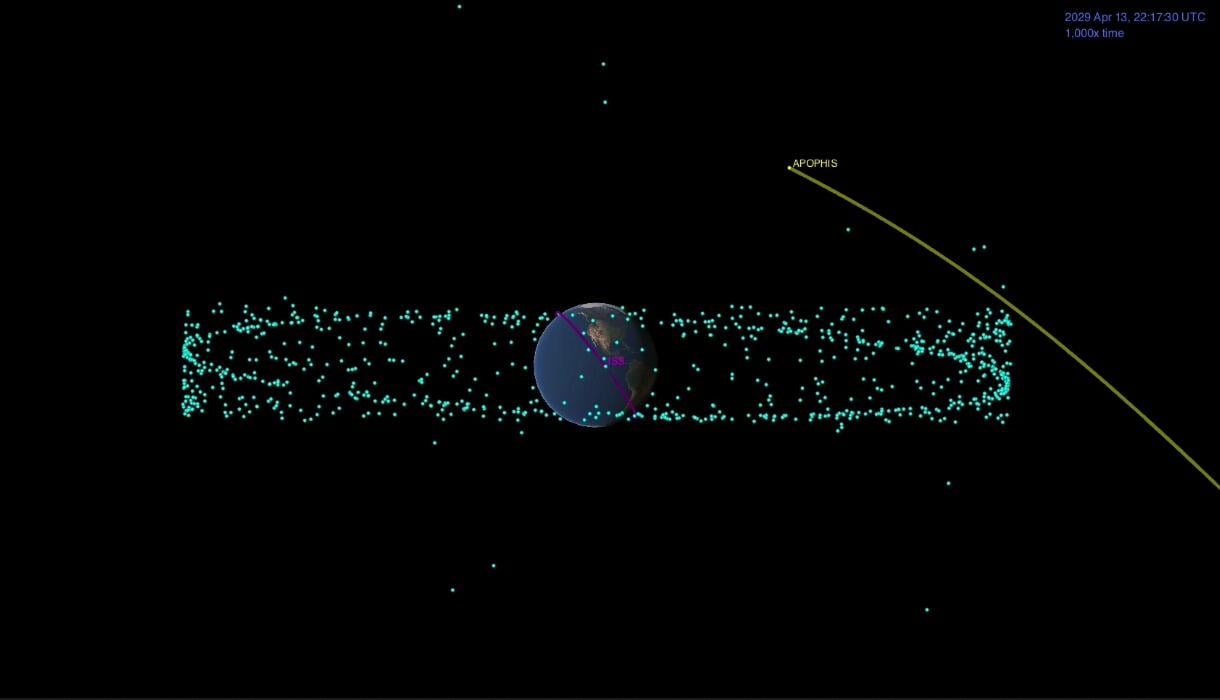
On the evening of 13 April 2029, a point of light may appear among the stars and move quickly enough for anyone watching carefully to see that it does not belong there.
It will not be a satellite. It will not be a meteor burning in the atmosphere. It will be asteroid 99942 Apophis, a stony object with a mean diameter of about 340 metres, passing roughly 32,000 kilometres above Earth’s surface.
That is inside the altitude used by geostationary weather and communications satellites. It is less than one tenth of the average distance to the Moon. For an asteroid of this size, it is the closest encounter humanity has ever known about years in advance.
It is also safe.
NASA has ruled out an impact by Apophis for at least the next century. The encounter is compelling precisely because the danger has been removed. We can watch a once-threatening asteroid become a worldwide astronomical event and, at the same time, a natural experiment in what a planet’s gravity does to a small body passing close by.
New visibility maps presented in June 2026 suggest that as many as 7.6 billion people, close to 90 per cent of the world’s population, may live somewhere from which Apophis is potentially visible to the unaided eye during its seven-hour passage. That number needs qualifications, but even the qualified version is remarkable.
Closer than satellites does not mean through the satellite belt
Distance comparisons can be accurate and still leave the wrong picture.
Geostationary satellites orbit about 35,786 kilometres above the equator. Apophis is expected to come within approximately 32,000 kilometres of the surface, so at closest approach it will indeed be nearer to Earth than those spacecraft are.
But not all weather satellites are that high. Many polar-orbiting weather spacecraft circle in low Earth orbit, hundreds rather than tens of thousands of kilometres above us. Apophis will remain far outside those orbits.
Nor will it travel along the equatorial ring occupied by geostationary satellites. Its path cuts through near-Earth space at a different angle. NASA’s current Apophis overview says there is no danger to satellites, astronauts or anyone on Earth. Calling the flyby “inside geostationary altitude” describes radial distance, not a collision course through a crowded motorway of spacecraft.
Apophis will be closest at about 21:45 UTC. Because it is so near, observers in different countries will see it against different background stars, an effect called parallax. Its apparent track will depend substantially on where the observer stands.
That proximity will also make the asteroid appear to move unusually fast. It will look more like a modest star steadily crossing the sky than a fireball or a cinematic rock with a visible tail. At an expected third or fourth magnitude near its brightest, it should be comparable to the fainter stars in the Big Dipper.
What the 90 per cent visibility figure actually means
The newest estimate comes from geographic visibility maps prepared by cartographer Michael Zeiler with astronomers and visualisation specialists including Richard Binzel, Richard Tresch Fienberg and Ernest Wright. The maps were presented at the Apophis T-3 Years workshop in Padua in June 2026 and published through Eclipse Atlas.
They calculate that about 7.6 billion people live in regions where Apophis could be visible at some point between roughly 15:00 and 22:00 UTC. The path covers Australia, much of Asia, Africa and Europe, as well as parts of eastern South America.
This is a cumulative potential audience, not a claim that 90 per cent of humanity will look up and see the asteroid at the same moment.
At peak brightness, calculated for about 20:35 UTC, the maps put the possible simultaneous audience at approximately 5.7 billion. By closest approach an hour later, the best viewing has shifted west and the potential audience has fallen. North America is poorly placed for naked-eye viewing.
Even within the mapped region, “potentially visible” assumes that the sky is dark enough, the asteroid is above the local horizon and the observer knows where to look. Cloud, haze and city lighting will remove many people from the real audience. Updated orbital data before 2029 will also refine the track.
Still, there are few precedents for a scientific event that so much of the inhabited world might experience directly. In my earlier account of the 1859 Carrington solar storm, auroras carried activity on the Sun into skies as far south as Cuba. Apophis will be less colourful, but potentially more deliberate: a faint moving point that billions of people can be told where and when to find.
The asteroid once had a real impact probability
The name Apophis is the Greek form of Apep, the ancient Egyptian figure associated with evil, destruction and disorder. Co-discoverer David Tholen later told NASA that the team selected it after researching Apep, although he and Roy Tucker also knew the name from the television series Stargate SG-1.
The asteroid earned the ominous name during a genuinely unsettling period.
Roy Tucker, David Tholen and Fabrizio Bernardi discovered it from Kitt Peak National Observatory on 19 June 2004. Weather and technical problems limited the first observations to two nights. When the asteroid was recovered that December and its orbit calculated from a short arc of data, the estimated probability of an Earth impact in 2029 rose to 2.7 per cent.
That did not mean Apophis had suddenly changed direction. It meant astronomers had a broad range of possible orbits consistent with limited observations, and Earth lay inside part of that uncertainty region.
Older images were then found in which the asteroid had been recorded before its official discovery. These “precovery” observations extended the measured arc and eliminated the 2029 impact path. Further observations ruled out 2036, but a small possibility for 2068 survived for years because the 2029 encounter would substantially alter the asteroid’s orbit.
In March 2021, Goldstone and Green Bank radar measurements pinned down Apophis’s distance while it was 17 million kilometres away to an accuracy of about 150 metres. The resulting orbit was precise enough for NASA’s Center for Near-Earth Object Studies to remove Apophis from the Sentry risk table. Its published conclusion was unambiguous: no impact risk for at least 100 years.
The history matters because it shows what an asteroid probability is. It is not a countdown and it is not a forecast of intent. It is a measurement of what remains possible given the observations available at that moment. Better observations did not save Earth from Apophis. They revealed that Earth had never needed saving from it.
Earth will barely notice, but Apophis will
Apophis will pass Earth intact. The encounter is not close enough for our planet’s tidal forces to pull the asteroid apart.
That does not mean it will leave unchanged.
Today Apophis is an Aten asteroid, orbiting the Sun in a little less than one Earth year and spending much of its path inside Earth’s orbit. The 2029 gravitational encounter will enlarge that orbit. Afterwards, its year will last a little more than one of ours and it will be reclassified as an Apollo asteroid.
Its rotation is already complicated. Radar and light-curve observations suggest an elongated, possibly two-lobed body that tumbles rather than spinning cleanly around one axis. It completes one component of that motion in roughly 27 hours and a slower rocking motion in about 264 hours.
Earth’s changing pull across the asteroid may alter that tumble. It could also disturb loose regolith, expose fresher rock or trigger small landslides on slopes already close to failure. A 2024 paper in The Planetary Science Journal modelled short seismic shaking followed by longer surface changes driven by a modified tumbling state. Those are predictions to be tested, not guaranteed events.
This is what makes the flyby scientifically valuable. An asteroid’s response to a known gravitational stress can reveal how tightly its parts are held together. That matters well beyond Apophis. A coherent monolith and a loose rubble pile would not necessarily respond in the same way to an attempted deflection.
Spacecraft are being sent to watch the before and after
Ground-based observatories will measure the orbit, brightness and rotation of Apophis throughout the encounter. Spacecraft can add something Earth cannot: close images and direct measurements taken on both sides of the event.
ESA’s Rapid Apophis Mission for Space Safety, or Ramses, is intended to arrive before the flyby and remain with the asteroid as it passes Earth. In February 2026, ESA signed an €81.2 million development contract with OHB Italia, taking the total committed value to about €150 million and beginning construction, assembly and testing. The agency’s current plan calls for a 2028 launch.
Japan’s DESTINY+ spacecraft is now planned to share that launch, make a high-speed reconnaissance flyby of Apophis and then continue to its main target, the active asteroid Phaethon. Ramses should stay close enough to compare Apophis before, during and after Earth’s tidal encounter.
NASA will arrive from the other side of the story. OSIRIS-REx completed its primary job when it returned a sample from asteroid Bennu to Earth in 2023. Instead of retiring the spacecraft, NASA renamed it OSIRIS-APEX and redirected it towards Apophis. The active extended mission is scheduled to rendezvous in June 2029, after the Earth encounter, and study whatever changed.
There is something satisfying about sending an already accomplished machine to meet an asteroid that has itself been given a second identity. I wrote previously about how Opportunity turned a planned 90-day Mars mission into fourteen and a half years. OSIRIS-APEX is a different kind of extension, but it carries the same lesson: the most valuable spacecraft are sometimes the ones that finish their original assignment with enough health and ingenuity left for another.
The contrast with Cassini’s deliberate end at Saturn is equally revealing. Cassini was destroyed while working because planetary protection required a controlled ending. OSIRIS-REx was preserved because celestial mechanics offered a credible second destination. Mission endings are engineering decisions, not merely moments when fuel runs out.
A former threat becomes a planetary-defence rehearsal
No mission needs to move Apophis. The asteroid will miss Earth, and intervening would introduce risk where none exists.
What scientists can do is treat the encounter as a rehearsal built by nature. Telescopes around the world will coordinate observations. Radar will measure distance and motion. Spacecraft will inspect surface changes. The response of Apophis to Earth’s gravity will improve models of asteroid structure, and those models could influence how a genuinely hazardous object is handled in the future.
This is a quieter form of planetary defence than blowing up a rock at the last moment. It is the slow work of finding objects early, reducing orbital uncertainty, learning their material properties and preparing techniques before an emergency exists.
Apophis is well suited to carry that message because its public identity has already passed through every stage of the problem. It began as a faint object on two nights of telescope images. It became the highest-profile impact probability of its time. It was narrowed by old photographs and radar until the danger disappeared. Now it is a destination for three spacecraft and a moving star that much of humanity may be able to see.
On 13 April 2029, the most important fact about the god of chaos will be that nothing chaotic is happening. The asteroid will follow a precisely measured path through empty space. Earth will bend that path. Billions of people may watch. And for a few hours, planetary defence will look less like fear of the sky than the ability to understand it.