
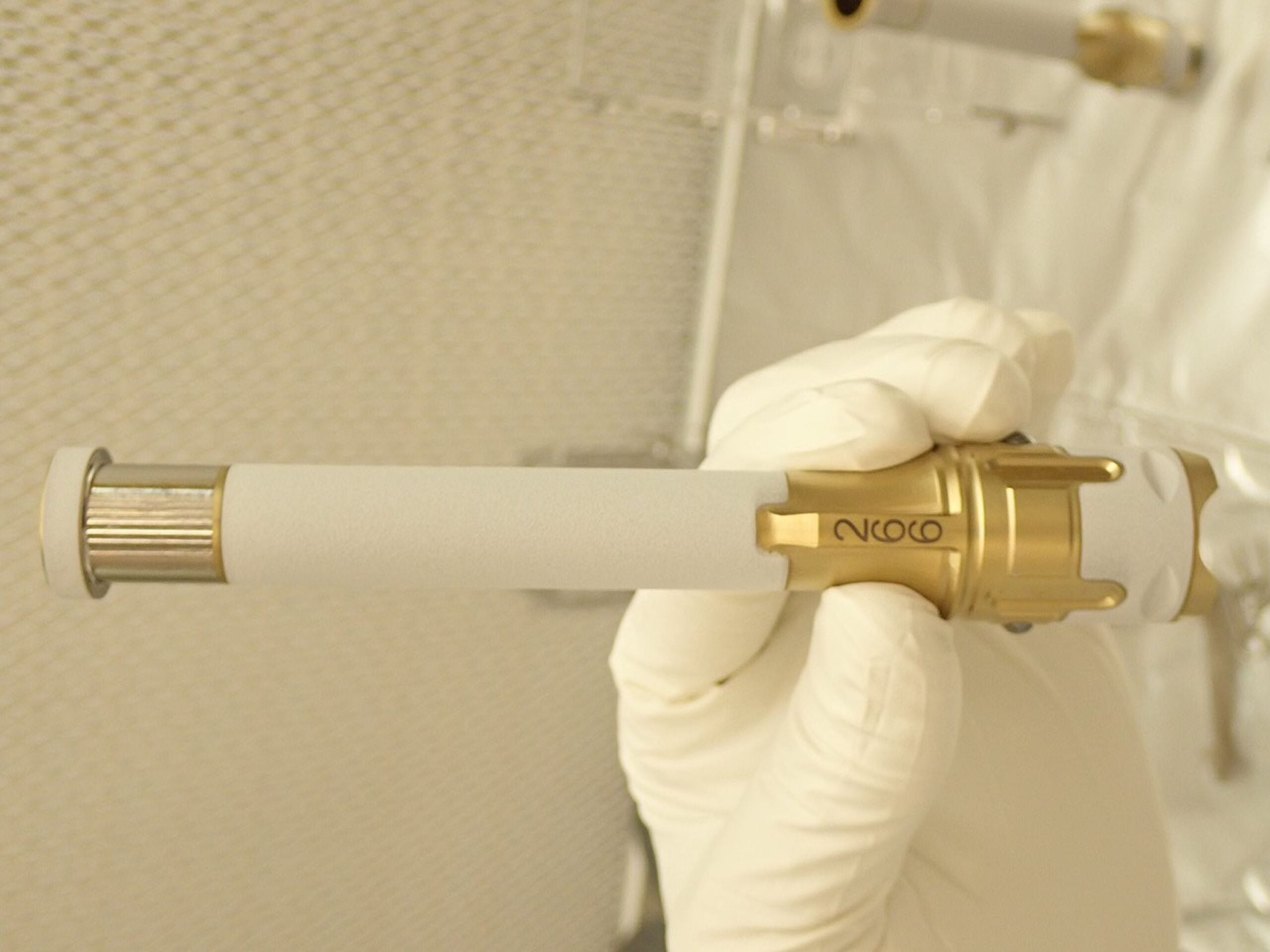
The cleanliness requirement for a Perseverance sample tube can be expressed in a number small enough to be almost meaningless at first glance: 150 nanograms.
That was the upper limit NASA set for the total mass of Earth-derived organic compounds allowed in a collected sample. For a narrower group of compounds considered especially relevant to the chemistry of life, the limit fell to 15 nanograms.
An average thumbprint carries about 45,000 nanograms of organic material. Left uncorrected, one print would therefore exceed the total organic allowance by roughly 300 times. The tube would not become permanently useless, but it could not be accepted for flight in that condition. It would have to be cleaned again, measured again and shown to meet the requirement.
This is what it means to manufacture a container for a question about ancient life. Cleanliness is not housekeeping around the experiment. It is part of the experiment.
The container is part of the measurement
Perseverance landed in Jezero Crater in February 2021 carrying 43 titanium tubes. Thirty-eight were assigned to collect rock, loose surface material or Martian atmosphere. Five were built as witness tubes, a separate set of controls for recording contamination that might accompany the sampling process.
The scientific case for these objects is straightforward. A rover can examine a rock on Mars, photograph its texture and use compact instruments to measure minerals and organic compounds. A laboratory on Earth can bring a much wider collection of instruments to the same material, repeat analyses, divide a sample among research groups and apply techniques that may not exist yet.
That opportunity also creates a harder evidential problem. Earth is covered in organic chemistry. It is in skin oils, cleaning products, solvents, adhesives, plastics, lubricants, dust and the air inside a laboratory. If a returned tube contains an interesting carbon-bearing molecule, researchers must be able to ask whether it came from Mars, from the rover or from the people and factories that built the hardware.
Space Daily’s earlier account of the tube programme described the containers as some of the cleanest objects made on Earth. The deeper point is that every contaminant left behind would become a competing explanation for a future result.
A fingerprint would fail the limit, not destroy the titanium
The fingerprint comparison is useful because it puts nanograms into a human scale. A print is almost invisible, yet its organic burden is hundreds of times larger than the amount permitted across an entire Martian sample.
It is worth stating the consequence precisely. A careless touch during manufacture would not chemically ruin titanium forever. It would break the documented chain of cleanliness. Engineers would need to remove the contamination and prove that they had done so. A tube that could not be brought back within specification would be rejected from the flight set.
The distinction matters because contamination control is built around measurement rather than faith. A clean-room suit, mask and pair of gloves reduce the opportunity for material to transfer. They do not establish that none did. The evidence comes from repeated cleaning, sampling, chemical analysis and records that follow the hardware through assembly.
NASA’s 2020 description of the manufacturing programme says 93 tubes were fabricated and 43 selected for flight. Each selected tube accumulated more than 250 pages of documentation and three gigabytes of images and video. That archive is part of the scientific value of the object. It records what was done to the tube before anything Martian entered it.
The tubes were assembled inside a clean room within a clean room
JPL used what the project called a hyper-clean-room environment, effectively a cleaner enclosure inside an already controlled clean room. Between assembly stages, technicians blasted the tubes with filtered air, rinsed them with deionised water and cleaned them ultrasonically with solvents including acetone and isopropyl alcohol.
The components were then measured for remaining contaminants and baked. Heat can drive off volatile compounds that would otherwise emerge later, a process known as outgassing. That possibility matters on a rover containing polymers, electronics, lubricants and adhesives. Material released slowly during the cruise to Mars or during surface operations could find its way into the sampling chain.
Biological contamination is only one category. The system also had limits for inorganic particles and non-biological organic compounds. A molecule does not need to come from a living cell to confuse an astrobiology investigation. It only needs to resemble a target of interest or alter the sample enough to obscure the original chemistry.
The physical design helps maintain the result. The tube’s titanium nitride surface treatment resists contamination. A reflective white coating limits solar heating after a tube is placed on the Martian surface, reducing the chance that temperature will change the sample chemistry. Once filled, the tube receives a mechanically activated hermetic seal intended to keep material from entering or leaving.
Five witness tubes turn contamination into a control experiment
No cleaning programme can make a complex rover literally free of terrestrial material. Perseverance therefore carried a way to measure what travelled with it.
The five witness tubes resemble the sample containers but were preloaded with materials designed to capture molecular and particulate contaminants. They can record gases released by rover materials, residues associated with the landing system and other Earth-derived matter present near the sampling hardware.
Opening a witness tube in the same operational environment as a sample tube produces a control. If a compound appears both in Martian material and in the witness record, researchers have reason to investigate a terrestrial or spacecraft source. If it appears only in the sample, that does not prove a Martian origin by itself, but it removes one obvious alternative.
NASA’s current sample inventory lists three of the five witness tubes as sealed. One of them was placed with nine other tubes at the Three Forks depot in Jezero Crater. The remaining collected material is largely held aboard the rover.
The depot matters because a sample is not merely a piece of rock. It is a rock linked to a location, images, instrument observations, handling history and a control that can expose contamination. Remove that context and part of the evidence disappears.
Organic chemistry is not the same thing as life
The word “organic” creates another source of confusion. In chemistry, it refers broadly to compounds built around carbon. Living systems make many organic molecules, but so do non-biological processes in rocks, atmospheres, hydrothermal environments and interplanetary material.
This is why contamination control cannot by itself prove that a Martian molecule was produced by life. It protects the first step: establishing that the chemistry genuinely belongs to the sample and is not an unnoticed contribution from Earth.
The distinction is especially relevant now. Space Daily recently reported on complex organic carbon detected in ancient Jezero mudstones. Such detections are scientifically important without being biological verdicts. Researchers still have to consider geology, water-rock reactions, meteorite delivery, radiation damage and the history of the instrument itself.
A separate Perseverance sample from Cheyava Falls has drawn attention because it combines organic carbon with minerals and small structures that can be produced by reactions capable of supporting microbial metabolism. As our earlier examination of that sample emphasised, plausible non-biological pathways remain. A clean tube preserves the possibility of testing those pathways more rigorously; it does not decide between them.
The engineering was designed for scientists who may not exist yet
The tubes also had to satisfy demands beyond cleanliness. Each is less than 15.2 centimetres long and weighs under 57 grams, yet it must move through Perseverance’s drill and internal handling system, accept a seal and survive years of cold, radiation and transport.
Engineers scrutinised more than 60 dimensions on each tube. A deviation comparable to the thickness of a human hair could make a candidate unsuitable because the same container had to pass through several tightly toleranced mechanisms.
The original return architecture has since become uncertain. The United States’ fiscal 2026 budget ended the previous Mars Sample Return programme, while Perseverance continued its surface mission and its tubes remained on Mars. A future retrieval effort would require a new political, financial and engineering path.
That uncertainty does not make the cleanliness work obsolete. Returned samples are scientific archives. Apollo material collected more than half a century ago is still being opened for analyses that mission planners could not have specified in 1969. If the Perseverance tubes eventually reach Earth, researchers may examine them using instruments and questions unavailable when the containers were made.
The absence of a fingerprint is evidence
Most engineering is judged by what a machine adds: distance, power, speed, images or data. The sample tubes were also judged by what their makers could keep out.
The 150-nanogram limit, the witness tubes and the paperwork all serve the same purpose. They allow a future laboratory to distinguish a faint Martian signal from the much louder chemical background of the planet that built the rover.
A stray fingerprint would have overwhelmed the allowed organic budget. That is why the correct response would have been rejection or recleaning, followed by another measurement. The tube could not leave Earth merely looking clean. Its history had to show that it was clean enough for the claim scientists might one day ask it to support.
If a returned sample eventually contains persuasive evidence about ancient Martian chemistry, some of the most important evidence will be invisible. It will be the compounds that are absent, the controls that remained quiet and the human touch that never reached the inside of the tube.
