
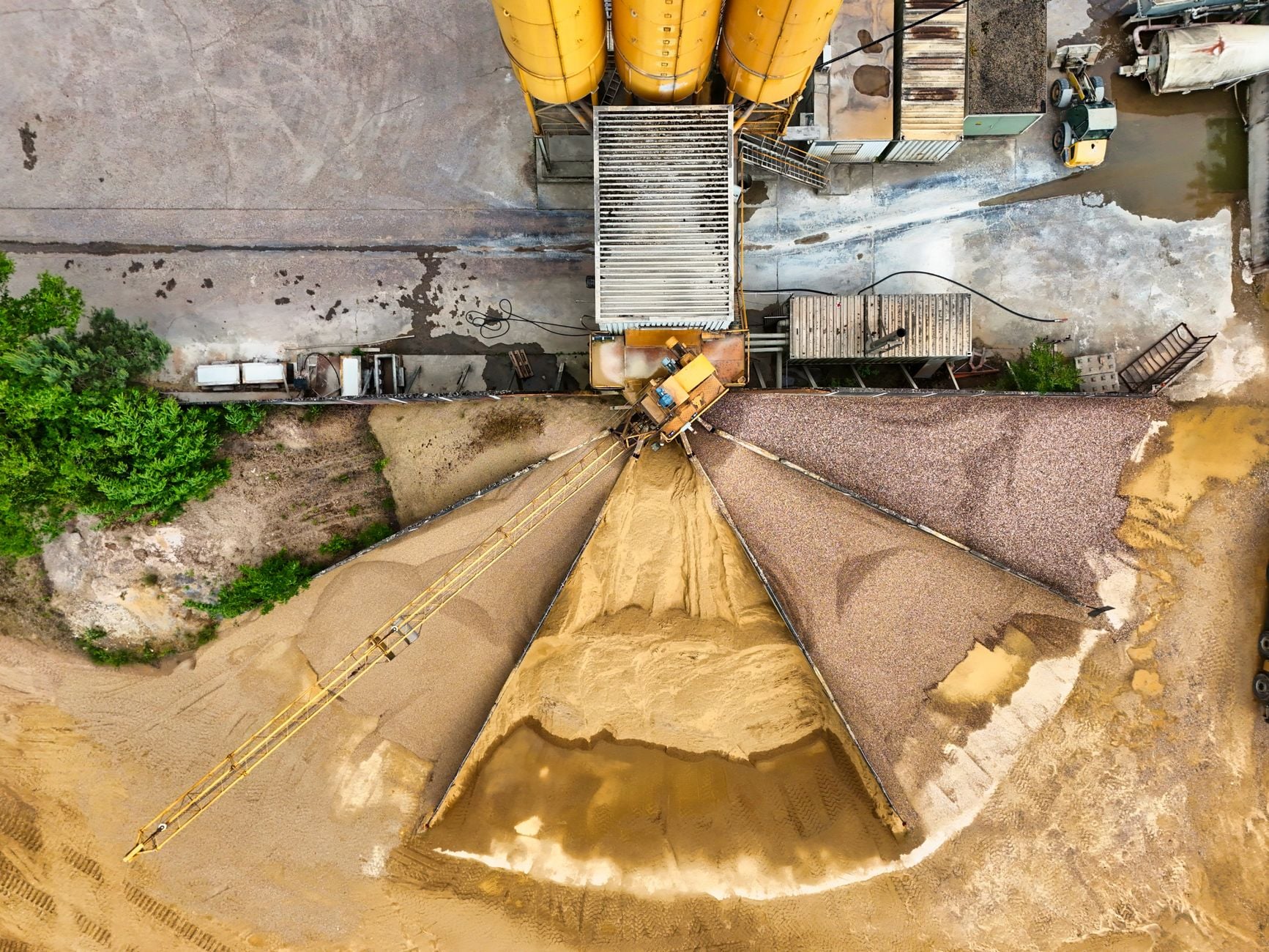
Sand looks like the definition of abundance. It covers deserts, fills beaches and lies beneath rivers and shallow seas. Yet construction does not consume “sand” as a single interchangeable substance. It consumes particles with particular sizes, shapes, mineral strength, cleanliness and grading.
That distinction sits beneath one of the largest material flows on Earth. The United Nations Environment Programme estimates that humanity uses roughly 50 billion tonnes of sand and gravel each year, more than any resource except water. Most people rarely notice this extraction because the material disappears into concrete, asphalt, roads, foundations and reclaimed land.
Desert cities make the contradiction visible. Dubai is surrounded by dunes, but wind-blown sand is commonly too fine and too narrowly graded to serve as the principal fine aggregate in structural concrete without blending or treatment. The city’s construction supply therefore draws on crushed rock, quarried aggregate, manufactured sand, carefully processed local material, marine sediment for suitable applications and imported products where specifications require them.
The important story is not that desert sand is useless. It is that a resource can be everywhere and still be the wrong material for a particular job.
Fifty billion tonnes is an estimate of a poorly measured industry
UNEP’s 2022 Sand and Sustainability report placed annual use at 50 billion tonnes of sand and gravel. Its 2026 follow-up retained that scale and described sand as the world’s most heavily used solid material.
The figure is often shortened to “50 billion tonnes of sand”, but gravel belongs in the estimate too. This is not a precise global weigh-in. Extraction is fragmented among formal quarries, dredging fleets, small operators and illegal mining. Records are incomplete, definitions vary, and some totals are inferred from the quantity of cement used and the aggregate needed to turn it into concrete.
The order of magnitude is nevertheless useful. UNEP says the annual volume would be enough to build a wall 27 metres high and 27 metres wide around Earth. In May 2026, the agency warned that demand for sand used in buildings could rise by as much as 45 per cent by 2060.
Much of the mass in a concrete structure is aggregate rather than cement. Cement paste binds the mixture, but sand and stone provide most of its volume. A city is therefore built not only from steel and cement plants, but from an enormous and continuous movement of granular rock.
Concrete needs a distribution of grains, not a bucket of sand
Strong concrete depends on how particles fit together. Coarse aggregate forms much of the skeleton. Fine aggregate fills spaces between larger stones. Cement paste coats the particles and binds them after hydration.
If every grain is nearly the same small size, the mixture leaves more void space or demands more paste and water to become workable. Too many extremely fine particles also increase surface area, changing water demand, shrinkage and the amount of binder required. Engineers therefore specify a particle-size distribution rather than accepting material simply because it feels sandy.
Wind is an effective sorting machine. It preferentially carries grains within a limited size range, leaving many dune deposits very fine and poorly graded for conventional concrete. A 2022 review of concrete made with dune sand found that more than 90 per cent of grains in some reported samples fell below 0.4 millimetres, with grading values outside common fine-aggregate requirements.
Shape matters as well, but the familiar explanation that all desert grains are polished spheres is too simple. Some dune sands are relatively smooth and rounded; others contain many sub-angular grains. Studies of deserts in different regions have found substantial variation. For concrete, fineness and poor grading are often the more consistent limitations.
This is why the phrase “desert sand cannot be used in concrete” should not be treated as a law of materials science. The more accurate claim is that raw dune sand usually cannot replace well-graded construction aggregate at high proportions without changing the mix design, processing the material or accepting different performance.
Dubai does not import every grain it builds with
The image of ships carrying Australian sand to a city surrounded by Arabian dunes has become an internet parable. It contains a real insight, but it is frequently exaggerated into the claim that Gulf cities import nearly all of their construction sand.
Aggregate is heavy and relatively low in value, making long-distance transport expensive. Builders usually prefer the nearest source that meets the specification. In the United Arab Emirates, that supply includes hard rock quarried and crushed in the northern emirates, manufactured fine aggregate produced by crushing, and local sands that can be screened, washed or blended for particular mixes.
Dune sand can sometimes replace part of a conventional fine aggregate. An experimental study comparing beach, wadi, dune and crushed-rock fines found that concrete with dune sand remained technically possible, although strength generally declined as the dune-sand proportion rose and absorption increased. The result supports partial use and careful design, not the idea that any dune can be shovelled directly into structural concrete.
Marine sand belongs to another category. Dubai’s artificial islands used very large volumes of dredged sediment for reclamation and shaping land. That does not mean unwashed seabed sand can automatically enter reinforced concrete. Chlorides, shells, silt and grading must be assessed because salts can accelerate corrosion of embedded steel.
Imports still have a role, particularly for specialised grades or when local supply, cost and project requirements make them sensible. The point is that Dubai relies on a portfolio of sources and processing methods. Its dunes do not remove the need for a materials industry.
Taking suitable sand from water can move the damage elsewhere
If wind-blown sand is a poor direct fit for conventional concrete, attention shifts towards rivers, floodplains, coasts and the seabed. Those deposits may offer broader particle-size distributions, but they are not inert stockpiles waiting to be removed.
Sand in a river carries sediment downstream, shapes channels and helps maintain deltas. Coastal sand absorbs wave energy and supplies beaches. Removing it faster than currents and erosion can replace it can deepen channels, destabilise banks, lower nearby groundwater, accelerate coastal retreat and allow salt water to move into aquifers.
Marine extraction is already industrial in scale. UNEP’s Marine Sand Watch estimated in 2023 that between four and eight billion tonnes of sand and other sediment were dredged from marine and coastal environments each year. Its central estimate was about six billion tonnes, or more than one million dump-truck loads a day.
Not all of that material becomes concrete, and dredging includes clay, silt, gravel and rock. But the figure shows why the problem cannot be solved by telling builders to move from deserts to the sea. A better grain can come from a more ecologically important place.
Manufactured and recycled aggregate change where the pressure falls
One response is to manufacture the grading that construction requires. Rock can be crushed and screened into coarse aggregate and manufactured sand. The process consumes energy and creates dust, but it allows producers to work with known geology and reduces dependence on sediment taken from active rivers and beaches.
Old concrete can also be crushed and reused. Recycled aggregate is not an exact substitute in every structural application because attached mortar changes water absorption and strength, but it can replace virgin material in appropriate mixes, road bases and other uses.
UNEP has also highlighted “ore-sand”, a construction material produced from mineral-processing residues that would otherwise remain as mine waste. None of these options is impact-free. Quarrying changes landscapes, crushing requires energy, and recycled material needs sorting and quality control. They are useful because they widen the supply system and make it possible to avoid the most damaging sources.
Dune sand itself is an active research subject. Blending it with coarser manufactured aggregate, using it as a partial replacement, altering binder chemistry and improving particle packing can produce workable concretes. The aim is not to declare the desert off limits. It is to match a variable natural material to a tested engineering recipe.
Sand abundance is not the same as aggregate security
The world is not close to running out of individual quartz grains. The constraint is access to suitable aggregate that can be extracted legally, processed to specification, transported at acceptable cost and removed without destroying the systems that depend on it.
That is why sand shortages are local even when the global quantity appears limitless. A fast-growing city can exhaust nearby river deposits, restrict coastal dredging and face high transport costs long before the planet runs out of sand. A desert city can look across an ocean of dunes and still need crushers, quarries, washing plants, laboratories and ships.
The 50-billion-tonne estimate turns an ordinary material into a planetary issue. Each grain is small, but construction concentrates them at a scale comparable with the largest flows in the human economy. Once sand is locked into a road or tower, it no longer supports the river, beach or seabed from which it came.
Dubai’s dunes are therefore not a punchline about importing what lies outside the window. They show the difference between geological abundance and engineering suitability. Humanity does not merely need sand. It needs the right grains, in the right proportions, from places that can afford to lose them.
