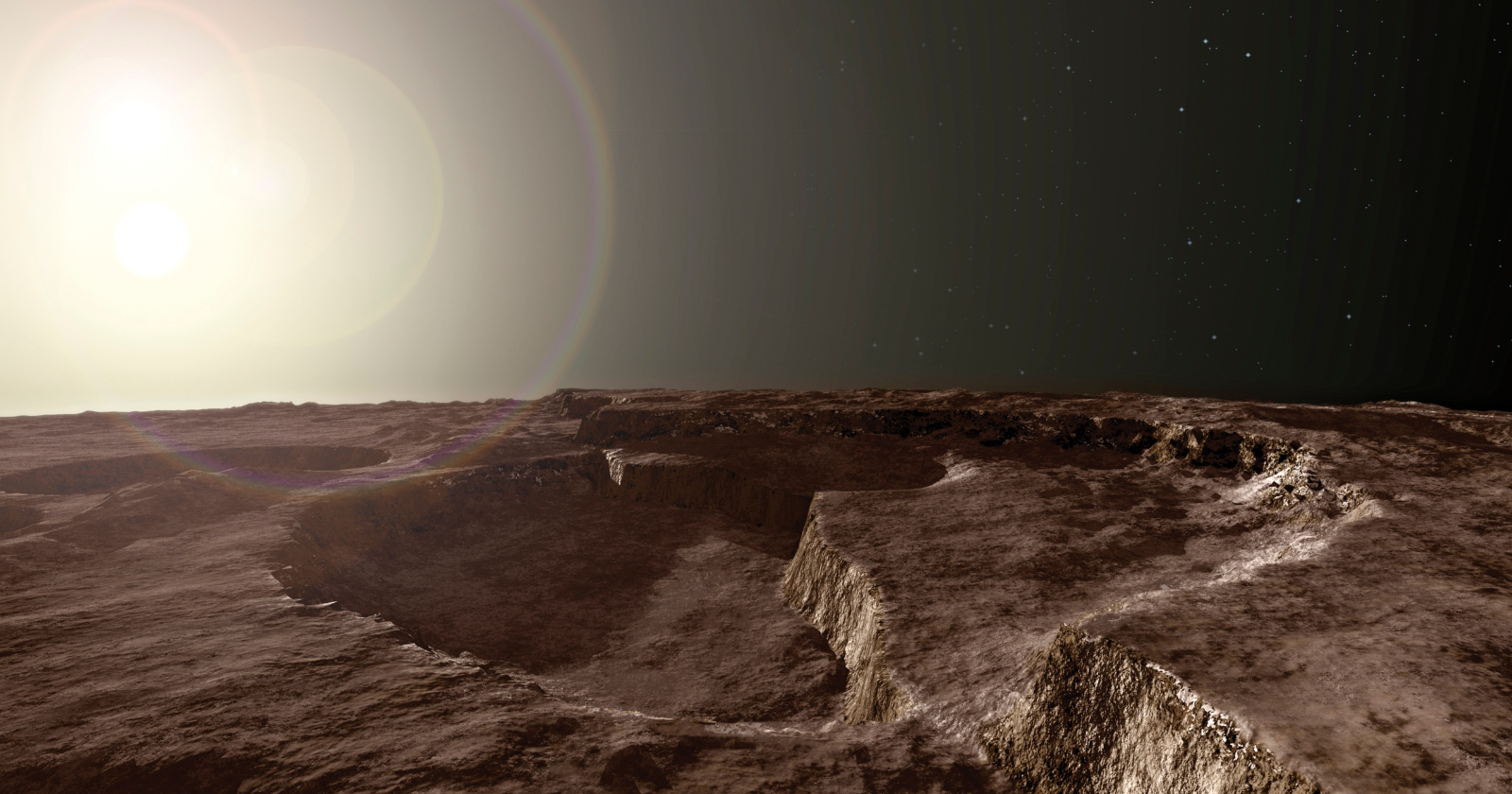
Mercury is the closest planet to the Sun. At its equator in daytime, the surface can reach about 430 degrees Celsius, well above the melting point of lead.
Near the poles, however, the floor of a deep crater can remain below minus 170 degrees Celsius. Water ice lies at the surface in the coldest of these places and beneath a dark insulating layer in others.
I find the contrast easier to understand once the word “near” is handled carefully. Mercury has ground hot enough to melt lead, but not every sunlit patch beside a polar crater reaches that temperature. The hottest figures refer mainly to lower latitudes under direct sunlight. At the poles, sunlight arrives at a shallow angle.
Even so, the boundary between illuminated rock and permanent shadow can be abrupt. With almost no atmosphere to circulate heat, a crater rim and the floor below it can occupy very different thermal environments.
NASA now says its MESSENGER mission verified that Mercury’s polar deposits are dominantly water ice. That is a reasonable summary of a case built in 2012 from three independent kinds of evidence. It does not mean the spacecraft landed, drilled or held a piece of Mercurian ice in an instrument.
Permanent shadow is a problem of geometry
Mercury’s rotation axis is tilted by only a small fraction of a degree. The Sun therefore stays close to the horizon at the poles rather than climbing high across the sky with the seasons. In a sufficiently deep high-latitude crater, the rim blocks direct sunlight throughout Mercury’s year.
“Permanent” describes the illumination produced by the planet’s present spin and the crater’s topography. It should not be read as proof that no ray of sunlight has reached a particular floor at any time since Mercury formed. Craters have ages, and the planet’s orientation has a history. What researchers can map is terrain that receives no direct sunlight under the relevant geometry today.
The lack of substantial air is just as important. Mercury has an exosphere, an extremely sparse population of atoms released from the surface, rather than an atmosphere capable of carrying heat around the planet.
That makes Mercury a useful contrast with Venus. In my recent article on possible microbial survival in Venus’s clouds, the atmosphere was central to why temperature and pressure change with altitude. Mercury offers the opposite arrangement. The temperature of a piece of ground depends strongly on whether sunlight and thermal radiation can reach that particular piece of ground.
The shadow is not perfectly isolated. Crater walls can scatter light and radiate heat towards the floor, while the regolith conducts some heat from nearby material. Researchers therefore calculate temperatures rather than treating every dark pixel as equally cold.
Radar found the deposits before MESSENGER explained them
The first strong clue did not come from a spacecraft. In 1991, observations using NASA’s Goldstone radar antenna and the Very Large Array found unusually bright radar patches near Mercury’s north pole. Similar features were later mapped in the south.
Water ice can produce this radar behaviour, but it was not the only proposed material. Sulphur and rough surface textures were among the alternatives. Mariner 10 had photographed less than half of Mercury in the 1970s, so scientists could not yet match every bright radar feature to a detailed map of polar craters.
MESSENGER changed that after entering orbit in March 2011. Its cameras mapped the polar topography and illumination over time. By 2012, the mission team found that the radar-bright deposits at both poles were confined to permanently shadowed terrain.
Location alone was not enough. The stronger case came from three studies published together in Science.
First, MESSENGER’s neutron spectrometer measured fewer energetic neutrons escaping from the north polar region. Hydrogen is particularly effective at slowing neutrons, and the size and distribution of the signal were best explained by water-rich material. David Lawrence and colleagues estimated a total polar water mass between about 2.1 × 10¹³ and 1.4 × 10¹⁵ kilograms, a deliberately broad range.
Second, the spacecraft’s laser altimeter found bright surfaces in some of the very cold areas and unusually dark surfaces in somewhat warmer ones. Gregory Neumann and colleagues interpreted the bright deposits as exposed ice and the dark deposits as a covering above buried ice.
Third, thermal models led by David Paige predicted where surface ice and buried ice should remain stable. Those predicted zones matched the radar and reflectance patterns.
No one of those measurements would have carried the same force alone. Together they connected a radar signature, a hydrogen signal, surface brightness and temperatures calculated from the terrain.
Some ice is exposed and some is under a dark cover
The coldest crater floors closest to the north pole have modelled maximum surface temperatures below 100 kelvin, or about minus 173 degrees Celsius. NASA’s temperature map of the north polar region shows exposed ice to be stable in places such as Prokofiev crater.
Farther from the pole, a crater floor may still avoid direct sunlight but receive enough indirect heat to make exposed water ice slowly escape into space. In these locations, MESSENGER found dark material where thermal models said ice could survive only underground.
The proposed covering is thin on a planetary scale, perhaps tens of centimetres, but enough to reduce loss from the ice below. It may contain complex organic compounds delivered with water by comets or volatile-rich asteroids.
“Organic” here is a chemical category, not evidence of organisms. Carbon-bearing compounds can form without life and are found in meteorites and comets. Mercury’s polar ice is also not a liquid habitat. It is a frozen deposit in a near-vacuum, exposed to radiation at the surface and separated from any continuing water-rock system.
That distinction matters when comparing it with the salts, hydrogen and phosphorus detected in material from Enceladus. On Saturn’s moon, those chemicals appear to come from a subsurface ocean in contact with rock. On Mercury, water tells us about volatile delivery and preservation, not about a currently habitable environment.
The deposits may be metres thick in some craters, but their depth and volume remain uncertain. The neutron instrument averaged composition over a broad area. Radar is sensitive to material properties and geometry rather than acting as a ruler inserted through the deposit. Estimates ranging from several metres to several tens of metres depend on models and on which craters are included.
Shadow is necessary, but it does not guarantee ice
There is a useful complication in the maps: about half of the permanently shadowed area at each pole is not radar-bright.
A 2018 study of Mercury’s south pole found the same broad pattern seen in the north. Radar-bright deposits are strongly associated with permanent shadow, yet many shadowed places that appear thermally suitable have no detectable radar-bright material.
Several explanations remain possible. Some cold traps may never have received much water. Ice may have been lost during warmer episodes, mixed with regolith until its radar signature weakened, or buried too deeply for the observations to detect. Small patches can also fall below the resolution of a particular instrument.
This is the same kind of selection problem that appears elsewhere in planetary science. In my article on the search for life beneath Mars, depth could provide protection while also making the most relevant material difficult to sample. On Mercury, the shelter comes from crater geometry, but the observational problem is similar. The places most capable of preserving a volatile are also the places cameras cannot illuminate directly.
Permanent shadow creates a cold trap. It does not supply the water, date its arrival or ensure that enough accumulated to be visible.
The ice may be younger than the craters holding it
It is tempting to call Mercury’s ice ancient, and on a human scale it almost certainly is. On a geological scale, its age is still an active question.
Water could have come from comet and asteroid impacts, micrometeorites, gases released from Mercury’s interior, or chemistry involving hydrogen carried by the solar wind. Molecules released elsewhere on the surface would make a series of hops through Mercury’s exosphere. Most would be destroyed by sunlight or lost to space, but a small fraction could eventually land in a polar cold trap.
The relatively pure radar signature of some deposits and the associated dark material have led researchers to consider episodic delivery by a volatile-rich impact. A 2019 crater-counting study argued that exposed ice surfaces may have been emplaced within roughly the past 150 million years. That is young compared with Mercury’s 4.5-billion-year history, although the estimate depends on how impact craters in dark, poorly illuminated terrain are identified and interpreted.
A 2026 transport model tested whether one impact on the scale of the 97-kilometre Hokusai crater could supply much of the present inventory. In the simulation, a volatile-rich collision produced a temporary, optically thick water-vapour atmosphere. Self-shielding slowed the destruction of water by ultraviolet light, and about 31 per cent of the gravitationally bound vapour reached polar cold traps. Most deposition was complete within one Mercury solar day, equivalent to 176 Earth days.
The result shows that rapid delivery is physically plausible under the model’s assumptions. It does not identify Hokusai as the actual source. The authors also found that a larger, slower impact might be required to create deposits thick enough to match the radar observations.
Mercury may therefore hold ice that has survived for tens or hundreds of millions of years without preserving water continuously since the Solar System began. Different deposits may also have different ages and sources.
BepiColombo will revisit the polar ledger
MESSENGER ended in 2015 when it ran out of propellant and struck Mercury. The next sustained orbital investigation will come from BepiColombo, the joint mission of the European Space Agency and the Japan Aerospace Exploration Agency.
According to ESA’s June 2026 arrival schedule, the spacecraft is due to enter Mercury orbit on 21 November 2026. Its two orbiters will separate, with the Mercury Planetary Orbiter expected to reach its science orbit by March 2027.
The mission will not land in a cold trap. Its instruments can instead improve maps of topography, temperature, chemistry, hydrogen and surface reflectance, with coverage that should be especially valuable in the less well characterised south polar region.
The questions are now more precise than “Can ice exist at Mercury?” Researchers want to know how much is exposed, how much is buried, why apparently suitable shadows differ from one another, what the dark cover contains, and whether the deposits record one delivery event or many.
For me, Mercury’s polar ice is less a contradiction than a lesson in scale. A planet can be described truthfully as hot enough to melt lead, yet that global label tells us very little about a crater floor that the Sun cannot see.