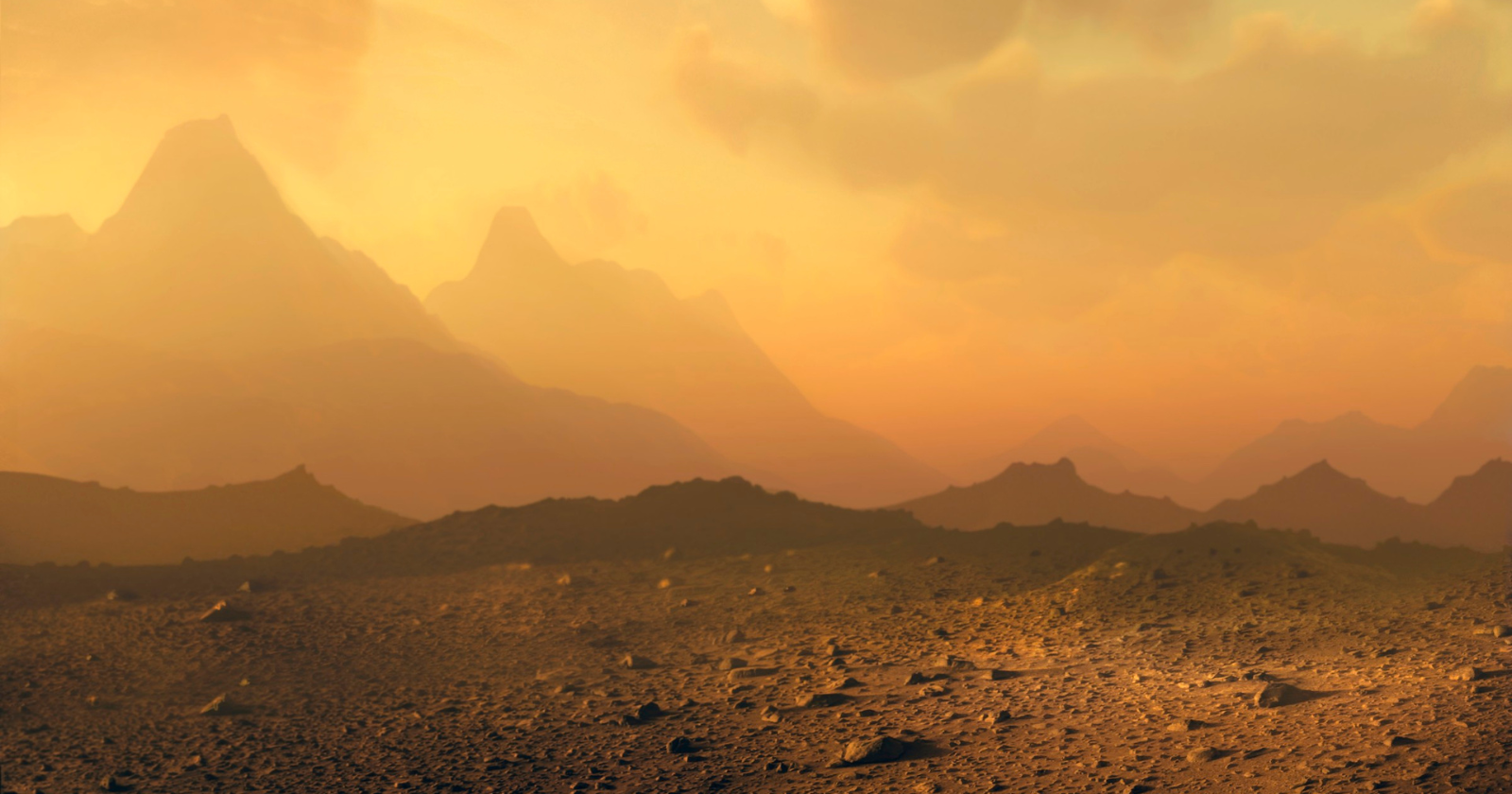
Venus is difficult to reconcile with the word habitable. Its average surface temperature is about 465 degrees Celsius, and the pressure at ground level is roughly 93 times the pressure at sea level on Earth. The atmosphere is mostly carbon dioxide. Within it sits a global layer of clouds made largely from droplets of concentrated sulphuric acid.
But altitude changes the calculation. At about 50 kilometres above the surface, NASA gives a temperature range of 30 to 70 degrees Celsius, with atmospheric pressure similar to that at Earth’s surface. Seventy degrees is hardly a mild afternoon, but part of that band has temperatures and pressures that terrestrial organisms can tolerate.
That narrow layer has kept a serious, highly speculative question alive: could microscopic organisms spend their entire existence inside Venus’s clouds?
An accepted 2026 paper released in article-in-press form by Scientific Reports has now added fungi to the discussion. I went into the paper expecting an experiment that exposed fungal spores to simulated Venusian clouds. That is not what the researchers did, and the distinction matters.
This is one study, not settled consensus. It offers a candidate worth testing, not evidence that anything is alive on Venus.
What the new fungus study actually measured
Anna Olewicz, Grzegorz P. Słowik and Miroslav Kolařik examined spores from three acid-loving fungi: Acidiella bohemica, Acidomyces acidophilus and Acidomyces acidothermus. These are melanised fungi found in harsh terrestrial settings. Earlier work has shown that some can grow at a pH near zero, tolerate metals or radiation, and, in the case of A. acidothermus, grow at temperatures up to 45 degrees Celsius.
The team was interested in light, not survival. Venus has broad dark markings that absorb ultraviolet radiation, and the chemical identity of part of that absorber remains unresolved. Biological material has been proposed as one possible explanation, alongside several non-biological compounds and particles.
The researchers grew the fungi on malt-extract agar at 24 degrees Celsius. They suspended the spores in demineralised water, then measured how the samples absorbed light across wavelengths from 200 to 700 nanometres. The three species produced absorption peaks between 243 and 323 nanometres, partly overlapping the ultraviolet range associated with Venus’s clouds.
The overlap was incomplete. The authors acknowledge that their samples did not reproduce the spectral slope observed between 400 and 500 nanometres.
More importantly, the spores were not placed in concentrated sulphuric acid, a carbon-dioxide atmosphere or Venus-level dryness. The experiment shows that these fungal spores absorb some of the same ultraviolet wavelengths. It does not show that they could remain alive, reproduce or perform metabolism in a Venusian cloud droplet.
The cloud-life idea is nearly 60 years old
Harold Morowitz and Carl Sagan set out an early version of the idea in a 1967 paper in Nature. The measurements available to them were limited, and their understanding of the clouds included details that later observations changed. Their central move still frames the modern discussion: the surface may be lethal, while a layer higher in the atmosphere offers a less destructive temperature and pressure.
A permanent aerial biosphere would need more than a comfortable altitude. It would need a liquid environment, raw materials, an energy source and some way to avoid slowly falling into hotter air below.
Sara Seager and colleagues tackled that last problem in a 2020 Astrobiology paper. Their proposed life cycle places microbes inside liquid cloud droplets. As droplets grow, gravity pulls them down. The liquid then evaporates in the warmer lower atmosphere, leaving desiccated spores in a relatively stagnant haze between about 33 and 48 kilometres. Atmospheric mixing could eventually carry some spores back up, where they would seed new droplets and rehydrate.
It is a model, not an observed ecosystem.
Fungal spores make sense as analogues within this model because they are small, built for aerial dispersal and often resistant to drying and radiation. Yet an Earth fungus that tolerates an acidic lake is still a long way from an organism that can complete its life cycle in concentrated sulphuric acid with almost no available water.
Water may be the harder limit
The temperature comparison is the part of the Venus story that travels easily. The water problem is less intuitive and much less encouraging.
Water activity measures how available water is for biological processes, rather than simply asking whether water molecules are present. A value of one corresponds to pure water. In a 2021 Nature Astronomy study, John Hallsworth and colleagues calculated that Venusian cloud droplets have a water activity of no more than 0.004. The lowest confirmed limit at which a known terrestrial organism can remain metabolically active is about 0.585.
That leaves a gap of more than two orders of magnitude.
The difference between low pH and low water activity is easy to blur. Earth’s acid-loving microbes generally inhabit aqueous environments where acid is dissolved in water. In much of Venus’s cloud layer, the droplet is better understood as concentrated sulphuric acid containing a relatively small amount of water. Surviving acidity in a mine pool does not establish that an organism can function with sulphuric acid as its main solvent.
The 2026 fungus paper names low water activity, scarce molecular oxygen and uncertain organic carbon as its three major obstacles. Those are not small details around an otherwise habitable setting. They determine whether an organism could obtain energy, build cells and reproduce at all.
Some biological molecules survive, while others do not
Laboratory chemistry has made the picture more interesting without making it conclusive. Sara Seager and colleagues reported in a 2023 Proceedings of the National Academy of Sciences paper that the five nucleic acid bases used by DNA and RNA retained their heavy-atom structures in sulphuric acid concentrations from 81 to 98 per cent at room temperature. Follow-up work published in 2024 found that those bases could remain stable for at least a year.
Stable ingredients are not a living system.
A 2024 study in Scientific Reports produced a useful counterweight. Most of the simple two-amino-acid molecules the researchers tested broke down within weeks at Venus-relevant acid concentrations. The authors concluded that hypothetical life using sulphuric acid as a solvent would probably need an alternative to the peptide bonds on which terrestrial proteins depend.
These results leave room for complex organic chemistry. They also show how much machinery is missing between a durable molecule and a cell capable of inheritance, repair and metabolism.
A spectral resemblance is a reason to look closer
The fungal-spore study gives future Venus investigations a more specific comparison to make. Better measurements could ask whether the unknown ultraviolet absorber follows the complete spectrum of a biological pigment, whether cloud particles contain complex organic material, and whether the droplets contain enough biologically available water for any active chemistry.
Those tests would also have to rule out mineral and atmospheric explanations. A partial match to an ultraviolet spectrum is not a biosignature when several non-biological candidates remain available. The disputed history of phosphine claims in Venus’s atmosphere is a good reason to demand multiple, independent lines of evidence.
What I take from this is narrower than the headline version. Venus has a layer where heat and pressure alone do not rule out life. The new paper suggests that acid-loving fungal spores are useful Earth analogues when thinking about that layer, but it does not show they could live there. The next useful evidence will have to come from the chemistry and particles inside the clouds themselves.