

The gap between Earth and Neptune
Exoplanet surveys have revealed a population with no close counterpart in the solar system. Worlds larger than Earth but smaller than Neptune frequently circle other stars, sometimes in tight orbits where a year lasts only days. Their absence here is a clue about how the solar system evolved.
The label needs care. NASA’s guide to super-Earths stresses that these worlds can contain rock, gas or both. A radius between Earth’s and Neptune’s does not reveal an interior, and researchers also use mass-based definitions. The new model concerns a compact, heavy-element-rich planet of several Earth masses.
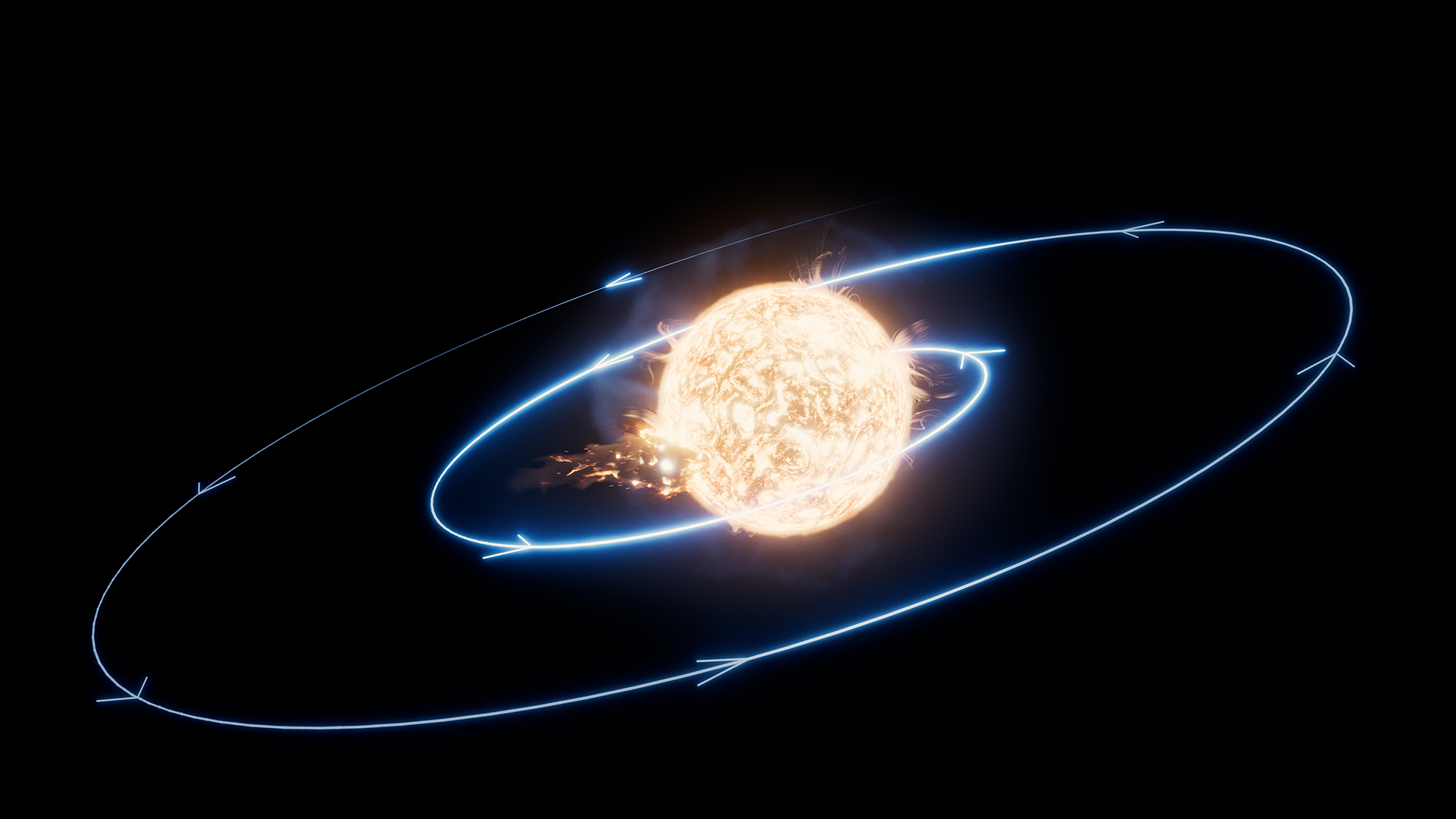
The study proposes a severe answer to the missing-world question. The planet may not have escaped or failed to form. It may have spiralled inward while the Sun was young, crossed the turbulent outer envelope and deposited most of its heavy elements beneath the region that became the modern convection zone.
No buried planet has been detected. The claim is that this early meal can improve several mismatches between calculations and the present Sun simultaneously. The proposed evidence is indirect: a chemical layer, a more accurate internal sound-speed profile and a surface lithium abundance consistent with present observations.
The Sun is a precision laboratory
The hypothesis comes from Mutlu Yıldız of Ege University, sole author of the Monthly Notices of the Royal Astronomical Society study. It does not begin with an image of a falling planet. It begins with persistent differences between standard solar calculations and unusually precise measurements of the Sun.
A successful model must reproduce the solar radius and luminosity after about 4.6 billion years. It must also match the convective envelope’s depth, surface helium and heavy-element abundances, depleted lithium and the sound-speed profile inferred from oscillations. Changing one ingredient can improve one constraint while worsening another.
Yıldız used stellar-evolution calculations, including the open-source MESA code, to follow chemically nonuniform accretion. The models varied opacity, equations of state and prescriptions for convective and turbulent mixing. Some sequences also used the independent ANKI stellar-evolution code.
That comparison matters because extra parameters can make an exotic history look better by giving it more freedom. Optimized models without engulfment reduced parts of the discrepancy. They did not match the combined helioseismic and surface constraints as well as the best engulfment sequence in the study’s statistical comparison.
A chemical layer below the convection zone
A young star and its disc need not exchange material of one composition. Planet formation removes rock-forming elements from some disc gas. Later accretion of dust-poor gas can dilute the stellar surface, while ingestion of a rocky planet delivers a concentrated packet of heavy elements.
In the preferred calculation, dissolved planetary material settles below the convection zone, around 96 to 97.3 percent of the Sun’s mass measured outward from the centre. It creates a localized heavy-element enhancement. That changes opacity, temperature and density, which alter how fast sound travels through the region.
The planet would not remain recognizable inside the Sun. Its proposed fingerprint is a composition gradient left after its material was redistributed. The modern surface can be comparatively poor in refractory, rock-forming elements while a deeper layer retains the chemical consequences of engulfment.
This split is possible because the Sun’s convective envelope became much thinner as the star evolved. Material mixed into the envelope can follow a different history from dense material deposited beneath it. The model connects that separation to present surface chemistry and hidden internal structure.
Sound waves turn the Sun transparent
Helioseismology measures oscillations at the solar surface and uses them to infer inaccessible structure. A SOHO helioseismology result illustrates the method’s power: sound-speed departures expose temperature and composition differences near the boundary between the convective and radiative regions.
Standard models have struggled to match the sound-speed profile below that boundary while also satisfying the convection-zone depth and surface composition. Revised solar-abundance measurements intensified the problem because lower heavy-element concentrations changed opacity and weakened agreements produced by older abundance mixtures.
The engulfment models improve the combined fit by reshaping the layer to which the oscillations are sensitive. In the best sequences, the root-mean-square sound-speed discrepancy is roughly an order of magnitude smaller than in the study’s standard low-metallicity reference, although the comparison depends on adopted physics.
This is the title’s seismic fingerprint. More precisely, it is helioseismic. It is not a new signal attributable only to a planet. The measured oscillations already exist; the claim is that an early engulfment history better explains their inferred internal profile.
Why five to ten Earth masses
Across related best-fitting calculations, the inferred swallowed mass is roughly five to ten Earth masses. The preferred model, labelled DD1020, centres near 5.6 Earth masses. The paper informally names the hypothetical world Dev Dilek, but that name does not imply an observed object.
When the Sun’s severe lithium depletion is included, the acceptable interval tightens to about 4.6 to 5.8 Earth masses, provided the accreted material was lithium-poor. Other choices for stellar microphysics produce heavier solutions, widening the broader family of favourable cases toward ten Earth masses.
This distinction prevents false precision. The broad range reflects multiple treatments of stellar physics, while 5.6 Earth masses belongs to one favoured configuration. It is not a measurement of a vanished planet, but the material needed for one history to satisfy several solar constraints together.
The Royal Astronomical Society summary calls the convergence notable. The paper’s comparison indicates that the improvement is not explained solely by the engulfment models having more adjustable parameters. That result strengthens this scenario without making it unique.
Could a rocky planet reach the required depth?
A planet entering a star faces tides, crushing pressure, heat and drag. If it breaks apart or evaporates too high, its heavy elements mix through the wrong region. Yıldız tested first-order feasibility using Roche-lobe stability, high-pressure planet structures and classical estimates of drag and ablation.
The calculations suggest that a compact, core-dominated rocky planet could reach the solar surface without complete tidal disruption. As it descends, external pressure compresses it and reduces its cross-section. In the classical treatment, that shrinking target limits drag and ablation before it reaches the convective envelope’s base.
The conclusion applies to a dense planet under the model’s assumptions. A puffy sub-Neptune with a deep hydrogen and helium atmosphere would interact differently. The hypothetical body could resemble a stripped heavy-element core, retaining a super-Earth mass while providing the compact structure needed for the plunge.
This is plausibility, not a simulated ingestion. The paper leaves orbital dynamics, shock formation, thermal evolution and hydrodynamic instabilities for future coupled calculations. Those processes could change how the planet fragments, mixes or deposits energy. The survival result supports the scenario without closing the physical case.
A pathway proposed a decade earlier
The idea of lost close-in super-Earths predates the new calculation. In 2016, Rebecca Martin and Mario Livio examined how disc turbulence affects formation and migration. Their study suggested that super-Earths could form farther out, migrate inward and fall into the Sun if the late disc was sufficiently cool.
That work offered a route, not evidence that the event occurred. It also suggested that inward-migrating planets could clear material inside Mercury’s present orbit. The new paper asks a different question: if such a loss happened, can the Sun retain an observable record after four billion years?
Timing is critical. Extensive early convection can mix accreted material deeply and erase a localized signature. Later, as the convective envelope retreats, metal-rich debris can concentrate near its base. The paper constructs staged accretion histories to create the required gradient while preserving surface composition.
Other stars show how ingestion might alter chemistry. A SpaceDaily report on TOI-5882 described high lithium as a possible engulfment clue. The solar proposal is different: it must explain very low surface lithium while hiding heavy elements deeper down.
Lithium is both clue and condition
Lithium burns at temperatures much lower than those needed for hydrogen fusion, so mixing can carry it from a stellar surface into layers hot enough to destroy it. The Sun has far less surface lithium than simple models predict. Any early accretion history must avoid restoring too much.
Yıldız’s lithium match requires lithium-poor engulfed material and limited later mixing below the convection zone. Too much mixing would erase both the lithium pattern and the heavy-element layer needed for the sound-speed improvement. The chemical and helioseismic signatures are coupled rather than independent additions.
The assumption deserves attention because ordinary rocky material is not automatically lithium-free. The mass interval is conditional on a chosen accreted composition and mixing history. Alter either, and the amount of planetary material needed by the calculation can move. The model identifies a coherent solution, not a measured composition.
This coupling makes the hypothesis easier to challenge. A different treatment of lithium burning, diffusion or turbulent mixing could move the inferred mass or remove the need for engulfment. Improved measurements and more detailed models must show that the same history continues satisfying every constraint.
How to test a four-billion-year-old meal
The solar system’s architecture is unusual but not inexplicable. NASA’s survey of strange planetary-system layouts notes that worlds between Earth and Neptune are among the most common discoveries, though none survives locally. Formation, migration, collision and loss can shape that contrast.
The decisive test is not finding an intact planet inside the Sun. It is independently identifying the predicted composition gradient and sound-speed structure, then showing that ordinary adjustments to opacity, abundances and mixing cannot reproduce them as well. Solar neutrinos and improved abundance measurements may add cross-checks.
Similar work on other stars could help. Asteroseismology can probe stellar interiors, while comparisons between binary partners or stars of similar age can reveal unusual surface abundances. Consistent chemical and seismic signatures associated with planetary architectures would turn a solar curiosity into a wider test.
For now, the result is a disciplined possibility rather than recovered history. A rocky planet of roughly five to ten Earth masses improves several solar-model discrepancies, and a simplified survival calculation lets it reach the required depth. Whether that solution records a lost world awaits independent tests and fuller physics.