
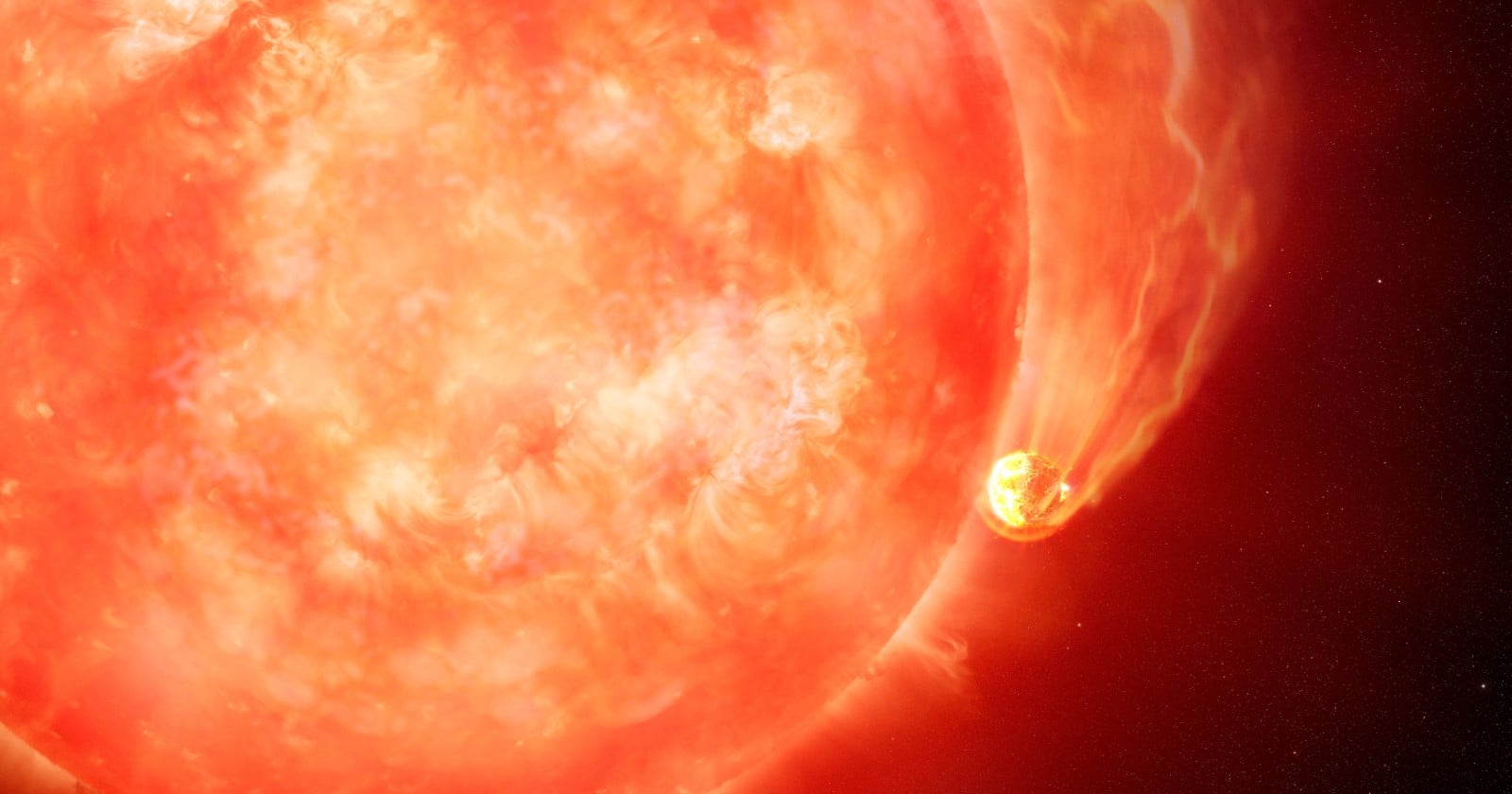
An aging star is carrying a chemical signature it has no business still having: a strong line of lithium, an element that stars of its kind burn away as they grow old. A team of astronomers argues the most likely reason is dramatic. The star, called TOI-5882, may have swallowed one of its own planets, and the lithium is what the meal left behind. The claim, reported in a study in The Astrophysical Journal, is careful to call the engulfment a candidate rather than a settled fact, and the reasons for that caution are as interesting as the headline.
TOI-5882 is close to the Sun in temperature, around 5,700 kelvin, though about a third more massive, and it has begun to evolve off the main sequence into an early subgiant. That evolutionary stage is the whole point. It is the window in which a swallowed planet should leave a lithium mark that is neither burned away nor diluted beyond detection.
A star that kept too much lithium
Lithium is fragile. It survives in the cool outer layers of a young star, which is why a strong lithium line is normally a sign of youth. As a star ages and its outer convective envelope deepens, that envelope drags surface material down to layers hot enough to destroy lithium, and the element steadily disappears. An old star with a lot of lithium is a puzzle that demands an explanation.
To measure how anomalous TOI-5882 really is, the team drew on archival spectra from the Tillinghast Reflector Echelle Spectrograph in Arizona, then weighed the star’s lithium against a control group of 61 subgiants pulled from the GALAH stellar survey and matched to TOI-5882 in temperature, gravity, metal content, and color. Against that carefully matched crowd, TOI-5882 sits in the 98.4th percentile in both the strength of its lithium line and its inferred lithium abundance. Only a handful of otherwise similar stars carry as much.
The team was deliberate about who counted as a fair comparison. Young stars that never lost their birth lithium would contaminate the sample, so they screened the control stars for signs of youth and removed one that turned out to belong to a stellar group only about 400 million years old. What remains is a population of genuinely evolved stars, and TOI-5882 stands out even among them.
The timing matters because an early subgiant sits in a narrow sweet spot. Its outer convective layer has grown deep enough to swallow and dissolve an incoming planet, yet the bottom of that layer is still cool enough that any lithium delivered survives instead of burning. Reach that stage too early and there is no envelope to catch the signal; reach it too late and the lithium is destroyed or diluted away. In every other respect TOI-5882 is an unremarkable star, roughly 4 billion years old, richer in metals than the Sun, a steady member of the galaxy’s thin disk, which makes its lithium excess harder to wave away as some quirk of an unusual object.
Could a swallowed planet explain it
If the lithium was not inherited and was not made inside the star, the most direct way to add it is from outside. A planet is a natural candidate. Planets lock up lithium in their rock and metal, and when a star engulfs one, that material dissolves into the star’s outer envelope and briefly lifts its surface lithium before the slow mixing of the star buries the signal again.
The team modeled how much planetary material it would take to produce the excess they measured. Under realistic assumptions about a planet’s composition, the answer is roughly 9 to 95 times the mass of Earth, which is to say a body somewhere between a super-Earth and Neptune. That is an order of magnitude less than the mass you would need if you assumed the swallowed object had the Sun’s own lithium-poor composition, a comfortably planet-sized figure.
There is even a plausible culprit for the shove. TOI-5882 still hosts a surviving companion, a brown dwarf about 22 times the mass of Jupiter on a tight 7-day orbit. That companion is itself a rarity, one of only about 40 known brown dwarfs that transit their star on orbits shorter than 10 days and one of just four found circling an evolved subgiant. A heavy companion on a close orbit can gravitationally stir an inner planetary system over long stretches of time, nudging a smaller planet onto a star-grazing path that ends in the star. The brown dwarf’s gravity only had to unsettle a smaller world’s orbit over billions of years.
Other ways to make a star lithium-rich
This is where the caution comes in, and the paper spends real effort on it. A high lithium line by itself does not prove a planet was eaten, so the team worked through the other ways a subgiant could end up lithium-rich and argued each one away for this particular star.
Inherited youth is out, because TOI-5882 shows none of the usual youth signals, no infrared excess, no telltale emission, no rapid spin. Internal manufacture is out, because the process that can rebuild lithium inside an evolved star only switches on later, once a star is well up the red giant branch, and TOI-5882 has not reached that stage. Exotic external sources such as nova debris or cosmic-ray bombardment are out, because they would leave other chemical fingerprints the star does not show. By elimination, a swallowed planet is left as the most direct explanation.
Elimination is not the same as a photograph, though, and the authors know it. Their comparison rests on stitching together measurements from different instruments and pipelines, which can carry small systematic offsets, and they note that a bias would have to be both large and pointed squarely at lithium to overturn the result. The inferred abundance is also more model-dependent than the raw line strength, which is why they report both. And no engulfed planet has been seen; its existence is read entirely from one chemical clue in the light of the surviving star.
How to close the case
TOI-5882 is a strong candidate, not a closed case, and the study frames it that way on purpose, as a test of a specific prediction about where in a star’s life an engulfment scar should be visible. It passed that test. Confirming the story will take more, most likely a hunt for the other chemical elements a rocky planet would have carried in alongside its lithium, so the signal can be matched against a fuller recipe.
Those heavier elements are the next thing to look for. Until they turn up, the evidence that a planet met its end here rests on a single bright line of lithium, shining in the spectrum of a star that should have destroyed it long ago.
