

The James Webb Space Telescope did not photograph water droplets or watch rocky grains condense beside the Milky Way’s central black hole. It did something both less visual and more diagnostic: it separated the mid-infrared light of a dying star into a spectrum and found the wavelength patterns of water molecules and oxygen-rich silicate dust.
The star is IRS 3, the brightest L-band source in the Galactic centre and a prominent asymptotic giant branch star in the Milky Way’s inner parsec. On the sky it appears just 4.4 arcseconds from Sagittarius A*, the radio source marking the Galaxy’s four-million-solar-mass black hole.
At the Galactic centre’s distance, that angle corresponds to 0.17 parsec, or approximately 0.55 light-years. The number sounds exact. Its geometry is not. It is a projected separation, while the water and dust are spectral identifications rather than objects resolved grain by grain.
Those distinctions do not weaken the result. They show what Webb actually added. The peer-reviewed study in Astronomy & Astrophysics demonstrates that an evolved star can maintain a molecule-bearing, silicate-rich envelope inside one of the Galaxy’s most radiation-dominated neighbourhoods.
The 0.55-light-year distance is drawn across the sky
A telescope image supplies two coordinates easily: left to right and up to down. Depth is harder. IRS 3 and Sagittarius A* may look close because their positions nearly align from Earth, while one sits some unknown distance in front of the other.
The 4.4-arcsecond angular gap becomes 0.17 parsec when converted using the distance to the Galactic centre. That is the separation projected onto the plane of the sky. It is effectively a minimum. The star’s true three-dimensional distance from Sagittarius A* can be equal to that value or larger, depending on its line-of-sight position.
The paper does not place IRS 3 on a measured circular orbit exactly 0.55 light-years from the black hole. Nor does the conversion show that every part of its envelope experiences one uniform radiation field.
Still, the projection is physically informative. IRS 3 is observed within the central parsec, a region crowded with stars, hot gas, strong ultraviolet sources and fast-moving material. Even if the unseen depth component increases its real separation, this is not a quiet counterpart to the Solar neighbourhood.
Water appears as a pattern of missing infrared light
The 2025 observations came from Webb’s Mid-Infrared Instrument, or MIRI, under the MICONIC guaranteed-time programme. MIRI’s Medium Resolution Spectrometer produced the first continuous mid-infrared spectrum collected for IRS 3, according to the ESA/Webb science release.
When light from the star and warm dust passes through cooler molecular material, particular wavelengths are absorbed. Water has many rotational and vibrational transitions in the mid-infrared. Rather than appearing as a single coloured line, it leaves a structured band of reduced intensity.
The strongest match in IRS 3 lies between about 6.0 and 6.25 micrometres, within a broader region of absorption extending through roughly 6 to 8 micrometres. The researchers took water transitions from the HITRAN molecular database, broadened them to match MIRI’s instrumental response and compared them with the measured spectrum.
The agreement supports H2O in the circumstellar envelope. This is molecular water, not liquid water, an ocean, a habitable environment or even necessarily ice. Some weaker nearby features remain ambiguous and may include foreground ice, ammonia-bearing material, large molecules or residual uncertainty in the extinction correction. The primary molecular-water identification is stronger than an assignment of every small dip in the spectrum.
Two silicate absorptions reveal the star’s chemistry
Galactic-centre observations are difficult because light from IRS 3 crosses a long, dusty path before reaching Webb. The team corrected the spectrum using three alternative extinction laws. Although the detailed corrected shape changed, the central classification survived all three.
A broad feature centred near 9.7 micrometres traces the stretching of silicon-oxygen bonds. A second feature near 18.5 micrometres corresponds to bending in oxygen-silicon-oxygen structures. The ratio of their optical depths was 3.5 plus or minus 0.1.
Together, these bands identify amorphous silicates in an oxygen-rich envelope. That resolves a long-standing ambiguity. Earlier work had left open whether IRS 3 might be a carbon-rich AGB star, partly because the crowded and obscured Galactic centre makes it easy to mix one source with unrelated material along the same line of sight.
Webb directly recorded the fingerprints of silicate dust that already exists. The description “freshly produced” rests on the wider physical interpretation: IRS 3 is in a late, high-mass-loss phase, its spectrum is reproduced by nested dust shells and its wind is continually replenishing the envelope. The telescope did not follow individual atoms as they assembled into a grain.
A 10,000-AU envelope creates shelter as well as exposure
IRS 3 is a cool, luminous AGB star near the end of its life. Pulsations and a strong wind lift gas away from its surface. As that material expands and cools, molecules can persist and solid particles can condense.
The dusty envelope has an estimated radius of about 10,000 astronomical units, roughly one-sixth of a light-year. Radiative-transfer modelling tested around 100,000 arrangements and found that one uniform shell could not reproduce the observations. The preferred description uses several components.
Temperatures decline from approximately 1,200 kelvin in the inner dust to around 80 or 100 kelvin in the outer zones. Models favour aluminium oxide mixed with amorphous silicates in the hotter inner region, with silicates dominating farther out.
That architecture helps explain why the phrase “radiation-drenched environment” should not be read as though every molecule is bare beside the black hole. Dense circumstellar material can absorb and reradiate energy. Distance from the star, local density and shielding create a range of microenvironments inside the envelope.
The result remains surprising because the whole system exists in the central parsec. It shows that harsh surroundings do not immediately erase the products of an evolved star’s wind. It does not measure how long water survives, how rapidly grains are destroyed after leaving the envelope or how much material reaches the wider interstellar medium.
This is a companion question to Space Daily’s earlier IRS 3 report
Space Daily’s earlier detailed analysis of IRS 3 followed the multi-shell model, the oxygen-rich reclassification, the assumed wind speed behind the mass-loss estimate and the uncertainty surrounding weaker absorption bands.
The narrower issue here is the chain of evidence inside the new headline. “Detected” means MIRI measured absorption at wavelengths matched to H2O and silicates. “Freshly produced” is an inference from dust chemistry plus a replenished, mass-losing envelope. “0.55 light-years” describes the two-dimensional projection. “Survive” means the material is present in the 2025 spectrum, not that its lifetime has been measured.
Keeping those meanings separate makes the result more useful. It distinguishes four astronomical measurements from a single cinematic picture of water floating beside a black hole.
A dying star can still enrich the Galactic centre
AGB stars are major suppliers of interstellar dust. They return material altered by stellar evolution to their surroundings, providing raw ingredients that can later enter clouds, stars and planetary systems. The central question was whether the environment around Sagittarius A* interrupts that recycling.
IRS 3 shows that it does not halt the first step. The star is shedding an oxygen-rich wind, maintaining dust shells and retaining water in its envelope. A bow shock shows that the expanding material is already interacting with the surrounding medium.
The wider Galactic centre is dynamic as well as bright. Space Daily has previously examined evidence for a wind from Sagittarius A*, inferred from a cone-shaped gap in molecular gas. Stellar winds, black-hole-driven outflows, radiation and orbital motion all influence where material travels after a star releases it.
The new paper argues that IRS 3’s bow shock is more likely governed by the star’s motion through the local interstellar medium at its projected location than directly dominated by a black-hole wind. That is another reminder that “near Sagittarius A*” describes a complicated physical region, not one destructive mechanism acting everywhere in the same way.
Presence is established more firmly than lifetime
The observation is a spectrum taken in 2025. It cannot by itself show how quickly water is broken apart, how often dust shells are replenished or what fraction of the expelled grains survives beyond IRS 3.
Follow-up spectroscopy could track changes in the molecular and dust bands. Better constraints on line-of-sight position would refine the actual separation from Sagittarius A*. Searches for a possible companion could help explain the shell structure, while analysis of the weaker features may identify additional molecules or ices.
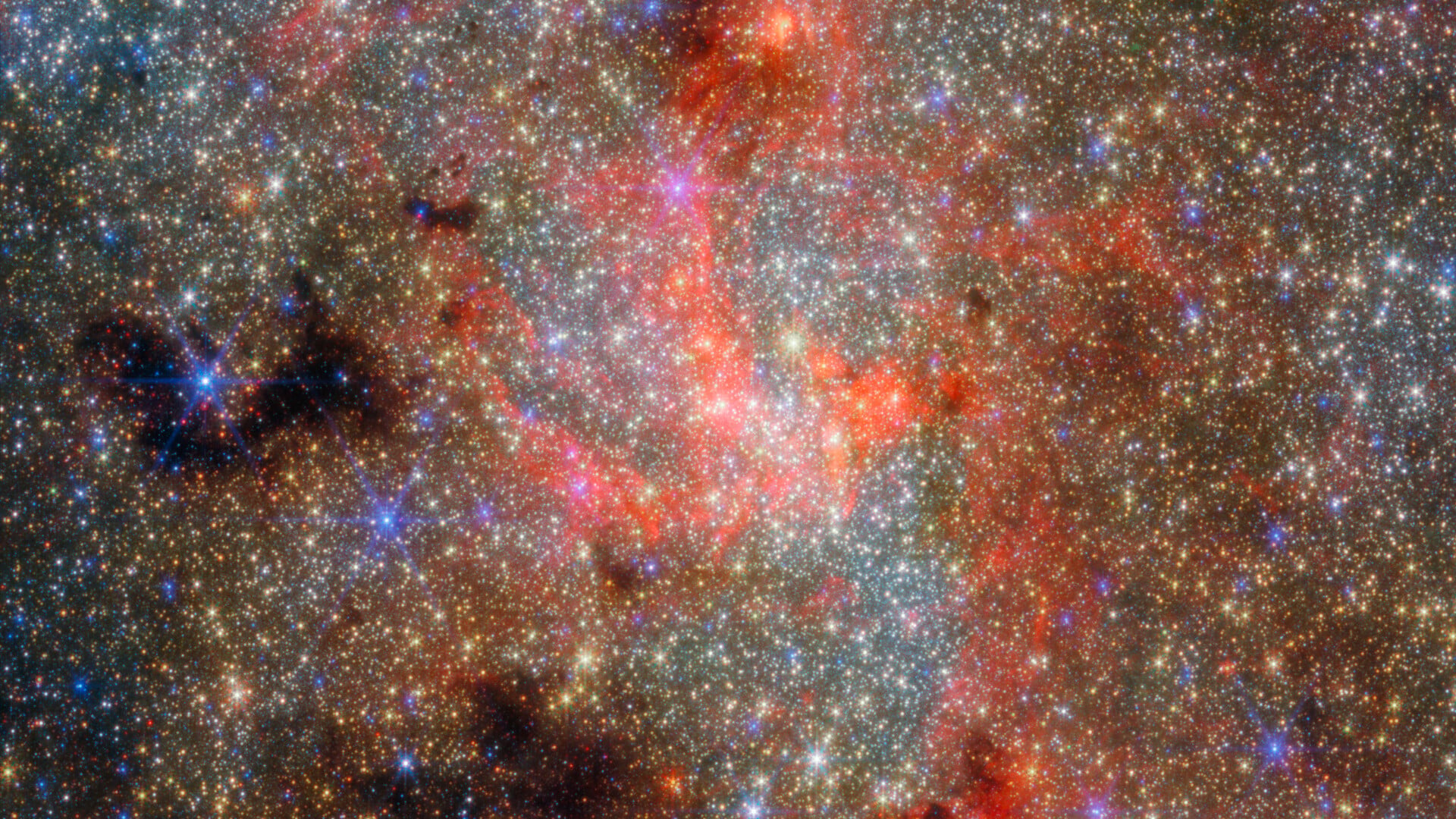
The official Webb NIRCam field image captures the extraordinary crowding and obscuration around IRS 3, but the decisive evidence is not visible as blue water or individual grains. It resides in the spectrum: a sequence of missing wavelengths that records what the star’s envelope contains.
That is enough to establish an important boundary. The Milky Way’s central environment is hostile, but not uniformly sterile. A dying star can still build oxygen-rich dust and hold molecular water inside its own extended atmosphere. What Webb has not yet measured is how far those fragile products travel once they leave that shelter.