

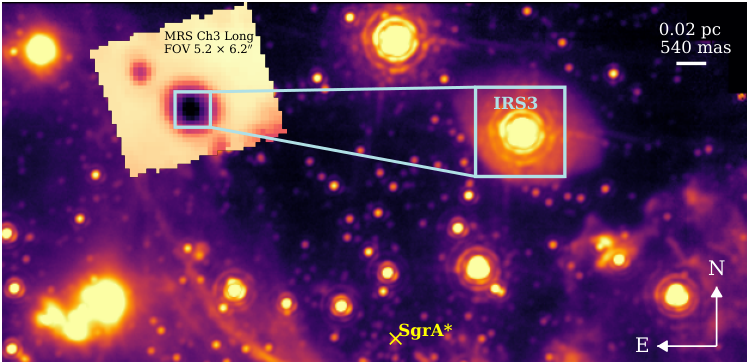
The James Webb Space Telescope has identified water and oxygen-rich silicate dust in the envelope of IRS 3, a dying giant star seen only 0.17 parsec from Sagittarius A* in projection. That separation is about 0.55 light-years, placing the star deep inside the crowded central parsec of the Milky Way.
Water, in this result, means mid-infrared absorption by H2O molecules. Webb did not find liquid water or image a reservoir. It measured a pattern of wavelengths removed from the star’s light as that light passed through its enormous circumstellar envelope.
The result comes from observations made in 2025 with Webb’s Mid-Infrared Instrument, or MIRI. Florian Peißker and 20 coauthors reported the analysis in August 2026 in the peer-reviewed journal Astronomy & Astrophysics.
This is one study, not settled consensus. Its conclusion is strong but narrower than saying chemistry near the Galactic centre had been considered literally impossible. The paper tests whether the radiation-dominated environment around Sagittarius A* prevents an old star from making dust and retaining molecules. In IRS 3, it evidently does not prevent either process completely.
What 0.55 light-years actually measures
IRS 3 appears 4.4 arcseconds from Sagittarius A*, the compact radio source associated with the Milky Way’s central black hole. As Space Daily explained after the Event Horizon Telescope image, the black hole contains about four million times the Sun’s mass and lies roughly 27,000 light-years from Earth.
At that distance, 4.4 arcseconds translates to about 0.17 parsec, or 0.55 light-years. The conversion is straightforward. Its interpretation needs care.
A sky image gives two positional coordinates far more readily than it gives depth along the line of sight. IRS 3 could sit in front of or behind Sagittarius A* by an additional, unknown amount. The quoted distance is therefore the separation projected onto the plane of the sky, effectively a minimum geometric separation. It is not a measured three-dimensional orbital radius, and the paper does not claim that the star circles the black hole at exactly that distance.
The distinction does not remove IRS 3 from an extreme neighbourhood. It remains the brightest L-band source and the most prominent asymptotic giant branch star within the Milky Way’s inner parsec, surrounded by intense radiation, hot gas, dense stellar traffic and material moving under the influence of the central black hole.
A late-life star wrapped in 10,000 AU of material
IRS 3 is an asymptotic giant branch, or AGB, star. Stars of low and intermediate mass enter this late phase after exhausting helium in their cores. Pulsations and winds lift gas from the surface; farther out, the expanding material cools enough for molecules and solid grains to form.
That process matters well beyond one star. AGB stars return newly processed material to their galaxies, and their envelopes are major factories for interstellar dust. Earlier Space Daily coverage of variable AGB stars described how their pulsations and changing brightness are tied to the quantities of dust they release. IRS 3 asks whether the same recycling can continue beside a supermassive black hole.
The envelope has an estimated radius near 10,000 astronomical units. That is roughly one-sixth of a light-year from the star to its outer edge, although its shape is not a tidy sphere. Infrared images show an extended source and a bow shock, evidence that the outflow is meeting the surrounding interstellar medium.
Peißker’s team used the Hyperion radiative-transfer code to compare the spectrum with a grid of about 100,000 models. A single shell could not reproduce the observations. Their preferred arrangement has several shells, with temperatures declining from about 1,200 kelvin in the inner dust to 80 or 100 kelvin in the outer components.
The same modelling favours a cool star with an effective temperature near 2,800 kelvin and a luminosity of roughly 55,000 to 60,000 Suns. Stellar-evolution tracks then suggest a present mass around six solar masses and an age near 72 million years. Those values depend on the adopted metallicity, temperature, luminosity and evolutionary tracks. They are inferred properties, not direct weighings or a precise birth certificate.
Two silicate features changed the star’s classification
Once the researchers corrected for dust extinction along the line of sight, the MIRI spectrum showed broad absorption centred at 9.7 micrometres and 18.5 micrometres. The shorter-wavelength feature corresponds to the stretching of silicon-oxygen bonds. The longer one traces the bending of oxygen-silicon-oxygen bonds.
The ratio between their optical depths was 3.5 plus or minus 0.1. Together with the overall spectral shape, the features identify amorphous silicates characteristic of an oxygen-rich envelope. Models combining aluminium oxide with amorphous silicates in the hotter inner region, and silicates alone in the cooler shells, reproduced the observed spectrum.
That changes a long-running argument about IRS 3. Earlier observations had supported several classifications, including the possibility of a carbon-rich AGB star. The Galactic centre is so crowded and obscured that a large beam can mix the star with unrelated foreground and background material. Webb’s continuous mid-infrared spectrum supports an oxygen-rich star instead.
The team tested three different extinction laws for the central parsec. The precise corrected spectrum shifted, but the oxygen-rich classification survived all three choices. That robustness matters because subtracting the foreground is one of the largest analytical difficulties in this field.
Dust production is inferred from shells and mass loss
Webb recorded the chemical fingerprints of existing dust. The claim that IRS 3 is still producing it comes from placing those fingerprints alongside the envelope’s shells, temperature structure and current mass loss. The telescope did not watch individual silicate grains condense.
Assuming a wind speed of 15 kilometres per second, the researchers estimated that IRS 3 is losing around six times 10-5 solar masses each year. That rate is characteristic of the brief, intense “superwind” stage of an oxygen-rich AGB star. Previous studies that adopted wind speeds of 20 or 30 kilometres per second arrived at similar mass-loss estimates, but the paper warns that different diagnostics and assumptions prevent a strict one-to-one comparison.
The multiple shells may record episodes of stronger and weaker outflow. A companion could also help shape them, as could interaction with the medium near Sagittarius A*. The current data do not choose decisively among those possibilities.
Nor is the central black hole simply a source of light. Space Daily has previously covered evidence for a wind from Sagittarius A*, found through a cone-shaped deficit in molecular gas. IRS 3’s own bow shock is more likely dominated by its motion through the local interstellar medium at its projected distance, according to the new paper, but the wider centre remains an active environment capable of reshaping stellar ejecta.
The water signal is clear, while nearby bands remain uncertain
The water signature sits mainly between 6 and 8 micrometres. For the strongest section, between 6.0 and 6.25 micrometres, the researchers drew transition lines from the HITRAN molecular database, broadened them to match MIRI’s response and fitted them to the observed absorption. The agreement supports H2O within the envelope.
Some neighbouring features are less secure. The paper describes a narrow water component around 6.19 micrometres, but the broader shape there is ambiguous. Other dips might involve water ice, ammonia-bearing ice, large molecules, foreground polycyclic aromatic hydrocarbons or residual errors in the extinction correction. The authors also state that contamination by foreground ices cannot be excluded across every weak band.
Those caveats do not erase the main H2O match. They limit how much chemistry can be assigned to every part of a complicated spectrum. A dedicated analysis of the weaker bands is still to come.
MIRI’s combination of imaging and medium-resolution spectroscopy is particularly useful here. Visible light cannot penetrate the intervening dust, while older infrared observations often lacked either the spatial resolution to isolate IRS 3 or continuous coverage of the relevant wavelengths. Webb supplied both.
What IRS 3 adds to the Galactic-centre picture
IRS 3 shows that an AGB star can retain a layered, molecule-bearing envelope and contribute oxygen-rich dust within the central parsec. The surrounding conditions may strip and sculpt that material, but they have not sterilised the envelope or halted its late-life outflow.
The word “survive” still needs a timescale. Webb captured one spectrum in 2025. It does not establish how long the water persists, how rapidly the grains are destroyed after leaving the envelope, or what fraction of the expelled material becomes part of the central interstellar medium.
Follow-up work can test the unidentified absorption bands, search for a companion and monitor whether the shells or bow shock change. Better radial-distance constraints would also show how much farther IRS 3 lies from Sagittarius A* than the 0.55-light-year projected minimum. Those measurements will determine how local dust production feeds a region that is simultaneously making, moving and eroding stellar material.