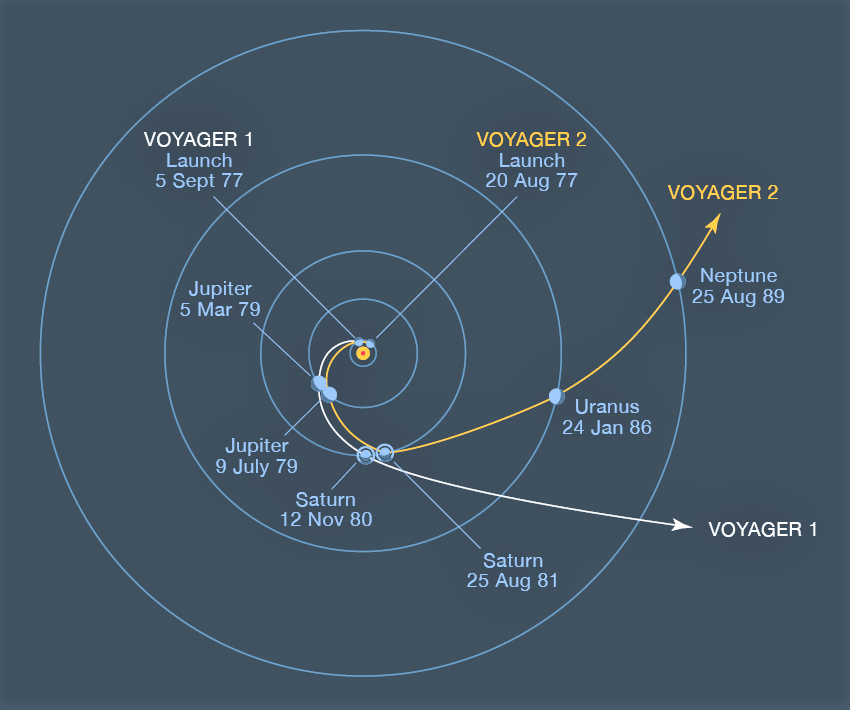
Voyager 2 left Cape Canaveral at 14:29:44 UTC on 20 August 1977. Its Titan IIIE-Centaur rocket supplied the first great push, but the spacecraft could not carry anything like the propellant needed to power itself from one outer planet to the next.
Instead, its route depended on the planets moving into a rare sequence. Jupiter had to be ready to bend the spacecraft towards Saturn. Saturn then had to redirect it towards Uranus, and Uranus had to pass it onwards to Neptune. JPL’s technical summary describes this as a roughly three-year opportunity that occurs once every 176 years.
Twelve years and five days after launch, Voyager 2 passed Neptune. It remains the only spacecraft to have visited all four giant planets, and the particular Grand Tour opportunity that made the journey possible will not return until around the middle of the 22nd century.
The planets were not standing in a straight line
When I first encountered the phrase “planetary alignment”, I imagined Jupiter, Saturn, Uranus and Neptune arranged like points on a ruler. That is not what mission planners meant.
The four planets occupied a long arc on the same broad side of the Sun. More importantly, their positions and orbital motion allowed a spacecraft leaving Earth in the late 1970s to meet them in the correct order. Each encounter could change the craft’s direction and Sun-relative speed enough to reach the next moving target years later.
The distinction matters because a view of the planets from above would not have looked like a neat queue. The alignment was a chain of future appointments. Missing the launch window, arriving on the wrong side of a planet or passing at the wrong angle could break everything downstream.
NASA pages variously describe the recurrence as about 175 or 176 years. That is not a substantive disagreement. The launch opportunity itself extended across several years, and different proposed Grand Tour routes included different combinations of planets. A 1970 NASA design study put the next comparable opportunity in 2150, while a current NASA profile of Voyager mission designer Charley Kohlhase gives 2153. “The 2150s” is the sensible level of precision.
A route discovered before there was a spacecraft
The path emerged from work at the Jet Propulsion Laboratory in the early 1960s. Mathematician Michael Minovitch developed methods for calculating trajectories through the gravitational influence of several moving planets. In 1965, JPL engineer Gary Flandro examined the outer planets and identified the exceptional opportunity approaching in the late 1970s.
NASA’s detailed history of the Grand Tour shows how ambitious the first plan became. The Thermoelectric Outer Planets Spacecraft programme, known as TOPS, considered four advanced spacecraft travelling along complementary routes. Between them they could visit Jupiter, Saturn, Uranus, Neptune and Pluto.
The timing was favourable; the budget was not. The proposed programme grew towards $1 billion at a moment when NASA funding was shrinking after Apollo and the agency was trying to finance the Space Shuttle. NASA cancelled the full Grand Tour in January 1972 and approved a cheaper pair of Mariner-class craft, initially committed only to Jupiter and Saturn.
That scaled-down mission became Voyager. The official plan was more modest, but engineers preserved the trajectory option that mattered. If the spacecraft survived Jupiter and Saturn, if its instruments remained useful and if NASA approved the money, Voyager 2 could continue to Uranus and Neptune.
What “borrowed gravity” actually means
A gravity assist can sound as though a planet simply pulls a spacecraft in and flings it out faster. The fuller explanation depends on which object you measure the speed against.
Relative to Jupiter, Voyager 2 accelerated as it fell towards the planet and slowed again as it climbed away. Ignoring small effects, it left Jupiter’s gravitational field with about the same Jupiter-relative speed it had on arrival, but travelling in a different direction.
Jupiter itself was moving around the Sun. Voyager approached from behind in the planet’s orbit, and Jupiter’s gravity turned the spacecraft while the two were moving together. Viewed relative to the Sun, the encounter transferred a minute amount of Jupiter’s orbital momentum to Voyager.
NASA’s trajectory primer describes the planet as losing a tiny amount of orbital energy. The loss was effectively meaningless to Jupiter but enormous to a 722-kilogram spacecraft. NASA calculates that the Jupiter encounter increased each Voyager’s Sun-relative speed by roughly 35,700 miles per hour, while slowing Jupiter’s orbit by the equivalent of only about one foot over a trillion years.
So the energy was not free and it was not created by gravity. “Borrowed” is useful shorthand for an exchange so lopsided that only the spacecraft’s side can be noticed. The practical prize was a major change in speed and direction without carrying the rocket propellant that an equivalent engine burn would have required.
The first flyby determined the last one
Voyager 2 reached Jupiter on 9 July 1979. The planet’s gravity bent its path towards Saturn, where it arrived on 25 August 1981. Saturn then sent it towards Uranus for the encounter on 24 January 1986. Uranus supplied the final assist to Neptune, reached on 25 August 1989.
These were not four independent visits assembled along the way. Mission designers studied more than 10,000 possible trajectories before choosing the two Voyager paths. The altitude and timing of every close approach constrained where the spacecraft could go next.
This is why Voyager 1, despite its lower number, launched 16 days after Voyager 2 and reached Jupiter and Saturn first. It took a faster route. Its close pass by Titan at Saturn produced important measurements of that moon’s atmosphere, but Saturn’s gravity also bent Voyager 1 northward out of the plane where the outer planets orbit. Its planetary tour ended there.
Voyager 2 arrived later on the route that kept Uranus and Neptune available. The numbering described encounter order, not launch order.
The contrast continues today. In my earlier article about Voyager 1 crossing into interstellar space while remaining deep inside the Solar System’s distant comet cloud, the apparent contradiction came down to which boundary we mean. Here, the two spacecraft’s different positions beyond the heliosphere trace back to geometry chosen before either one left Earth.
Voyager 2 turned a five-year design into a 12-year planetary mission
The outer-planet extension was never guaranteed at launch. Voyager’s primary mission covered Jupiter and Saturn, and the spacecraft were designed around an expected five-year life. Uranus lay another four and a half years beyond Saturn. Neptune required another three and a half years after that.
Longevity therefore mattered as much as trajectory. Electronics had to survive radiation at Jupiter, years of cold and declining electrical power, and radio delays that made immediate help from Earth impossible. The spacecraft also had to be reprogrammed remotely as the mission changed.
The three radioisotope thermoelectric generators on each Voyager converted heat from plutonium-238 into electricity. I have written before about why every spacecraft designed to operate beyond Jupiter has depended on that scarce isotope. Sunlight becomes too weak for the compact solar arrays available to the Voyager designers, while plutonium supplied steady power through the entire planetary tour.
Gravity assists cut Voyager 2’s journey to Neptune from about 30 years to 12. NASA gives the travelled distance to the Neptune encounter as 7.1 billion kilometres. At the end of that chain, navigators delivered the spacecraft to within about 100 kilometres of its intended aim point after a flight measured in billions of kilometres.
The shortcut delivered more than four portraits
Voyager 2 did not merely pass close enough to photograph four large planets. It carried 11 scientific investigations designed to measure atmospheres, magnetic fields, charged particles, rings and moons.
At Jupiter it watched the active volcanoes on Io and returned close observations of Europa. At Saturn it studied the ring system and atmosphere. At Uranus it discovered moons and rings while measuring a magnetic field radically tilted and offset from the planet’s centre. At Neptune it found fierce winds, a dark atmospheric feature and new moons before passing close to Triton.
Some of the public memory of those encounters also needs qualification. As I explained in my piece on the famous cobalt-blue images of Neptune, colour processing made the planet look much darker and bluer than Uranus. Modern recalibration shows the two worlds are closer in visible colour than the familiar Voyager portraits suggest. The underlying measurements remain invaluable; the way some pictures were presented became part of the story too.
The larger scientific limitation is harder to correct. Voyager 2 remains the only spacecraft to have visited Uranus or Neptune. Much of what is known about their magnetic fields, internal structures and moons still leans on data collected during two brief flybys in 1986 and 1989.
Gravity assists are still doing the work
The Grand Tour geometry is rare, but gravity assists are now routine tools of planetary flight. Galileo looped past Venus and Earth to reach Jupiter. Cassini used Venus, Earth and Jupiter on its way to Saturn. Missions can also use a flyby to slow down, alter orbital inclination or reach a target that a direct launch could not economically serve.
NASA’s Europa Clipper offers a current example. As I noted when writing about its 2.9-billion-kilometre route to Jupiter, the spacecraft passed Mars in 2025 and is due to use Earth for another gravity assist in December 2026 before arriving at Jupiter in 2030. A more powerful modern rocket did not make planetary geometry irrelevant.
Nor does the wait until the 2150s mean no spacecraft can visit Uranus or Neptune before then. Individual ice-giant missions can use different launch years, different planets, longer flight times or more capable propulsion. What does not return until then is the comparable opportunity for one craft to run the complete Jupiter-Saturn-Uranus-Neptune sequence with successive assists.
A route through time as much as space
The part of Voyager 2’s story I find most absorbing is how many kinds of timing had to agree. The planets followed schedules measured in decades and centuries. Engineers had only a few years to design around the approaching window. Governments made annual budget decisions. The spacecraft then had to survive long enough for a possibility preserved on paper to become an authorised mission.
The four planets did not lift Voyager 2 out of the Solar System through a piece of navigational magic. They traded tiny portions of their motion with it, one carefully aimed encounter at a time. Jupiter made Saturn reachable, Saturn made Uranus reachable and Uranus made Neptune reachable.
The next comparable arrangement belongs to the 2150s. By then, almost everyone alive when Voyager 2 launched, and almost everyone alive now, will be gone. The machine that caught the previous window is already beyond the heliosphere, carrying a route through the outer planets that no spacecraft can simply repeat on demand.