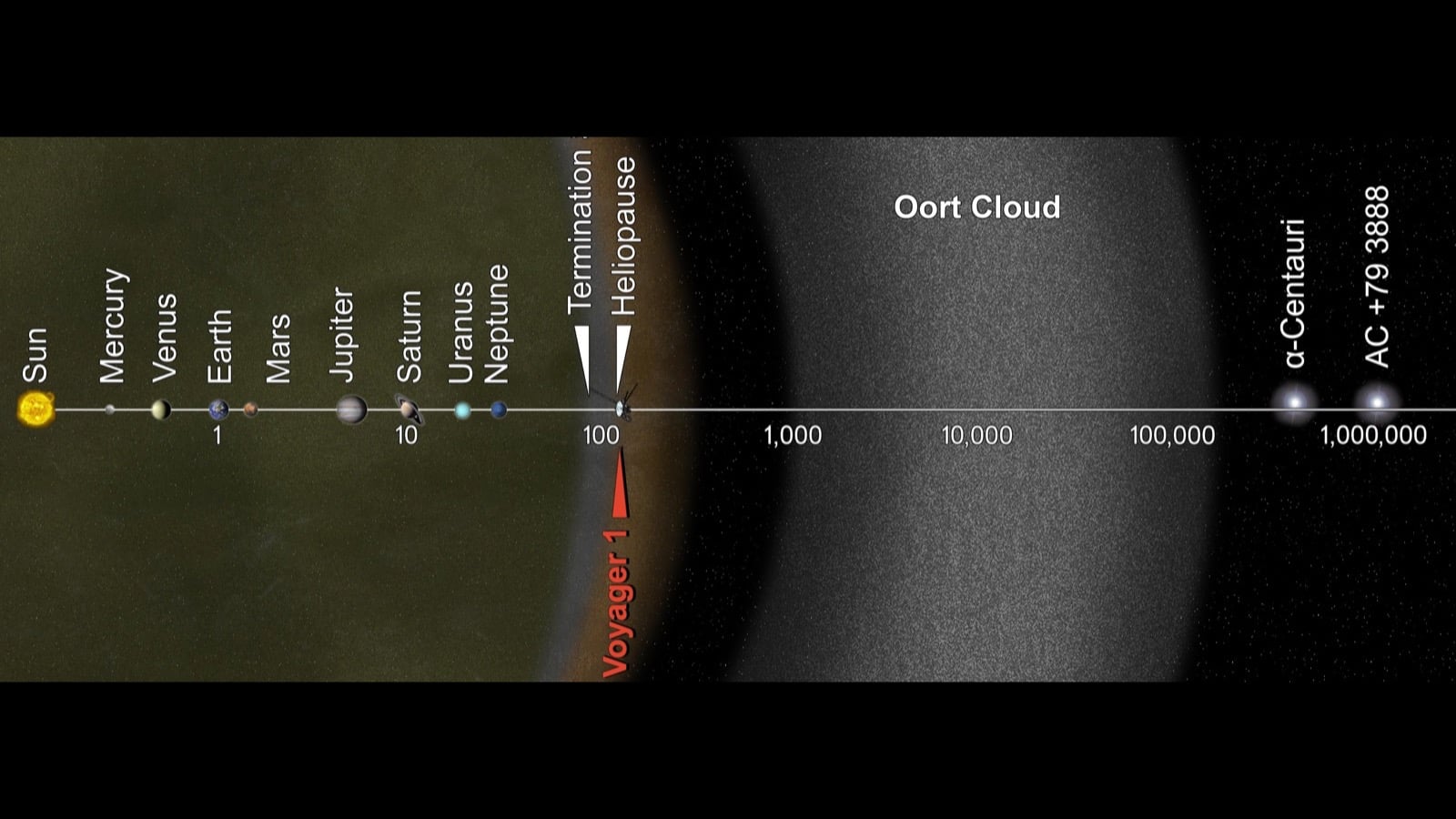
Voyager 1 has been travelling away from the Sun since 1977. It has passed every planet, crossed the frontier carved out by the solar wind and entered the material between the stars. Yet by another perfectly useful definition, it remains deep inside the solar system.
That sounds like a contradiction only because the phrase “solar system” is doing two different jobs. One boundary describes the reach of the Sun’s plasma and magnetic influence. Another describes the far larger realm in which objects remain gravitationally tied to the Sun.
NASA’s Voyager 1 mission record gives the first milestone clearly. The spacecraft launched on September 5, 1977, and entered interstellar space in August 2012. It was the first human-made object to do so. But it will take roughly 300 more years to reach the Oort Cloud and perhaps 30,000 years to pass beyond it.
The heliopause is a boundary of weather, not gravity
The Sun continually releases a flow of charged particles called the solar wind. That wind inflates an enormous bubble known as the heliosphere, which encloses all the planets and extends far beyond Neptune. NASA’s overview of the solar system distinguishes this plasma boundary from the much more distant limit of the Sun’s gravitational realm.
Eventually, pressure from the surrounding interstellar medium checks the solar wind. The outer boundary of this bubble is the heliopause. When Voyager 1 crossed it on August 25, 2012, the probe moved from plasma dominated by the Sun into denser plasma from the space between stars.
Nothing solid marks the crossing. There is no shell, wall or neat line painted across the darkness. The heliopause shifts as solar activity and conditions outside the bubble change. Crossing it is closer to leaving one weather system for another than stepping across a national border.
Most importantly, the heliopause does not mark the end of the Sun’s gravity. That influence fades gradually and reaches vastly farther than the solar wind bubble.
How scientists knew Voyager 1 had crossed
The announcement did not come immediately. Voyager 1’s own plasma instrument had stopped working in 1980, leaving the mission team without the most direct way to measure the surrounding plasma.
Instead, nature provided an experiment. A burst of solar material travelled outward and made the plasma around Voyager vibrate. Its plasma wave instrument detected those oscillations in April 2013. The pitch revealed a density consistent with interstellar plasma, more than 40 times the plasma density Voyager 2 had measured in the heliosheath.
By combining that evidence with abrupt changes in cosmic rays and particles from inside the heliosphere, scientists traced the crossing back to August 2012. NASA formally confirmed the result in September 2013, explaining that the probe was in a transitional region immediately outside the solar bubble.
Voyager had genuinely entered interstellar space. It had not, however, escaped every form of solar influence.
The Oort Cloud makes the solar system much larger
Far beyond the planets and Kuiper Belt, astronomers think a vast spherical swarm of icy bodies surrounds the Sun. This is the Oort Cloud, proposed to explain why long-period comets arrive from many directions.
No telescope has directly imaged the cloud as a structure. Its existence and dimensions are inferred from comet orbits and models of how the solar system formed. Current NASA estimates place its inner edge around 2,000 to 5,000 astronomical units from the Sun and its outer edge somewhere between 10,000 and 100,000 AU. One AU is the average distance from Earth to the Sun.
Voyager crossed the heliopause at about 120 AU. That means it had cleared the Sun’s plasma bubble while remaining far short of even the nearest plausible edge of the Oort Cloud.
The cloud’s icy objects still orbit the Sun, although passing stars and the gravity of the Milky Way can disturb them. If the solar system means the full family of objects gravitationally bound to our star, the cloud belongs inside it.
Thirty thousand years is an estimate, not an appointment
NASA says Voyager 1 is moving at about a million miles per day. Even at that speed, it will need around 300 years to reach the Oort Cloud and perhaps 30,000 years to leave its far side.
Those numbers are necessarily rough. We do not know precisely where the cloud begins or ends, and its remote objects form a diffuse population rather than a hard-edged shell. NASA’s own estimates span an order of magnitude for the outer boundary.
There is another sobering detail. Voyager will not still be talking to Earth when it reaches the cloud. Its radioisotope power supply is fading, and mission controllers are already shutting down instruments to extend its working life. The spacecraft itself should coast onward, but its scientific voice will fall silent long before those future crossings.
Both descriptions can be true
So has Voyager 1 left the solar system? In casual headlines, yes. It passed beyond the heliosphere and became humanity’s first working probe in interstellar space. In the broader gravitational definition used by NASA’s Voyager frequently asked questions, no. It must travel beyond the Oort Cloud before it has exited the solar system itself.
The distinction is more than wordplay. The solar system does not have one universal edge because the Sun affects its surroundings in more than one way. Its wind ends relatively close by. Its gravity holds a sparse population of bodies across a region that may reach a substantial fraction of the distance to the nearest star.
Voyager 1 therefore occupies a wonderfully strange address: in interstellar space, outside the Sun’s protective plasma bubble, yet still within the immense gravitational archipelago of the solar system. It has crossed a frontier without reaching the final edge, and no contradiction is required.