

No astronaut has returned from Mars with osteopenia. No human being has travelled to Mars at all.
The warning in the headline comes from a mathematical model published in 2020, not from a clinical follow-up of an interplanetary crew. Its authors took bone-density data from flights lasting months and extended a nonlinear curve across mission profiles lasting years.
That distinction does not make the result unimportant. It tells us how to use it. The model is a stress test for mission planning: if femoral-neck bone mineral density followed the assumed trajectory and if no effective countermeasures altered it, a long Mars expedition could push every modelled case below the normal range.
The conditions matter as much as the percentages. The 69 astronauts supplied the short-duration evidence used to fit the curve. They were not 69 people individually forecast to develop osteoporosis, and the data came from an era before the International Space Station’s present heavy-resistance exercise system.
The 69 astronauts were the model’s starting point
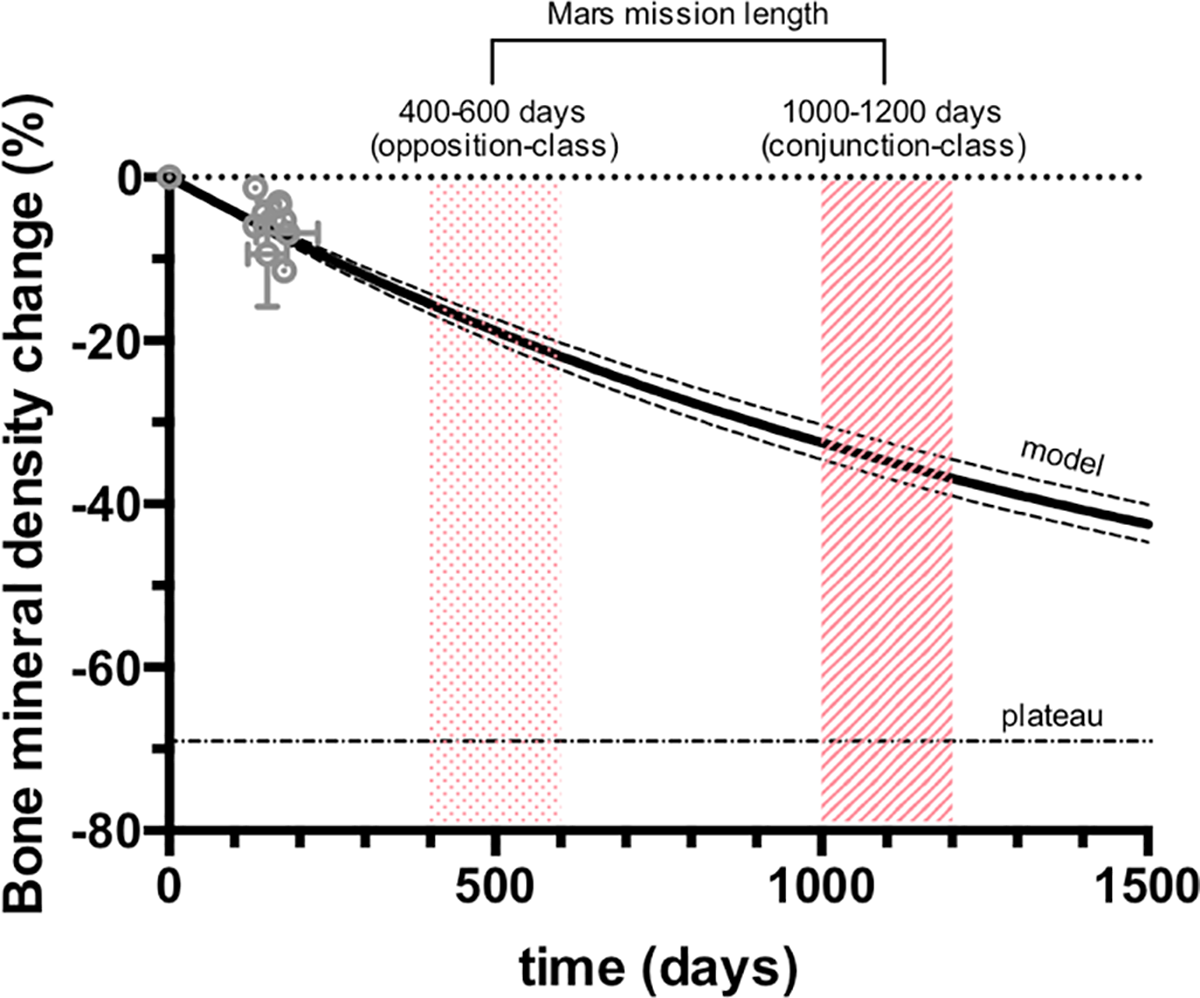
The study appeared in PLOS One in January 2020. Researchers from NASA Ames and Stanford assembled published femoral-neck bone mineral density measurements representing 69 astronauts after flights lasting between 132 and 228 days.
The femoral neck is the narrow region of bone joining the shaft of the femur to the head that fits into the hip socket. It normally bears load from standing and movement. In microgravity, that mechanical demand largely disappears, changing the balance between bone formation and resorption.
The flight data clustered within the first 228 days. The Mars predictions extended to 1,200 days. To bridge that enormous gap, the team fitted a one-phase exponential decay rather than multiplying a fixed monthly loss indefinitely.
A straight line would eventually predict less than zero bone density, a physically impossible result. The nonlinear model instead bent towards a plateau. The authors set that eventual plateau at a 69 per cent loss from preflight density, drawing on terrestrial evidence from prolonged bed rest and spinal-cord injury.
This is why the chart should not be mistaken for a record of three-year spaceflight. The grey points are observed short missions. Almost all of the curve that runs through the Mars windows is extrapolation.
“Roughly three years” refers to the longer orbital profile
The paper tested two broad mission classes. An opposition-class or short-stay profile lasted 400 to 600 days. A conjunction-class or long-stay profile lasted 1,000 to 1,200 days, roughly 2.7 to 3.3 years.
The shorter option sounds safer for a skeleton, but it is not simply a faster version of the same trip. It requires more demanding changes in velocity and therefore substantially more propellant. The longer profile uses more favourable Earth-Mars geometry and has generally been considered easier to execute with conventional propulsion.
For the opposition-class range, the model projected a 15.6 to 22 per cent reduction in femoral-neck density. For the conjunction-class range, the projected loss reached 32.4 to 36.8 per cent.
The authors then converted those estimates into T-scores for combinations of age, sex and ethnicity. They used average preflight bone densities from the US National Health and Nutrition Examination Survey, not the individual preflight scans of 69 named Mars candidates.
That methodological detail changes the meaning of the percentages. The “62 per cent” and “100 per cent” results describe the share of modelled demographic cases crossing thresholds under the study’s assumptions. They are not measured incidence rates and should not be read as the probability attached to a randomly selected future astronaut.
The two diagnostic words need careful handling
A T-score expresses how far a person’s measured bone density sits above or below a young-adult reference mean. In the categories used by the study, a score above -1 is normal, a score from -1 to -2.5 falls in the osteopenic range, and a score below -2.5 falls in the osteoporotic range.
Osteopenia and osteoporosis are not two diagnoses a person holds at once. Osteoporosis is the lower-density category. When the abstract predicted that 100 per cent of conjunction-class cases would develop osteopenia and 33 per cent would be at risk of osteoporosis, the clearest reading is that all reached at least the osteopenic range, while roughly one-third crossed the more severe threshold.
Even that does not translate directly into a fracture forecast. Bone mineral density is an important contributor to bone strength, but geometry, microarchitecture, accumulated microscopic damage and the load applied at a particular moment also matter.
NASA’s current bone-fracture risk description makes the same separation. A densitometric threshold borrowed from terrestrial medicine does not by itself state the chance that a younger astronaut will break a bone. Fracture risk depends on both skeletal fragility and the loads the crew encounters.
Those loads may be low while floating through interplanetary space, then change abruptly during landing, surface work or return to Earth. Mars supplies about 38 per cent of Earth’s surface gravity. It is enough to make falls, awkward suit movements and heavy equipment relevant, but no human dataset tells us whether living in that partial gravity for months would stabilise bone or allow continued loss.
The most alarming curve omitted today’s main defence
The paper is unusually direct about its limitations. Its astronaut data came from flights before the Advanced Resistive Exercise Device, or ARED, was introduced to the space station in 2009. It did not model exercise, diet, medication or other countermeasures. It also left out possible damage from prolonged deep-space radiation.
ARED can load the body through movements resembling squats, deadlifts, heel raises and other resistance exercises. Combined with adequate energy intake and vitamin D, it changed the bone response seen in later crews. A NASA technical summary reported that astronauts with access to ARED could return from station missions with bone mineral density close to preflight values, although bone turnover remained altered and mineral density alone could not prove that the remodeled bone had identical strength.
NASA’s more recent human-performance requirements now call for countermeasures to keep the femoral neck at or above 90 per cent of pre-mission density, and the total hip and spine at or above 95 per cent. The agency says most crewmembers on six-month missions return within those deficit limits.
That is better evidence than the older input data, but it does not erase the Mars problem. A six-month station mission is not a three-year expedition. The large ARED installation benefits from the space, structure, maintenance and logistics of the ISS. NASA notes that it cannot simply fit inside an exploration spacecraft, so smaller devices must reproduce enough loading with fewer resources.
No countermeasure package has been validated in humans for 1,000 to 1,200 days away from Earth. The 2020 paper was therefore right to say that mitigation during missions beyond one year remained untested, even though its unmitigated forecast should not be presented as what a well-protected modern crew will necessarily experience.
The model also simplified where gravity begins and ends
A round-trip Mars mission is not usually three uninterrupted years of microgravity. It contains an outbound cruise, time on the Martian surface and a return cruise. The balance depends on the trajectory.
The model used total mission duration as its time variable. It did not give Mars’s partial gravity a separate protective term. That is understandable because there are no human data from months at 0.38 g, but it means the forecast cannot tell us whether the surface stay would slow loss, produce a new equilibrium or be too weak to restore meaningful loading.
The assumed 69 per cent plateau also came from Earth analogues rather than astronauts observed until their loss levelled off. Spinal-cord injury and bed rest reproduce skeletal unloading in useful ways, but they are not Mars missions. Spaceflight changes fluids, muscles, radiation exposure, daily movement and many other conditions at the same time.
Individual variation in the source data was large. The model also used group-average reference bone densities to generate T-scores. A real flight surgeon would begin with an actual candidate’s scans, health history and response to training, not only their demographic category.
SpaceDaily recently examined why a nine-month outbound transit cannot be forecast by simple monthly multiplication. The same caution becomes more important over a full round trip. More time does not merely make the number bigger; it places more of the answer outside the duration of any human flight used to estimate it.
A warning model is useful when its assumptions remain visible
The headline’s percentages are real outputs of a peer-reviewed model. They are not direct observations, guarantees or current NASA forecasts for a named mission architecture.
The model asked what would happen if a nonlinear femoral-neck loss curve, fitted to 69 shorter-flight observations and informed by terrestrial unloading, continued across two candidate mission lengths. Under the longer profile, every demographic case fell below the normal T-score range and about one-third crossed the osteoporosis threshold.
Since then, current exercise and nutritional practice has supplied reasons for less pessimism. It has not supplied a three-year human dataset. Partial gravity, compact exercise hardware, deep-space radiation, autonomous medical care and the durability of bone quality remain open parts of the problem.
That makes the projection neither destiny nor a curiosity. It is a quantified description of what mission designers must prevent.
A crewed Mars vehicle will carry engines, shielding and life support. It will also need to carry enough mechanical loading, in some form, to persuade the human skeleton that it still lives in a world with weight.