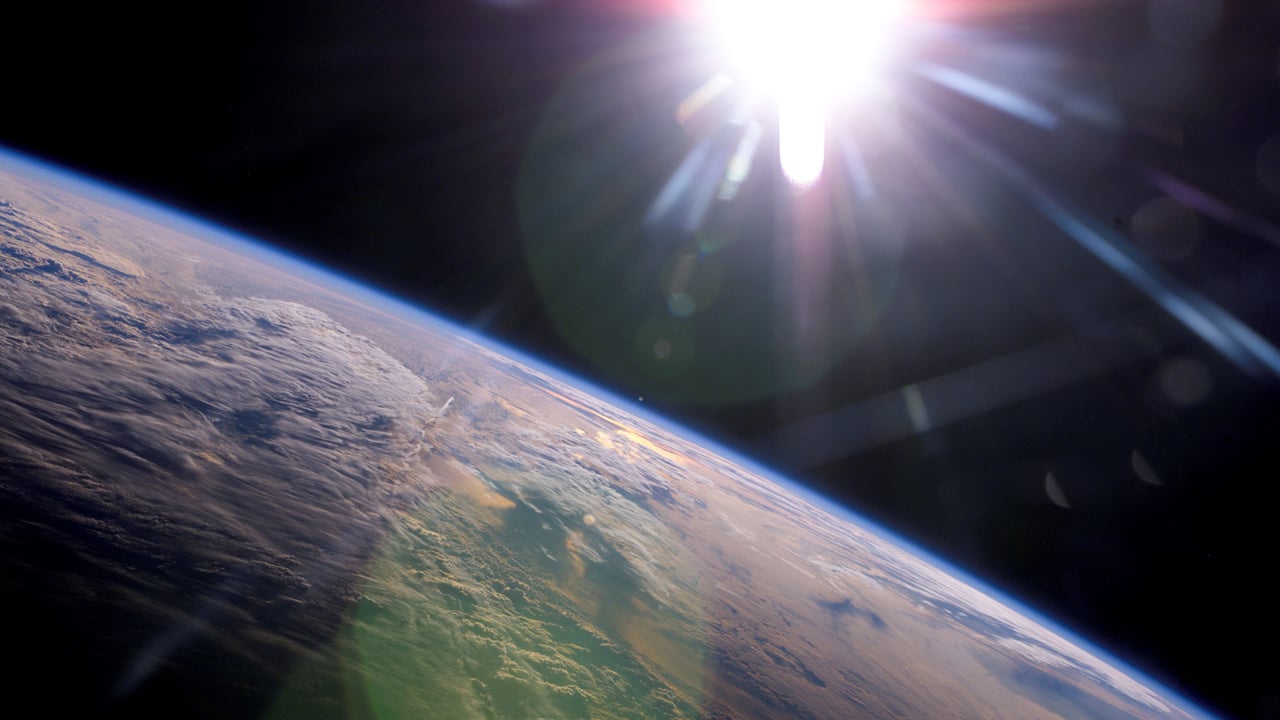
If the Sun could disappear in a physically impossible instant, Earth would not notice at once. The last sunlight already in flight would keep arriving. Only after those final photons crossed the Sun-Earth gap would the daylit side of our planet lose direct sunlight.
The familiar answer is eight minutes. A more precise average is eight minutes and 19 seconds. The sound comparison stretches the same distance into years: at 343 metres per second, a standard value for sound in air at 20°C, the journey would take about 13.82 years. Light in vacuum travels about 874,030 times faster.
This is a calculation, not a forecast or a physically possible solar event. Sound cannot travel from the Sun to Earth through the near-vacuum of interplanetary space. The thought experiment is useful because it places two very different propagation speeds across one astronomical distance, but the word if is doing nearly all the work.
Eight minutes is already a rounded figure
NASA’s basic guide to solar-system distances gives the mean Sun-Earth separation as roughly 149.6 million kilometres and its light-time as 8.3 minutes. Astronomers call that distance one astronomical unit, or 1 au. The formal length is 149,597,870,700 metres.
The speed of light in vacuum is exactly 299,792,458 metres per second. Dividing the astronomical unit by that speed gives 499.0048 seconds, or eight minutes and 19.0048 seconds. The neat eight-minute line in the headline is therefore shorthand rather than an exact arrival time.
Earth’s orbit is also slightly elliptical. The real separation varies over a year, so one-way light-time ranges by several seconds around the average. If the imaginary disappearance occurred near perihelion, the signal would arrive a little sooner than it would near aphelion. Nothing in the thought experiment needs millisecond precision; the average exposes the scale.
How eight minutes becomes 13.82 years
Now replace light speed with 343 metres per second. The NOAA educational table for sound in air gives that value at 20°C. Dividing 149,597,870,700 metres by 343 metres per second produces 436,145,396 seconds.
That is a little more than 5,048 days, or 13.82 years using a 365.25-day year. The second number in the headline follows from another division: 299,792,458 divided by 343 equals 874,030.49. Rounded to three significant figures, light is 874,000 times faster.
I think the arithmetic is most useful when its assumptions stay visible. The speed of sound is not a universal constant. It changes with the material and, in a gas, with conditions including temperature. At 0°C, a common value is about 331 metres per second, which would lengthen the imaginary trip to roughly 14.3 years. The headline’s nearly 14 years belongs specifically to the 343-metre-per-second convention.
The word if carries the whole premise
Sound is a mechanical wave. It moves when a disturbance makes particles push on neighbouring particles, transferring energy through a solid, liquid, gas or plasma. Light is electromagnetic radiation. As NASA’s explanation of mechanical and electromagnetic waves puts it, light can cross a vacuum but sound requires a medium.
Interplanetary space is not mathematically empty. It contains solar-wind plasma, dust and sparse neutral particles. But it is nothing like a continuous column of ordinary air. The particles near Earth’s orbit are too thinly spread to transmit an everyday acoustic wave from the Sun to a human ear.
Imagining room-temperature air filling one astronomical unit creates problems far larger than the travel time. That much gas would have mass and gravity, it would be heated and ionised, and it would not remain stationary or uniform. A pressure wave would spread, refract and lose energy. The 13.82-year result freezes all of that physics and asks only how long a marker moving at 343 metres per second would need to cross the distance.
The Sun really does ring
Calling the final signal a roar is not wholly arbitrary. The Sun contains real pressure waves. Convection near its visible surface continually excites oscillations that travel through the solar interior and return to the surface.
The NASA and ESA Solar and Heliospheric Observatory describes solar sound waves with periods near five minutes. Only particular combinations of period and horizontal wavelength resonate. Their pattern carries information about the otherwise hidden structure, composition and motion inside the Sun.
Helioseismologists do not place a microphone in interplanetary space. Instruments measure tiny Doppler shifts, surface velocities and brightness changes encoded in sunlight. Researchers can then translate those data into audible frequencies by speeding them up or shifting pitch. The result is sonification, not a recording of pressure waves that crossed the vacuum.
The prominent five-minute oscillations correspond to only a few thousandths of a cycle per second, far below the lower edge of human hearing. Even beside a hypothetical medium, the word roar would still hide questions about frequency, amplitude and how a listener or instrument responded.
What would happen after the last light arrived
For about 499 seconds, the visible Sun would look unchanged because every photon reaching us had already left before the imaginary event. When the final direct light arrived, the bright daytime sky would collapse with it. Earth would not become absolutely black: stars, artificial lights and delayed reflected light would remain. But the source of daylight and almost all incoming surface energy would be gone.
The comparison also separates light from matter. Solar-wind particles travel far slower than light, commonly taking days to cross the same gap. Spacecraft would continue encountering particles already on their way even after the last sunlight had arrived. A vanishing Sun cannot happen, so there is no complete physical sequence to model, but different messengers would not all stop together.
This delay is not peculiar to the Sun. SpaceDaily’s earlier look at signal time between Earth and Titan showed the same rule at a larger and changing distance. Space missions operate on old information because even radio, another form of light, cannot arrive instantaneously.
Gravity would share the light delay
A common follow-up asks whether Earth would leave its orbit immediately. In Newton’s simplified picture, gravity appears to act instantaneously. General relativity does not permit information about a changed gravitational field to propagate infinitely fast.
NASA’s physics explanation notes that changes in gravity propagate at the speed of light. Under the impossible premise, Earth would continue responding to the Sun’s old gravitational field for about the same eight minutes and 19 seconds. The change in light and the change in gravity would arrive together.
After that, Earth would no longer have the Sun curving its path into an orbit. It would move approximately along a tangent to its former orbit, with smaller perturbations from the remaining planets and other bodies. This is still only a way of exploring relativity. A star cannot simply vanish without a physical mechanism, conservation laws and an account of where its mass-energy went.
A roar is a metaphor, not a volume estimate
The travel-time calculation says nothing about loudness. A sound level requires a pressure amplitude at the listener, while the journey would depend on geometry, absorption, scattering and the properties of the medium. None of those variables appears in the division that produces 13.82 years.
It also does not mean Earth would hear one continuous note from the instant the Sun disappeared. In the invented system, Earth would keep receiving the acoustic past already spread along the route. The last wavefront emitted before the disappearance would arrive at the end of the 13.82-year delay. What that signal contained would depend on the hypothetical source and medium.
The word roar gives the number a human scale, but it should not be mistaken for a measurement. We have measured solar oscillations through their effects on light. We have not measured the volume of a Sun heard across ordinary air extending to Earth.
Why the comparison works anyway
The everyday version is lightning and thunder. Both begin at nearly the same time, but the flash arrives first because light crosses the atmosphere so much faster than sound. Stretch that contrast from a storm cloud to one astronomical unit and a delay of seconds becomes a delay of years.
That is the useful part of the thought experiment. It turns a speed ratio into waiting time. We see the Sun’s past by a little over eight minutes. Under invented acoustic rules, we would hear its past by nearly 14 years.
The real solar system supplies only the first delay. The second is arithmetic laid across a vacuum that refuses to carry the wave.