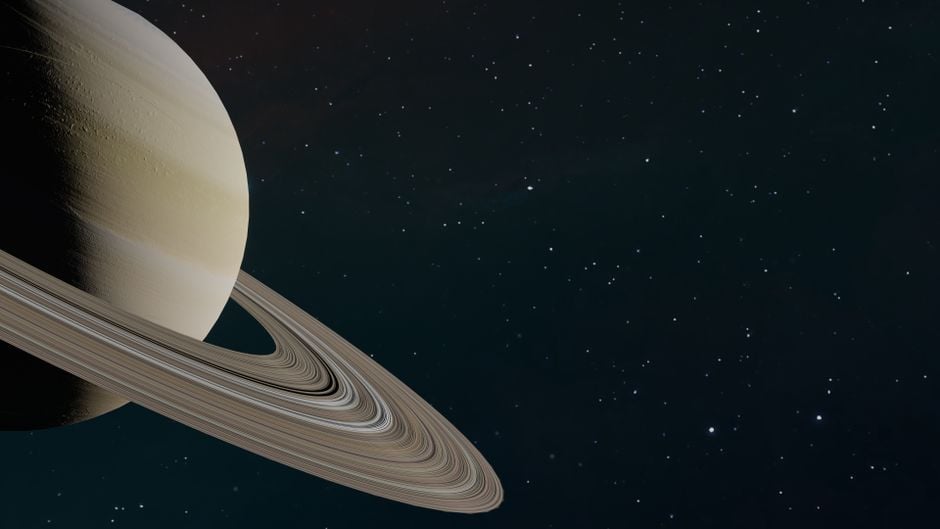
Titan is never quite the same distance away twice. Depending on where Earth and Saturn happen to be in their orbits when you ask, the gap between us and Saturn’s largest moon runs from around 1.2 billion kilometres at its closest to about 1.65 billion at its farthest, a swing of roughly 450 million kilometres, which is about three times the distance between Earth and the Sun.
I find that harder to picture than the number itself suggests. Titan isn’t moving around wildly. It’s Earth and Saturn doing the moving, at very different speeds, and the distance between us is just the arithmetic left over.
Why the distance keeps changing
Titan orbits Saturn at an average of about 1.2 million kilometres, which sounds like a lot until you compare it with the distance from Saturn to us. Saturn itself sits an average of roughly 1.4 billion kilometres from the Sun, or about 9.5 times Earth’s own distance from the Sun. Titan’s own orbit around Saturn barely registers against numbers that size. For working out how far away Titan is from Earth, you can more or less treat it as if it were Saturn.
The actual variation comes from timing. Earth completes a lap of the Sun every year. Saturn takes almost 29 and a half years to do the same. Because the two planets move at such different rates, they’re constantly sliding in and out of alignment. When Earth and Saturn are on the same side of the Sun, the distance between us shrinks to somewhere around 1.2 billion kilometres, roughly 8 times the Earth-Sun distance. When they’re on opposite sides, it stretches to about 1.65 billion kilometres, or 11 times that distance. Neither planet is doing anything unusual. They’re just far enough apart, and moving at different enough speeds, that the gap between them never settles.
There’s a second, smaller effect stacked on top of that one. Saturn’s own path around the Sun isn’t a perfect circle. Its orbit is slightly elliptical, swinging Saturn itself from about 1.35 billion kilometres from the Sun at its closest to roughly 1.51 billion kilometres at its farthest, a difference of some 160 million kilometres over the course of its 29 year orbit. That means the timing of a close approach matters too. The best possible alignment, Earth and Saturn on the same side of the Sun while Saturn happens to be near its own closest point, and the worst, opposite sides with Saturn out near its far point, aren’t quite mirror images of each other.
What that does to a signal
Distance in space is really a statement about time, since nothing, not even a radio signal, gets to skip that part. At Titan’s closest approach to Earth, a signal travelling at the speed of light takes a little over an hour to make the one-way trip. At its farthest, that stretches past ninety minutes. Mission controllers talking to a spacecraft near Titan aren’t just dealing with a long wait. They’re dealing with a wait that changes depending on the calendar.
There’s a separate, easily confused number worth keeping straight. Sunlight itself takes about 80 minutes to reach Titan, because that figure is based only on the distance from the Sun to Saturn, roughly 9.5 times the distance from the Sun to us. It’s a related idea but not the same measurement, and mixing the two up is an easy way to end up with a number that sounds right but answers the wrong question.
Getting there takes longer than hearing from it
A signal is one thing. An actual spacecraft is another, and it takes considerably longer to arrive than its own transmissions do once it’s there. Part of the reason is that most spacecraft can’t fly straight there. Cassini launched in October 1997 and didn’t reach Saturn until the middle of 2004, a cruise of nearly seven years, and most of that time went into a looping path rather than a direct one: two flybys of Venus, one of Earth, and one of Jupiter, each used to steal a bit of gravitational momentum before the final approach. Only after all that did Cassini release the Huygens probe for its own three week coast down to a landing on Titan’s surface in January 2005.
The next spacecraft bound for Titan is on a similar timetable, though not for the same reason. Dragonfly, the nuclear powered rotorcraft I wrote about when NASA confirmed the mission a few days ago, is set to launch in July 2028 and isn’t expected to touch down on Titan until 2034, a six year journey. NASA shortened that cruise by choosing a more powerful launch vehicle, one capable of sending Dragonfly on a more direct trajectory instead of stringing together the kind of gravity assist detours Cassini needed. Even with that shortcut, getting a machine to Titan still takes about as long as most people spend in primary school.
What I’d keep in mind
None of this makes Titan more or less reachable than it already was. It just means that “how far away is Titan” doesn’t have one answer, and the honest version of the answer changes depending on the date you ask it. Dragonfly is still two years from leaving Earth and eight from landing, which gives plenty of time to get used to a simple fact that’s easy to forget between headlines: distance out here is rarely a fixed number, it’s a moving target that happens to hold still long enough for us to launch something at it.