
For a long time, the most visible changes to astronauts in orbit were the obvious ones. Faces looked puffy. Legs looked thinner. Astronauts floated, lost bone and muscle, and returned to Earth needing time to regain balance. Then flight surgeons began paying closer attention to a quieter problem: some astronauts were coming home with changed eyes.
The condition is now generally discussed as spaceflight associated neuro-ocular syndrome, or SANS. It is not simply tired eyes after months of screens and checklists. In long-duration flyers, doctors have documented changes such as swelling around the optic disc, folds in the choroid, shifts toward farsightedness and flattening at the back of the globe. A landmark 2011 Ophthalmology paper helped pull those findings together after examining astronauts who had spent long periods in space.
The leading explanation starts with gravity, or rather with its absence. On Earth, gravity helps pull blood and other fluids toward the lower body. In orbit, that downward gradient disappears. Fluids redistribute upward toward the chest, neck and head. The rounder face of an astronaut in microgravity is the visible part of that shift. The less visible question is what happens behind the eyes.
A headward shift with eye-level consequences
Inside the skull and orbit, pressure relationships are finely balanced. The eye is not a rigid marble. It is a living structure surrounded by tissues, vessels, nerves and fluid spaces. If the environment around the optic nerve and the back of the eye changes for weeks or months, small anatomical shifts can matter.
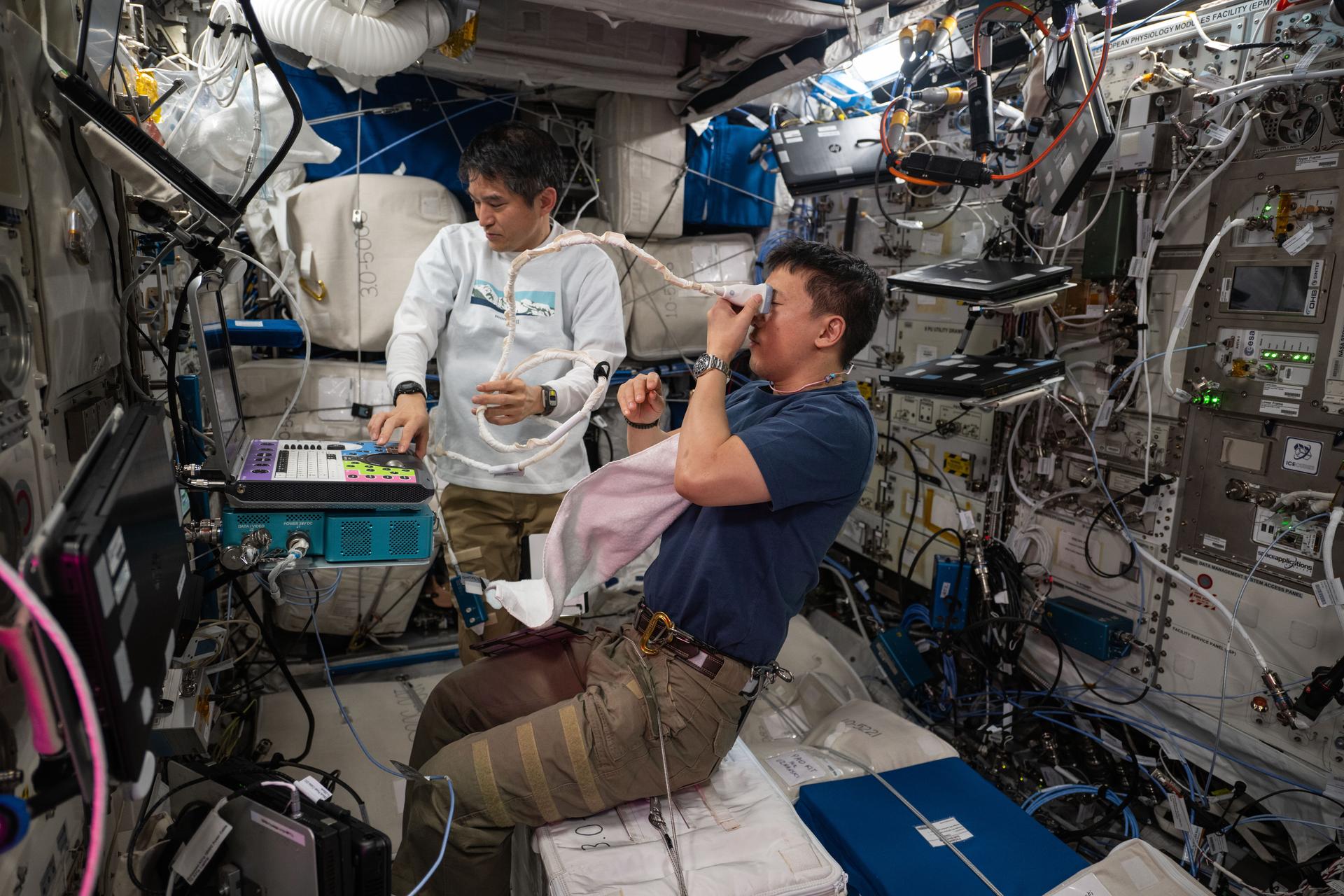
NASA now monitors crew eye health in orbit with tools such as ultrasound and optical coherence tomography. A 2025 NASA image of NASA astronaut Jonny Kim receiving an eye ultrasound on the International Space Station notes plainly that spaceflight can change eye structure and vision, and that scientists monitor astronauts throughout their missions for SANS.
That monitoring exists because the symptoms are operationally important. An astronaut may notice that near vision has changed, that reading glasses suddenly work differently, or that vision has become subtly blurred. In a spacecraft, where labels, displays, procedures and emergency cues all matter, even modest visual changes are more than a medical curiosity.
The back of the eye can flatten
The phrase “flattening the back of the eye” sounds dramatic, but it describes a specific anatomical observation. Imaging has shown posterior globe flattening in some astronauts after long-duration missions. In simple terms, the rounded rear wall of the eye can appear less curved than it did before flight.
That matters because eye shape helps determine focus. A small change in the geometry of the globe can shift where light lands relative to the retina. The result can be a hyperopic shift, meaning the eye becomes more farsighted. In everyday language, the astronaut’s visual prescription can change.
Magnetic resonance imaging added another layer to the story. In a 2012 Radiology study, researchers reported orbital and intracranial findings in astronauts after spaceflight, including globe flattening and changes around the optic nerve. Those findings helped move the issue beyond subjective complaints and into measurable anatomy.
It is not a simple pressure story
At first, many researchers suspected that the main culprit was elevated intracranial pressure, because similar eye findings on Earth can occur when pressure inside the skull is too high. That idea is still part of the discussion, but the spaceflight picture has become more complicated.
One reason is that microgravity removes the normal pressure gradient from head to foot. The relationship between pressure inside the eye, pressure around the optic nerve and pressure in the skull may change even if no single measurement looks extreme. A 2017 Journal of Physiology study found that intracranial pressure during acute microgravity was not simply a runaway high-pressure state, which is one reason researchers now talk about altered fluid dynamics rather than one neat cause.
Other suspected contributors include carbon dioxide levels, individual anatomy, vascular congestion, genetics, nutrition and how long a person spends in microgravity. SANS is therefore less like a single injury and more like a syndrome, a cluster of findings that may arise from several interacting stresses.
Some changes linger after landing
The reassuring part is that many astronaut body changes improve after return to Earth. Balance recovers. Fluid distribution changes again. Muscles rebuild. Some visual findings also improve. The troubling part is that recovery is not always complete, at least not quickly.
That is why the last words of the title matter. In a 2020 Neuro-Ophthalmology paper on persistent globe flattening, researchers described posterior globe flattening that could remain after long-duration spaceflight. The finding does not mean astronauts are routinely blinded by space. It means some structural effects can outlast the mission and deserve careful follow-up.
This persistence is especially important for future exploration. A six-month stay on the International Space Station is one thing. A Mars mission could involve far longer exposure to microgravity or partial gravity, with fewer chances for rapid medical evacuation and less real-time support from Earth.
Why future missions need better countermeasures
Researchers have tested or proposed several countermeasures. One approach is lower body negative pressure, which gently draws fluid toward the legs and tries to recreate part of the gravitational pull that is missing in orbit. Other work focuses on exercise, suit design, spacecraft atmosphere, nutrition and better in-flight eye diagnostics.
The difficulty is that the eye may be responding to a whole-body change. Microgravity affects circulation, cerebrospinal fluid, vascular tone, tissue loading and the normal division between “up” and “down” inside the body. A countermeasure that helps one pathway may not solve the whole syndrome.
That is why the ISS has become a medical observatory as well as an engineering platform. Astronauts do not just perform experiments on plants, fluids and combustion. Their own bodies become part of the research program, monitored before, during and after flight to understand what space does to human physiology.
The eye remembers gravity
SANS is unsettling because it shows how deeply Earth-normal the human body is. The eye evolved in a world where gravity constantly shaped blood flow, fluid pressure and posture. Remove that background force, and even a structure as familiar as the eyeball can begin to behave differently.
The lesson is not that humans cannot live in space. It is that long-duration spaceflight is not just transportation. It is a biological experiment in which every organ is being asked to operate outside the assumptions under which it developed.
Blurred vision may sound minor beside radiation, launch risk or the isolation of deep-space travel. But the eye is also a warning system. When the back of the eye flattens in orbit, it is telling mission planners that microgravity reaches into places a spacesuit cannot protect, and that the path to Mars will require medicine as much as rockets.