

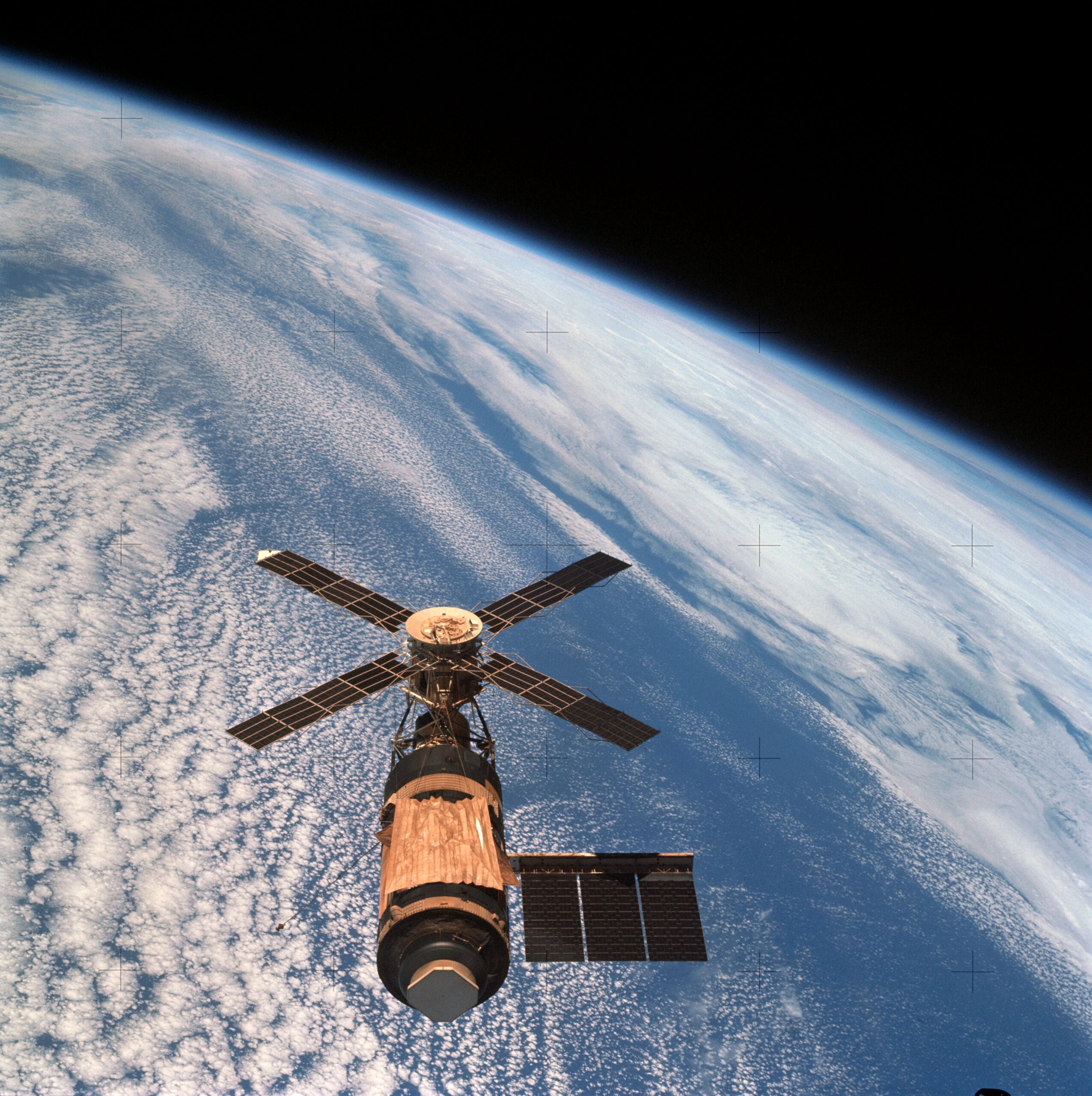
Skylab began as one of the most ambitious machines the United States had ever placed in orbit and ended as a trail of metal scattered across Western Australia.
Between those two moments, America’s first space station hosted nine astronauts, established three successive endurance records and showed that people could live and conduct serious science in orbit for months at a time. It then spent more than five years empty, circling Earth as engineers tried to preserve options for a future rescue that never came.
When the 77-tonne station finally re-entered on 11 July 1979, large pieces survived. Some went into museums, some entered private collections and some acquired an unexpected second life on the Australian landscape.
America’s first space station nearly failed at launch
NASA records Skylab’s launch on 14 May 1973, but the station was in serious trouble almost immediately. Aerodynamic forces tore away its micrometeoroid shield during ascent, taking one main solar array with it and jamming the other. With electrical power limited and the workshop exposed to direct sunlight, temperatures inside climbed to dangerous levels.
The first three-man crew launched 11 days later with repair equipment. The astronauts deployed a parasol-like sunshade through a scientific airlock, freed the surviving solar wing during a spacewalk and made the overheated laboratory habitable. That improvised rescue transformed what could have been an expensive orbital failure into a working station.
Nine astronauts turned it into a laboratory
Three crews of three lived aboard Skylab for 28, 59 and 84 days. The missions lasted a combined 171 days and each set a new American endurance record. The final crew’s 84-day stay remained the longest human spaceflight until a Soviet Salyut 6 expedition surpassed it in 1978.
Skylab was far more than a test of stamina. Its Apollo Telescope Mount observed the Sun in wavelengths largely blocked by Earth’s atmosphere, while astronauts studied Earth, materials and the effects of weightlessness on the human body. NASA’s mission archive describes a programme that returned about 175,000 solar images along with tens of thousands of Earth photographs.
The station also taught operational lessons that later became routine: how to schedule work during long missions, maintain a complex home in orbit and adapt when a crew’s workload became unrealistic. Skylab demonstrated that an orbital station could be both a residence and a productive scientific institution.
The $2.2 billion figure needs context
Skylab is commonly described as a $2.2 billion programme, a figure generally attached to spending from 1966 through 1974 and expressed in the dollars of that era. It was an enormous investment, although NASA reduced costs by converting an existing Saturn V third stage into the station’s orbital workshop and reusing Apollo-era spacecraft and launch hardware.
Historical totals are not perfectly uniform because accounts use different dates and programme boundaries. A NASA Kennedy Space Center history gives a total of $2.6 billion. The familiar $2.2 billion figure is therefore best treated as an approximate contemporary cost, not a single universally agreed final bill.
What that spending bought was a habitable laboratory with more internal volume than an Apollo capsule could approach, three successful expeditions and a foundation for later American work on Shuttle-Mir and the International Space Station.
Skylab circled Earth for more than six years
The final astronauts departed on 8 February 1974, leaving Skylab in a higher orbit with supplies and systems that might support another crew. NASA hoped the developing Space Shuttle could eventually boost or revisit it, but the Shuttle was delayed and unexpectedly strong solar activity heated Earth’s upper atmosphere, increasing drag on the station.
Skylab could not raise its own orbit. Controllers adjusted its attitude in an effort to influence where it would fall, but they could not direct it with precision. After six years and almost two months in space, the station broke apart during re-entry. Much of it fell into the Indian Ocean, but debris also crossed a long stretch of sparsely populated Western Australia, including the region around Esperance.
No one was injured. The descent nevertheless became a global media event, and residents quickly began finding tanks, structural pieces and fragments of insulation across the landscape.
The wreckage acquired a second life
Skylab’s end produced an unusual bridge between space history and local history. The Esperance Museum preserves a substantial collection of recovered debris, while other identified pieces entered institutional and private collections. Small fragments have also appeared as memorabilia, including material mounted inside clear Lucite display blocks.
One recovered object had a more practical afterlife. A circular lid from an oxygen tank landed curved side upward on a property and collected rainwater. According to the Powerhouse Collection’s documented history of the fragment, cattle and native animals used it as a drinking bowl. The object was not converted into a conventional cattle trough, but it effectively performed the same humble task for years.
That contrast is part of Skylab’s enduring appeal. A machine built for billions of dollars carried astronauts, solar telescopes and medical experiments around Earth, then returned as museum exhibits, collectors’ keepsakes and a rain-catching bowl in a paddock. Its scientific legacy helped shape every long-duration American space station that followed, while its surviving metal made the end of the space age’s first American outpost unexpectedly tangible.