
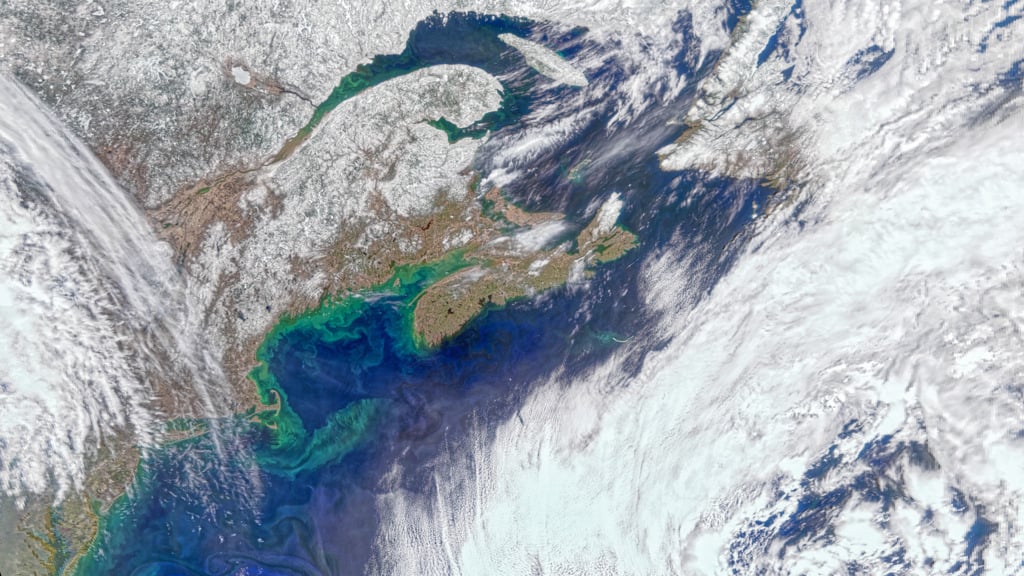
Earth’s climate did not simply drift from the greenhouse warmth of the early Cenozoic into the cooler, ice-bearing world of today. Atmospheric carbon dioxide fell substantially, polar ice expanded and sea level changed, while the ocean repeatedly adjusted how much carbon it buried in sediment.
A 2026 study proposes that those changes were connected by a feedback hidden in shallow seas. When sea level was extremely high, flooded continental shelves trapped phosphate efficiently. That deprived much of the ocean of a nutrient essential to life, reduced biological production and weakened the burial of organic carbon. More carbon dioxide was then able to remain in the ocean-atmosphere system.
As seas fell, the phosphate trap became smaller. More of the nutrient reached open water, marine productivity increased and additional organic carbon could be buried. But this was not a simple switch in which lower sea level always produced more burial. The researchers found an intermediate sweet spot where oxygen-poor water met carbon-rich shelf sediments and recycled phosphate most effectively.
That wrinkle is crucial. What the team describes as a thermostat was really a self-limiting system of shelves, nutrients, oxygen and sediment, operating over millions of years rather than holding Earth at one fixed temperature.
The evidence comes from three geological records
The study in Proceedings of the National Academy of Sciences was led by Rosalind Rickaby at the University of Oxford with Thomas Wood, Zunli Lu and Christian Bjerrum. It reconstructed changes across roughly the last 60 million years, spanning most of the Cenozoic era.
The researchers combined three kinds of evidence. Carbon-isotope records allowed them to estimate the proportion of total carbon buried as organic matter rather than calcium carbonate. Accumulation of phosphorus in deep-sea sediments offered a record of how efficiently the nutrient was being removed. Iodine-to-calcium ratios measured in fossil foraminifera served as a proxy for oxygen conditions in ancient seawater.
Each record has limits, but together they provided a way to compare organic carbon burial, phosphate availability and ocean oxygenation through time. An Oxford publication record summarizes the central result: organic carbon burial was suppressed during the Eocene hothouse, when the water column was relatively oxygenated and phosphate was scarce.
The study does not claim this mechanism was the only reason the planet cooled. Volcanic outgassing, rock weathering, tectonics, ocean circulation and other processes all shaped Cenozoic climate. The authors’ narrower argument is that burial of organic carbon in marine sediment probably carried more of the load than researchers had appreciated.
Why a small amount of buried plankton matters
Phosphate is a biologically available form of phosphorus, an element every cell needs. In the ocean it can limit how much new organic matter plankton produce. Give the sunlit ocean more phosphate, under suitable conditions, and photosynthetic organisms can convert more dissolved inorganic carbon into living tissue.
Most of that organic carbon does not stay buried. It is eaten, respired or decomposed, returning carbon dioxide to the water and eventually the atmosphere. Only a small share sinks far enough and survives long enough to enter sediment. Yet over millions of years that small imbalance can change the amount of carbon left in the active ocean-atmosphere system.
Phosphorus decides part of that balance, but it is not a simple tap. The recent review of the global phosphorus cycle describes how burial depends on sedimentation rate, biological activity, mineral reactions, temperature and oxygen. The new study adds the changing area and depth of continental shelves to that network.
How high seas could starve a warm ocean
During the Eocene, roughly 56 to 34 million years ago, Earth was much warmer and sea level was far above the modern shoreline. Large parts of the continents were flooded by shallow seas. These shelves received sediment quickly, making them unusually effective places to bury both organic matter and reactive phosphorus.
That efficiency produced a counterintuitive result. A wide ocean shelf could trap phosphate near the coast before the nutrient circulated through the broader ocean. With less phosphate available, open-ocean productivity fell. Less organic matter was produced, less carbon reached sediment, and the total carbon sink weakened.
The team reconstructed an extended depression in the fraction of carbon buried organically during the hothouse interval. The University of Oxford’s account of the research says this offers a potential answer to a longstanding question: where some of the carbon dioxide associated with the former greenhouse world went as Earth cooled.
“Allowed carbon dioxide to rise” should be understood as a proposed imbalance, not a measurement of one isolated cause. If sediment removed carbon more slowly than weathering, volcanism and other sources supplied it, carbon could accumulate in the ocean and atmosphere. The study infers that relationship from proxies and mass balance rather than reading ancient atmospheric carbon directly from these sediments.
Falling seas released the phosphate brake
As climate cooled and sea level declined, the flooded shelf area contracted. The zone of fast sediment accumulation shifted downslope and occupied less space, so a greater proportion of phosphate escaped burial and remained available in seawater.
That extra nutrient supported more marine productivity. When the resulting organic matter sank and decomposed, microbes consumed dissolved oxygen. Oxygen-minimum zones expanded through the water column. Where those low-oxygen waters came into contact with organic-rich shelf mud, iron minerals could release bound phosphate back into the water.
The released nutrient fed further productivity and, ultimately, more organic carbon burial. In that state, the system reinforced the removal of carbon dioxide and the development of cooler conditions. SpaceDaily has previously reported how phosphorus recycling from marine sediment can reshape the balance between ocean oxygen and biological production.
The oxygen result can seem backwards. Warm Eocene oceans in this reconstruction were comparatively well oxygenated because phosphate starvation limited the organic matter available for respiration. Cooler later oceans could develop stronger low-oxygen zones because more biological material was being produced and decomposed. Temperature still affects how much oxygen seawater can hold, but nutrient supply and respiratory demand add another control.
The strongest burial occurred in a narrow window
The feedback did not strengthen indefinitely as the shoreline retreated. The authors estimated a sea-level sweet spot roughly 20 to 40 metres above the modern level. There, oxygen-minimum zones with oxygen concentrations below about 90 micromoles per kilogram could overlap the carbon-rich continental shelf. Phosphate was recycled and elevated carbon burial could persist for more than a million years.
At still lower sea level, the top of an oxygen-minimum zone could sit deeper than the shelf break. It would lose contact with the sediments most capable of releasing phosphate, weakening the recycling loop. Carbon burial was therefore lower at both extremes, with the maximum in between.
This non-linear result gives the “thermostat” its meaning. Cooling and falling seas could initially increase nutrient availability and carbon burial, but continued retreat eventually separated the low-oxygen water from the shelf. The brake returned before the mechanism could keep accelerating toward global ice cover.
The idea has a history. Christian Bjerrum and colleagues used an ocean chemistry model in 2006 to predict that sea level could control phosphate inventories, productivity and organic carbon burial. The 2026 paper argues that carbon isotopes, phosphorus accumulation and oxygen proxies now show the predicted relationship in the geological record.
A deep-time regulator is not a modern escape route
The study describes changes unfolding over hundreds of thousands to millions of years. It offers no natural mechanism capable of cancelling the present surge in atmospheric carbon dioxide on a human timescale. NASA’s summary of climate evidence attributes the current warming trend to human activity and notes that it is proceeding at a rate not seen over many recent millennia.
There are also uncertainties inside the reconstruction. Carbon-isotope mass balance requires assumptions about the isotopic composition of inputs and the carbonate sink. Sediment records are geographically incomplete. The estimated total carbon flux is qualitative because ancient burial in the Indian and Pacific oceans is less comprehensively constrained than in the Atlantic.
For those reasons, the paper presents a mechanism supported by converging proxies, not a complete ledger for every carbon atom lost from the Cenozoic atmosphere. Even the word “thermostat” should be handled humbly. The feedback did not prevent large climate swings, and parts of it amplified cooling before becoming self-limiting.
What it offers is a richer picture of how a habitable planet regulates itself. Coastlines moved, shelf mud captured nutrients, plankton changed the oxygen demand of entire water masses, and a fraction of dead life carried carbon into the geological reservoir. None of those steps looks like a thermostat alone. Together, over 60 million years, they may have behaved like one.
