
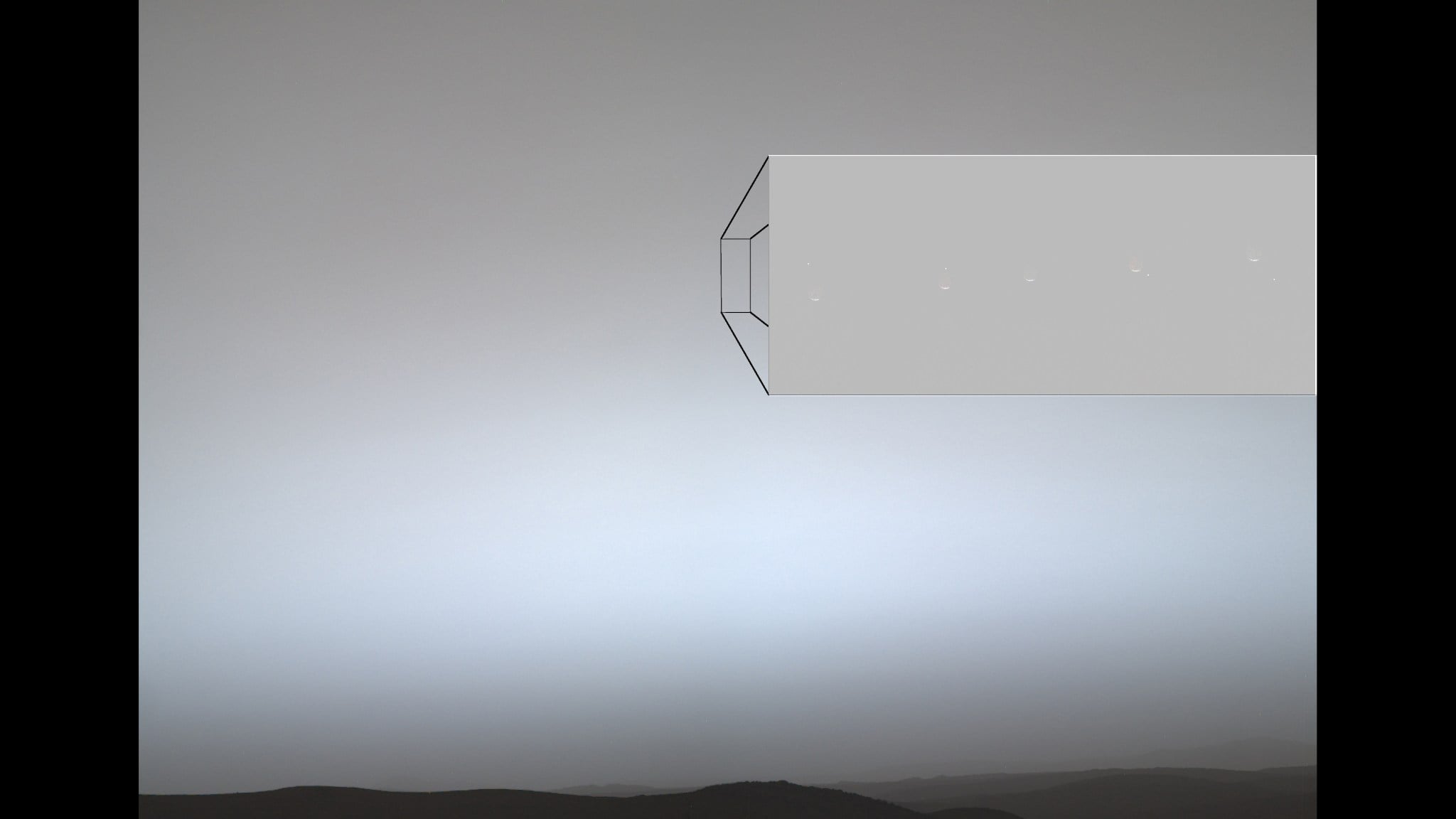
From the western rim of Jezero Crater, Earth was not a blue world on 2 July 2026. It was a single bright pixel, 314 million kilometres away, moving across the evening sky of Mars. A thin crescent of Phobos approached from the other direction. Then, for a few moments in an image sequence made by NASA’s Perseverance rover, the pixel was gone.
NASA describes this as the first observation made from the surface of another planet in which Earth was seen disappearing behind an object. The historical claim is real, but it is narrower than saying that no off-world camera had ever watched Earth become hidden. The Moon and orbiting spacecraft have supplied other forms of Earthset and occultation imagery. What happened at Mars was the first from a camera standing on another planet.
There is another important qualification. The published result is an annotated composite assembled from still images, not one exposure and not a continuous movie. That does not make the event less remarkable. It tells us exactly what Perseverance’s camera recorded and how NASA made an extremely small alignment visible to human eyes.
Nine frames from the Martian evening
Perseverance made the observation near 7 p.m. local solar time on mission sol 1,907. Its Mastcam-Z instrument took nine images while Earth moved from upper left to lower right and Phobos travelled from lower left to upper right. In the third frame, the bright point of Earth winked out behind the moon’s shadowed edge before appearing again.
The official NASA Photojournal record shows both the broad landscape and enlarged versions of the event. In the landscape, the alignment occupies a tiny outlined square above the Martian horizon. The inset combines several exposures from that patch of sky and raises the contrast so that a reader can follow two objects that would otherwise be almost impossible to distinguish.
NASA and the Mastcam-Z team were therefore not presenting an unbroken film. They were reconstructing a real passage from a timed sequence. The complete annotated series spans roughly 40 seconds, and its order is unambiguous: Earth approaches Phobos, disappears behind it and returns on the other side.
This was an occultation
The technical term for the event is an occultation. An apparently larger foreground body completely hides a more distant background body. Nothing physically happened to Earth, and Phobos did not cast a shadow across our planet. From Perseverance’s particular location, the moon simply occupied the same line of sight and covered Earth’s one-pixel image.
That differs from a transit, in which a foreground object appears smaller and crosses the visible face of a background object without covering it completely. It also differs from an eclipse caused by one body entering another’s shadow. In ordinary reporting these terms often blur together, but the geometry here is especially clear because Earth vanished entirely from the rover’s view.
Mars rovers have used Phobos for other alignments. In 2022, Perseverance recorded Phobos moving across the Sun. The irregular moon covered only part of the solar disc, so its lumpy outline remained visible. The July 2026 sequence reversed the scale relationship: tiny, distant Earth was fully concealed by the much closer moon.
A frequent moon and an uncommon alignment
Phobos is small, measuring roughly 27 kilometres across at its widest, but it travels only about 6,000 kilometres above the Martian surface. Its nearness makes it appear about one-third as wide as Earth’s Moon appears in our sky. Earth, meanwhile, was more than 300 million kilometres from the rover and registered as a single pixel.
According to NASA’s account released on 5 August, Phobos crosses the Martian sky three times each day, while Earth can remain visible for months at a time. Those facts make the meeting sound inevitable. It was not. The rover, the moon and Earth had to align within an exceptionally narrow angle, the observation had to occur while the objects were visible, and the cameras had to be pointed at the right patch of sky.
Mark Lemmon, a Mastcam-Z scientist at the Space Science Institute, said the observation required both planning and luck. Orbital calculations supplied the predicted geometry, but the small apparent size of Earth and the moon’s irregular outline left little margin. The result was possible because a camera designed for geological work can also make carefully timed astronomical observations.
What “the first time” means here
The wording matters. Cameras beyond Earth have photographed our planet for decades. Lunar missions have seen Earth approach or pass behind the Moon’s horizon. Spacecraft have recorded Earth and the Moon together from deep space. Mars rovers have also photographed Earth as a point of light, and Curiosity imaged Earth setting in 2024 while Phobos rose nearby.
None of those is the same category as an instrument resting on another planet and recording Earth being completely covered by a separate object in that planet’s sky. NASA’s claim is specifically that this is the first time humanity has captured such an observation “from the surface of another planet”. The phrase excludes cameras in orbit and cameras on the Moon, which is Earth’s satellite rather than a planet.
That boundary prevents an appealing image from turning into an inflated claim. Perseverance did not take the first distant portrait of Earth, nor the first image of Earth disappearing from any location beyond our world. It added a new viewing position to that history: the surface of Mars, with a Martian moon passing in front.
Why Phobos crosses the sky backwards
Phobos completes an orbit in about seven hours and 39 minutes, much faster than Mars rotates. It consequently moves across the sky from west to east, rising and setting in the opposite direction to the familiar daily motion of the Sun and distant stars. NASA’s overview of the Martian moons notes that its orbit is gradually shrinking as tidal forces draw it towards the planet.
Its rapid circuit creates repeated opportunities for rover teams to observe it, although one location does not see every orbit. As a recent SpaceDaily examination of Phobos’s motion explained, completing more than three orbits per sol translates to roughly two visible passages per Martian day for a stationary observer. The difference comes from the changing relationship between the moon’s orbit, the rotating surface and the local horizon.
Repeated measurements of Phobos can refine models of that motion. Solar transits, in particular, give rover teams sharply defined timing and position data. The Earth occultation is more notable as a difficult piece of geometry and a first viewing perspective than as a major new measurement of the moon, but it belongs to the same long record of Martian sky watching.
The smallest possible self-portrait
Perseverance was sent to Mars primarily to study Jezero Crater’s geology, search for signs of ancient habitable environments and cache samples for possible return to Earth. The Mars 2020 mission carries cameras for navigation, engineering and scientific context. Mastcam-Z, mounted high on the rover’s mast, can zoom, make colour and three-dimensional images, and look well beyond the rocks immediately in front of it.
On this occasion, its subject was the planet from which the rover, its builders and every human observer came. The image contains no continents, oceans or atmosphere that a reader can identify. Earth is only one illuminated detector element. Yet its disappearance is precisely what confirms that the pixel is a world situated behind another world’s moon.
Justin Maki, Perseverance’s imaging scientist at NASA’s Jet Propulsion Laboratory, called it a unique self-portrait, with Phobos entering the frame. The lightness of that description does not obscure the scale contained in the sequence. A machine on Mars watched the whole of Earth cross a narrow strip of alien sky, vanish behind a moon scarcely wider than a city, and return.
