

During the universe’s first few microseconds, temperatures were too high for quarks and gluons to remain confined inside protons and neutrons. Matter instead occupied a state called quark-gluon plasma. Despite its name and extreme heat, experiments have shown that this material behaves less like a thin gas than a strongly coupled liquid with extraordinarily low viscosity.
CERN has made microscopic droplets of quark-gluon plasma before by colliding heavy nuclei. The latest advance concerns how small the colliding nuclei can be while still producing a decisive signature. An ALICE Collaboration analysis of oxygen-oxygen collisions reports direct evidence that energetic quarks and gluons lost energy while crossing the medium, an effect called parton energy loss or jet quenching.
The result extends jet-quenching evidence to the smallest nuclear system studied so far. That is narrower than saying oxygen is the smallest possible way to create quark-gluon plasma. Smaller proton-based collisions have displayed collective behaviour, but the direct energy-loss signature remained elusive.
Oxygen opened the space between protons and lead
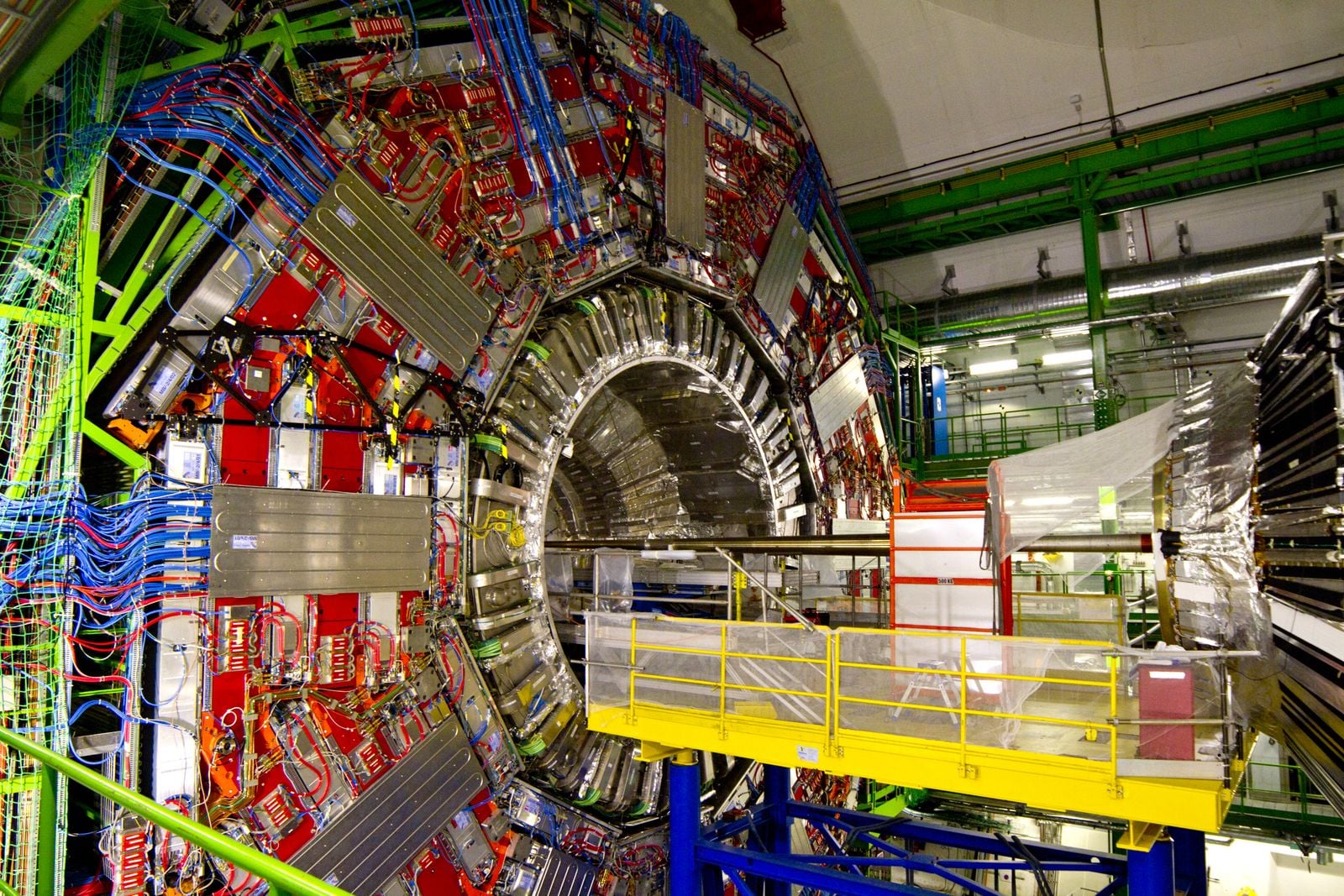
In July 2025, the Large Hadron Collider completed its first run with oxygen-oxygen and neon-neon collisions. Each fully ionised oxygen-16 nucleus contains eight protons and eight neutrons. The LHC brought the oxygen nuclei into collision at a centre-of-mass energy of 5.36 teraelectronvolts per nucleon pair.
That makes oxygen light compared with lead, the established workhorse of the LHC’s heavy-ion programme. A lead-208 nucleus contains 208 protons and neutrons. Colliding two of them deposits enough energy in a sufficiently large region to create a quark-gluon plasma droplet whose collective flow and effect on energetic particles are well established.
At the other end, proton-proton and proton-lead collisions have produced flow-like correlations and other intriguing plasma-like patterns. Their interpretation remains harder because the systems are tiny and the initial geometry is less certain. Oxygen supplies an intermediate test: much smaller than lead, but structured well enough for cleaner comparisons.
A jet becomes a probe of invisible matter
A violent interaction early in a collision can launch a high-energy quark or gluon. Physicists collectively call these particles partons. A parton cannot reach a detector on its own; as the system cools, it fragments into a narrow spray of ordinary particles called a jet.
If the parton crosses quark-gluon plasma, it interacts with the medium and surrenders some of its energy. Fewer high-momentum particles then emerge than would be expected from a suitably scaled proton-proton collision. This jet-quenching effect is a defining probe of the hot medium, not a direct photograph of it.
The distinction connects with earlier SpaceDaily coverage of the diffusion wake measured behind energetic partons in lead collisions. That work asked how a large plasma droplet responds after a jet deposits energy. The oxygen analysis asks an earlier boundary question: can a much smaller nuclear collision create enough medium to drain the jet at all?
ALICE separated hot effects from cold nuclei
The ALICE analysis posted in June 2026 measured neutral pions across a range of transverse momenta. Their production in oxygen-oxygen collisions was suppressed relative to a proton-proton reference, with a pattern resembling the suppression already seen in lead-lead collisions.
Suppression alone does not settle the case. A nucleus is not merely a bag of free protons and neutrons. Its internal quark and gluon distributions can change particle production before any hot plasma develops. These cold-nuclear-matter effects could imitate part of a jet-quenching signal.
ALICE therefore used proton-oxygen collisions from the same 2025 run as a control. The proton-oxygen result was compatible with no suppression. The researchers then formed a double ratio that largely cancels the cold contributions expected from the two oxygen nuclei. That comparison remained suppressed relative to models without parton energy loss at a statistical significance of 4.9 standard deviations.
The analysis consequently describes the result as establishing parton energy loss in oxygen-oxygen collisions. Its precise record is the smallest nuclear system studied to date with direct jet-quenching evidence. It is not the smallest collision of any kind, and it does not prove that every individual oxygen collision produces an identical, fully equilibrated droplet.
Why the plasma is called a near-perfect liquid
CERN’s overview of heavy-ion physics explains that quarks and gluons become deconfined at sufficiently high temperatures and densities. Early expectations often treated the result as a weakly interacting gas. Measurements instead revealed strong collective motion that can be described with relativistic fluid dynamics.
“Near-perfect” refers to the plasma’s exceptionally small shear viscosity relative to its entropy density. It does not mean the material is literally frictionless. Nor does “plasma” here mean the familiar electromagnetic plasma of separated atomic nuclei and electrons. Quark-gluon plasma concerns the constituents inside hadrons and the strong nuclear force that normally confines them.
The comparison with the early universe also has limits. The LHC recreates a tiny region with a similar high-temperature strong-force state. It does not reproduce the Big Bang, cosmic expansion, gravity or the universe’s full mixture of particles. The collider droplet spans roughly nuclear dimensions and survives for only a minute fraction of a second before cooling into hadrons.
A millionth of a second is therefore a useful headline marker, not a stopwatch reading for one sudden universal transition. Cosmological models place the quark-gluon epoch within the first microseconds, followed by the confinement of quarks into protons, neutrons and other hadrons as the expanding universe cooled.
Four experiments found pieces of the same picture
The ALICE result is part of a broader set of 2026 analyses. A CERN summary of all four main LHC experiments reports that ATLAS observed jet-pair imbalances consistent with energy loss, with a stronger effect in more central collisions. CMS found suppressed charged-particle production, while LHCb saw heavier neon collisions produce stronger suppression of charm-containing particles than oxygen collisions.
Flow offers a complementary test. Particles do not leave a plasma droplet uniformly when the original overlap region is asymmetric. Pressure converts that geometry into preferred directions of motion. Measurements from oxygen and neon show that fluid-like flow tracks the initial nuclear shape, while preliminary ALICE results show baryons carrying stronger anisotropic flow than mesons at intermediate momenta.
Each observable has different backgrounds and model assumptions. A collection of energy-loss, flow and particle-species measurements is therefore more persuasive than treating one pattern as a camera image of the plasma.
The lower boundary has become measurable
Oxygen does not close the question of how small quark-gluon plasma can be. It gives researchers a better point on a system-size map. Comparing proton, oxygen, neon, xenon and lead collisions can reveal whether jet quenching turns on abruptly or grows gradually as the hot region becomes larger and longer-lived.
The same comparisons can test when fluid dynamics becomes reliable. Collective flow may emerge in systems where energetic partons have too little material to show measurable energy loss. Alternatively, improved data may uncover a continuous progression in which both effects become easier to detect as size and particle multiplicity rise.
CERN did not recreate the Big Bang itself, and the detectors did not photograph a liquid droplet. The LHC briefly created matter governed by similar high-temperature strong-force physics, then inferred its presence from what happened to particles passing through it. The new boundary is specific but important: oxygen-oxygen is now the smallest nuclear collision system in which a defining jet-quenching signature has been isolated directly.