
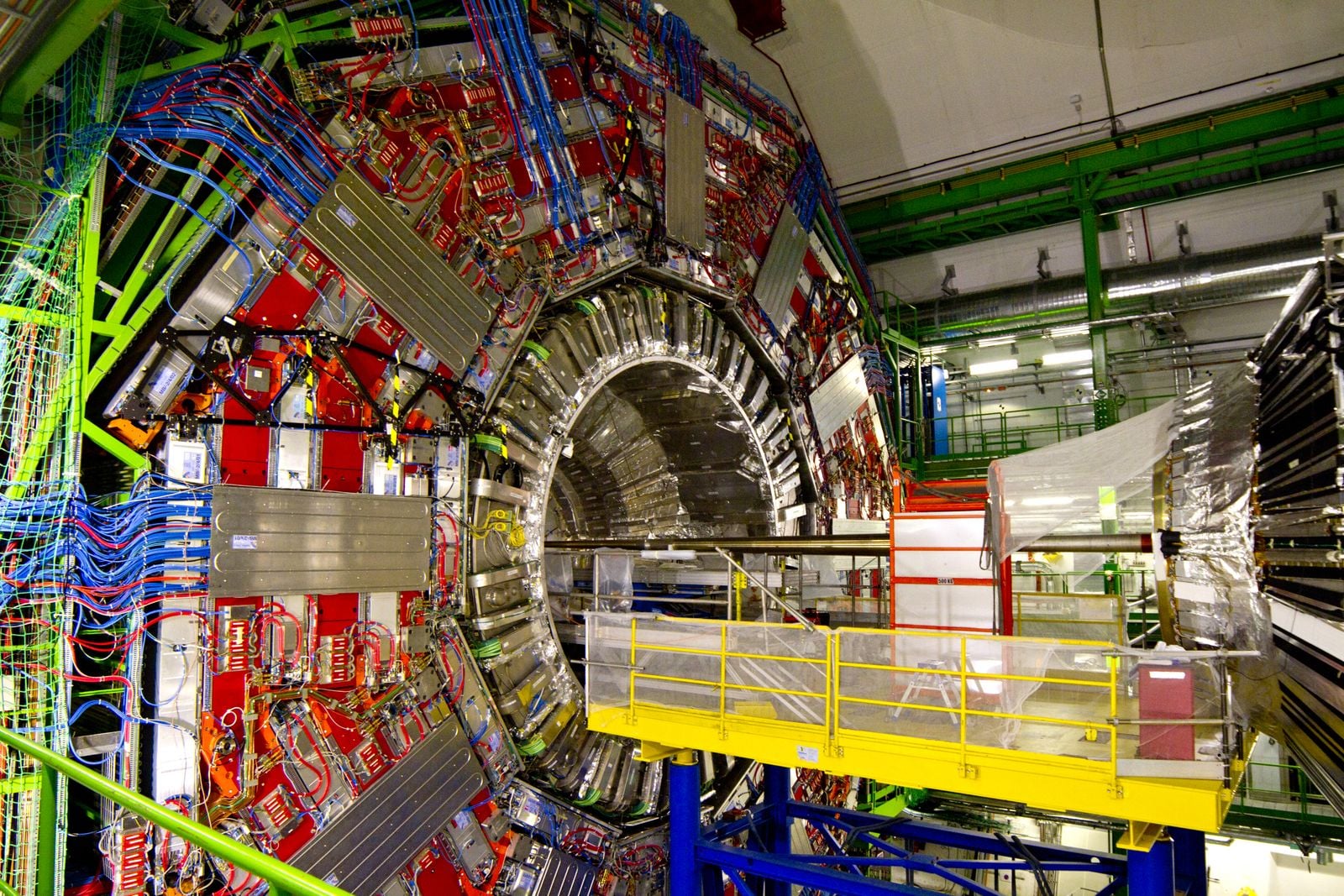
The CMS experiment at CERN has reported the first direct observation of a diffusion wake in quark-gluon plasma using dijet events, the short-lived fluid created when lead nuclei collide inside the Large Hadron Collider. The signal appeared as a deficit of low-momentum charged particles and exceeded five standard deviations in the most central collisions.
This was not a camera-like sighting of one identifiable quark cutting a visible channel. CMS inferred the wake statistically from many pairs of particle jets. Those jets begin with energetic partons, the collective name for quarks and gluons. The measurement does not identify an individual initiating parton as a quark, so the “single quark” description is headline shorthand for a more careful result.
The matter that came before atoms
For a few millionths of a second after the Big Bang, the universe was too hot for quarks to remain confined inside protons and neutrons. Quarks and the gluons that carry the strong force moved through a dense state of matter called quark-gluon plasma.
CERN’s account of heavy-ion physics describes this early material as a mixture dominated by quarks and gluons. Colliding heavy nuclei can create a microscopic version of those conditions at temperatures of several trillion degrees. The fireball then cools almost immediately, and its constituents combine into the ordinary particles recorded by the detector.
The name plasma can suggest a thin, hot gas. Measurements at CERN and at Brookhaven National Laboratory have instead shown strongly collective behaviour, closer to a liquid with very low viscosity. Brookhaven’s RHIC programme has measured quark-gluon plasma at about four trillion degrees Celsius.
A fluid can carry a disturbance. That is where the wake enters the physics.
What CMS actually measured
The CMS paper, accepted for publication in Physical Review Letters, compared lead-lead collisions with proton-proton collisions at a centre-of-mass energy of 5.02 teraelectronvolts per nucleon pair. The lead data were recorded in 2018 and the proton reference data in 2017.
Hard collisions between partons produce narrow sprays of particles called jets. They often appear in pairs moving in nearly opposite directions. CMS selected events with a leading jet above 130 GeV and a second jet above 50 GeV, then examined the distribution of lower-energy charged particles around them.
As a fast parton crosses the plasma, it transfers energy and momentum to the medium. The jet that eventually reaches the detector is therefore weakened, an established effect called jet quenching. The deposited momentum also makes the plasma respond. A diffusion wake is the resulting depletion on the side opposite the propagating jet.
No detector photographs that depleted region directly. The evidence is a small difference between carefully constructed particle distributions.
How two jets exposed a hidden deficit
The measurement is difficult because the two opposing jets create overlapping structures. The wake associated with one jet can sit beneath the extra particles associated with the other, masking the deficit.
CMS used an approach proposed by Zhong Yang and Xin-Nian Wang in a 2025 theoretical study. They calculated that selecting jet pairs separated in pseudorapidity, a detector coordinate related to angle, would shift the expected wake away from the competing jet signal. Subtracting correlations from small-gap events from those in large-gap events would make the missing particles visible.
The CMS data followed that pattern. The depletion was clearest for charged particles with transverse momenta between 1 and 2 GeV in the 0 to 30 per cent most central lead-lead collisions. It became smaller in more peripheral collisions, where less plasma is formed, and for particles in the higher 2 to 4 GeV range.
For the low-momentum particles in central collisions, the result differed from a no-wake baseline by more than five standard deviations. CMS therefore describes it as the first direct observation of the diffusion wake in dijet events from nucleus-nucleus collisions.
The prediction was older than the method
The broad idea has been in the literature for decades. Theorists in the mid-2000s calculated that a fast parton should disturb quark-gluon plasma, producing Mach-cone-like motion and a trailing wake. A 2006 calculation by Purnendu Chakraborty, Munshi Mustafa and Markus Thoma explicitly modelled wake structures produced by a fast parton.
Experiments had long since established that the plasma takes energy from jets. Detecting what the medium does with that energy was harder. CMS previously reported evidence from events containing a Z boson and a jet. An ATLAS search using photon-jet events found no significant wake within its uncertainties. The dijet method offered a much larger event sample and a way to move the signal out from under the jets themselves.
The observation does not reveal a new particle, and it does not show physicists watching an isolated quark in real time. It confirms a particular collective response of the plasma using a signal assembled from many collisions.
The models got the shape, but not the size
The comparison with theory is not a clean victory lap. Models that include jet energy loss and a hydrodynamic response from the plasma reproduced the general trend and roughly located the depleted region. A model without jet-medium interactions produced no comparable dip.
Yet the HYBRID and CoLBT-hydro calculations generally predicted a stronger depletion than CMS measured. The result supports the physical picture of a wake while showing that the current accounts of how deposited energy and momentum spread through the plasma are incomplete.
That mismatch is now the useful part. More precise wake measurements can help constrain the plasma’s transport properties and test how well different models describe its evolution. The next question is not simply whether a fast parton leaves a wake, but why the wake recorded by CMS is smaller than the leading calculations expected.
