

“Like dissolves like” is one of chemistry’s most useful shortcuts. Polar materials tend to associate with polar materials, while nonpolar compounds prefer their own kind. On Titan, at temperatures that turn water into rock and leave methane flowing as liquid, that shortcut has acquired an unusual exception.
Researchers at NASA’s Jet Propulsion Laboratory exposed crystals of hydrogen cyanide, or HCN, to methane, ethane and other small hydrocarbons. The molecules did not react into new compounds, but laser spectra showed that the HCN crystal had changed. Computational chemists at Chalmers University of Technology then found arrangements in which hydrocarbon molecules occupy the HCN lattice and remain energetically stable.
The combined evidence, reported in the PNAS study “Hydrogen cyanide and hydrocarbons mix on Titan”, supports an extraordinary form of cryogenic mixing. It does not overturn thermodynamics, and it does not mean every candidate structure would survive everywhere on Titan. It shows that a strong polarity mismatch need not prevent two substances from sharing a solid when temperature and crystal packing alter the energetic calculation.
A cold exception with a narrow meaning
HCN and methane look like poor partners. HCN has a strongly uneven distribution of electrical charge, making it exceptionally polar. Methane and ethane have much more even charge distributions and are nonpolar. Under familiar conditions, polar molecules attract one another too strongly to make room readily for nonpolar guests.
Yet “like dissolves like” is a rule of thumb, not a law. It summarises common behaviour in solutions. The new work concerns solid-state structures at temperatures near those of Titan, where entropy, weak intermolecular attractions and the geometry of a crystal lattice can produce a different outcome. The hydrocarbons do not become polar, and HCN does not stop being polar. The total arrangement simply becomes favourable enough to form.
The phrase “at around minus 179°C” also needs a precise reading. About 94 kelvin, or minus 179°C, is a representative temperature for Titan’s surface. The laboratory did not hold every mixture at that exact value. According to the methods, methane was introduced to HCN at 77 kelvin, while ethane, propane and butane were introduced at 90 kelvin. The Chalmers account of the collaboration describes experiments at temperatures as low as 90 kelvin as a close analogue for Titan’s environment.
What the experiment actually did
The JPL team first deposited gaseous HCN onto a cryogenic stage, annealed the material at 150 kelvin for five minutes, then cooled it. Researchers added methane at 77 kelvin or the larger hydrocarbons at 90 kelvin. At those temperatures HCN is solid, while methane and ethane can be liquids under the relevant conditions.
They examined the samples with Raman spectroscopy, which tracks the small energy changes experienced by laser light as it scatters from molecular vibrations. Several HCN bands shifted after hydrocarbons were added. Those shifts indicated that the HCN molecules had acquired new local environments even though both the HCN and hydrocarbons remained chemically intact.
Interpreting a shifted spectrum is not the same as seeing a structure. To test candidate explanations, the computational team searched 9,760 arrangements using crystal-structure prediction and dispersion-corrected density functional theory. The most promising HCN-methane and HCN-ethane structures reproduced key features of the measured spectra. Calculations also indicated that an HCN-ethane co-crystal could be stable both thermodynamically and kinetically under Titan surface conditions.
The proposed mechanism resembles insertion. Hydrocarbon molecules diffuse into gaps within an HCN solid and settle into a combined lattice. This is different from picturing two warm liquids blending uniformly in a beaker. It is a solid host accommodating molecular guests at cryogenic temperature.
What the spectra could and could not show
The evidence is strong enough for the researchers to identify spontaneous mixing, but it leaves a structural question open. A co-crystal usually implies an ordered solid with components present in a defined repeating arrangement. A solid solution can include more variable occupancy and disorder. Because the experiment did not directly determine long-range atomic order, the authors say either term may prove appropriate.
That distinction makes the result more interesting, not less. Raman spectroscopy is sensitive to molecular surroundings, and the agreement with computed spectra offers a physical explanation for the observations. A definitive structure would require further diffraction or related measurements. Those are difficult with a sample that must remain extremely cold and contains highly toxic HCN.
The study therefore did not photograph methane sitting in a particular lattice site. It combined laboratory changes in vibrational fingerprints with a large computational search that found plausible, stable structures. As earlier SpaceDaily coverage of the result noted, the oil-and-water analogy captures the surprise. The closer description is that molecules with sharply different polarity can share a cryogenic solid phase.
Methane and ethane do not behave alike
The headline pairs methane and ethane because both produced evidence of interaction with HCN, but their temperature windows are not interchangeable. The methane-associated spectral features weakened quickly when the sample warmed above about 85 kelvin. Titan’s surface is normally warmer, roughly 90 to 94 kelvin, so the proposed HCN-methane structure may be more plausible in colder parts of the atmosphere than across most of the ground.
Ethane is the more robust surface candidate. The modelling found favourable HCN-ethane arrangements, and the laboratory signature persisted to higher temperatures. Propane and butane also changed the HCN spectrum, although the paper concentrates its detailed structural analysis on methane and ethane.
This nuance is essential when laboratory chemistry is projected onto another world. A compound that forms during a controlled cold run is not automatically widespread on Titan. Scientists still need abundance, pressure, formation-rate and lifetime information, along with evidence that the same process works in mixtures containing many competing organics.
Titan nevertheless supplies a convincing setting. Cassini-Huygens revealed lakes and seas of methane and ethane, hydrocarbon rain, an atmosphere dominated by nitrogen and vast regions rich in organic material. Atmospheric chemistry also makes HCN, creating opportunities for the polar solid to encounter nonpolar liquids in clouds, falling particles, surface deposits or lake margins.
Why mixed crystals could change Titan geology
Planetary scientists already have a name for this class of material: cryominerals. On Earth, rocks are shaped by silicates, carbonates and other inorganic minerals. Titan’s surface can host molecular solids assembled from organic compounds at low temperature. An ACS review of Titan’s organic co-crystals catalogued several laboratory examples and argued that they may influence dunes, evaporite deposits, karst-like terrain and the pace of landscape change.
The HCN structures join a growing list rather than creating the idea from nothing. Earlier experiments produced a co-crystal made from acetylene and butane, two molecules expected to be common on Titan. Other combinations include benzene with ethane and acetylene with ammonia.
Putting HCN into a mixed solid could change its practical fate. Crystal composition can affect hardness, thermal expansion, dissolution, erosion and how easily grains stick together. If ethane becomes incorporated rather than merely washing past an HCN deposit, the resulting material could endure, move or weather differently. Over long periods, those small material differences could affect where organic compounds accumulate around dunes, channels and the margins of hydrocarbon seas.
None of those geological consequences has yet been observed directly on Titan. They are testable implications of the material properties. The next laboratory steps include measuring composition and phase boundaries, resolving atomic order, and exposing candidate crystals to more realistic multicomponent mixtures.
Why the result matters beyond Titan
HCN receives attention in prebiotic chemistry because, under suitable conditions, it can contribute to pathways that yield amino acids and nucleobases. That does not make the new crystals alive, or even evidence that biology is likely on Titan’s surface. The result concerns how a useful chemical feedstock may be stored and transported.
Physical form matters before any reaction begins. A molecule locked in a mixed crystal has a different lifetime and availability from the same molecule in a pure deposit. It may be protected, concentrated, released during dissolution or carried into a new environment by erosion. Discovering the inventory of possible solids is therefore part of reconstructing Titan’s chemistry, even when no life claim is involved.
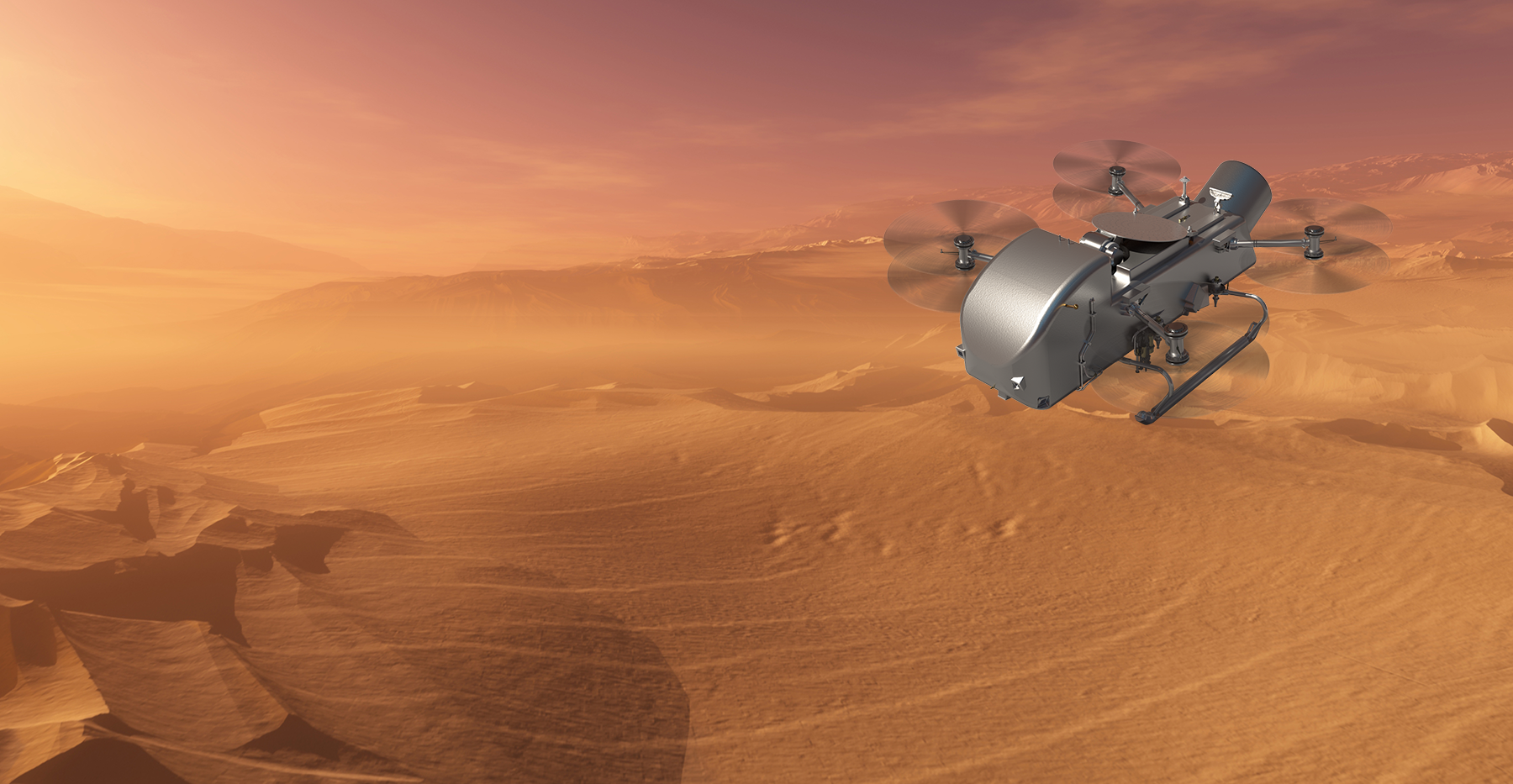
NASA’s Dragonfly rotorcraft mission is intended to sample surface materials at multiple locations and investigate Titan’s prebiotic chemistry and habitability. Its instruments will encounter natural mixtures far more complicated than a binary laboratory sample. Studies like this help scientists recognise which phases might be hiding inside those mixtures and which spectral signatures deserve attention.
The finding may also apply to cold environments beyond Titan, since HCN occurs in comets, planetary atmospheres and interstellar clouds. The durable lesson is methodological. Chemistry learned in a warm terrestrial laboratory is not a complete catalogue of what matter can do. At Titan temperatures, even molecules separated by a profound polarity mismatch can discover a stable way to share a crystal.