

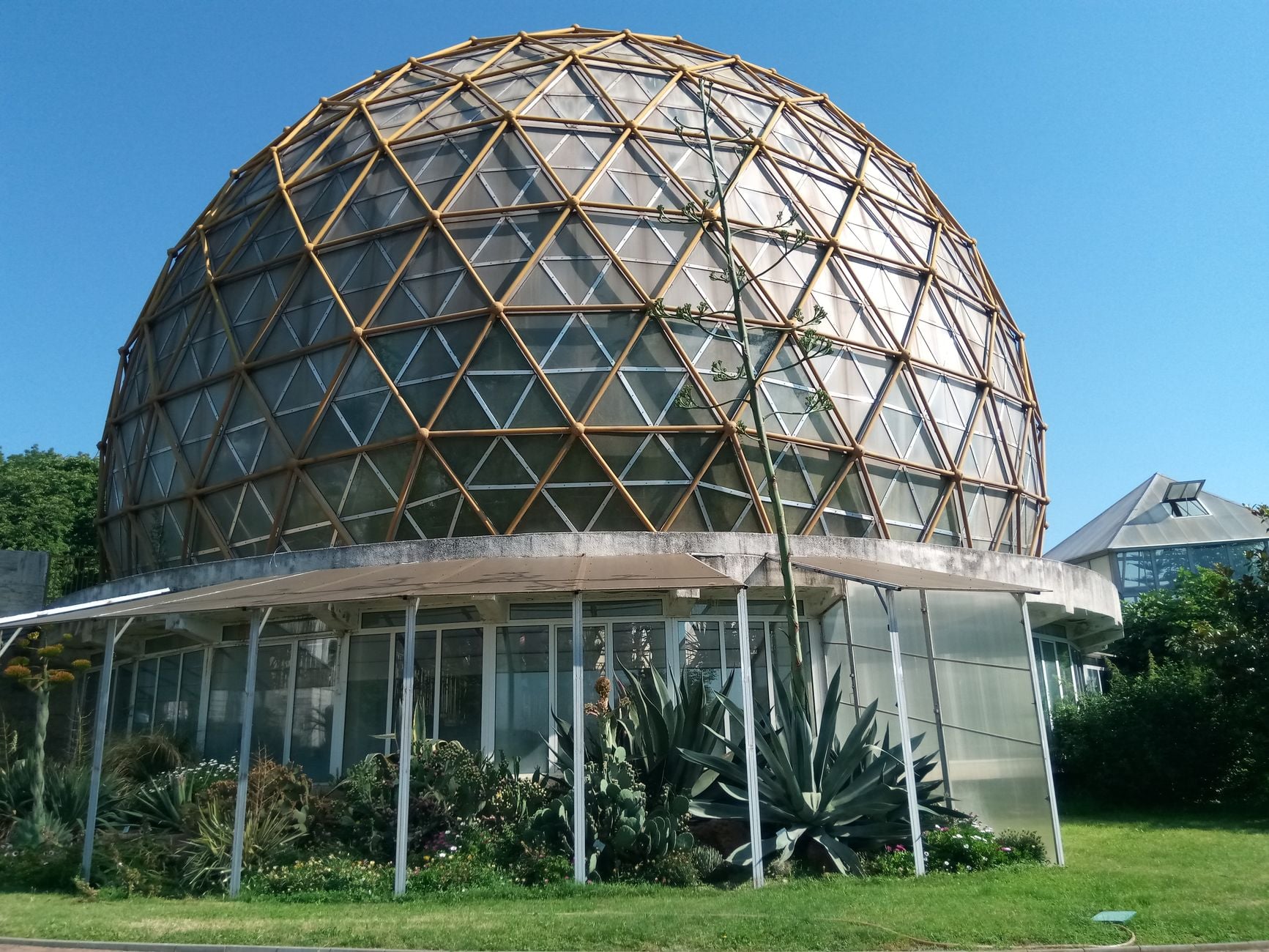
On 26 September 1991, eight people entered Biosphere 2, a sealed glass and steel structure in Oracle, Arizona, built to test whether a human-made ecosystem could keep people alive for two years.
The building was not a spacecraft, but it was a serious rehearsal for one of the hardest questions in space settlement: whether air, water, food, waste, soil, plants, animals, machinery, and human behaviour could be made into a working loop. The University of Arizona, which now owns the site, describes Biosphere 2 as a 3.14-acre research facility with 7.2 million cubic feet under sealed glass, 6,500 windows, and a welded stainless steel liner below it.
The first mission lasted until 26 September 1993. The story is often retold as theatre, but the more useful reading is less theatrical. Biosphere 2 showed that in a closed habitat, the building is not a container around the experiment. The building is part of the experiment.
What was sealed inside
Biosphere 2 was designed with miniature versions of several Earth systems: rainforest, ocean, mangrove wetland, savanna grassland, fog desert, agricultural areas, and human living space. It was intended to recycle air and water, grow food, process waste, and give researchers a controlled way to watch a small biosphere develop under glass.
The physical scale mattered. According to Biosphere 2’s research systems facts, the rainforest, savanna, ocean, desert, habitat, and two airtight lung structures each had their own engineered dimensions and operating limits. This was not a greenhouse with people added for publicity. It was a vast set of linked chambers whose atmosphere had to behave as one.
That ambition made the result more interesting than a simple failure story. Many things worked well enough to keep the crew alive. Food was grown. Water was recycled. Waste streams were handled. The sealed structure held its atmosphere tightly enough that slow chemical changes could be detected over months.
It also meant there was almost nowhere for mistakes to go.
The food problem was visible first
The crew did not starve, but food production was lower than hoped. In Advances in Space Research, Sally E. Silverstone and Mark Nelson later reported in Food production and nutrition in Biosphere 2 that the agricultural system produced most, but not all, of the crew’s diet during the first mission.
The human consequences were visible. Roy L. Walford and colleagues, writing in Proceedings of the National Academy of Sciences, described the Biosphere 2 diet as calorie-restricted, low-fat, and nutrient-dense. Their 1992 paper reported significant changes in blood glucose, cholesterol, blood pressure, and other measures during the period inside. The crew’s weight loss became part of the public image of the experiment, but in the technical literature it was also a data point in a longer question: how little land, energy, and food redundancy a closed habitat can safely tolerate.
That question is not historical trivia. Every proposed off-world habitat has to answer a version of it. A crew can bring supplies, but the further and longer the mission, the more life support becomes a system rather than a pantry.
The oxygen decline changed the story
The more serious problem was not food. It was air.
In Advances in Space Research, Mark Nelson, William Dempster, Norberto Alvarez-Romo, and Taber MacCallum described early atmospheric results from Biosphere 2 in Atmospheric dynamics and bioregenerative technologies in a soil-based ecological life support system. The oxygen level began near normal atmospheric concentration, then steadily fell. Later summaries of the mission record the decline from about 20.9 per cent to roughly 14.5 per cent after 16 months, a level often compared with high-altitude exposure.
The crew felt it. Reports from the mission describe fatigue and sleep problems as oxygen dropped. In January 1993, and again later that year, oxygen was added from outside. That intervention damaged the project’s public claim of closure, but it was also the responsible choice once human safety was at stake.
The more interesting scientific problem was why the missing oxygen did not appear as a matching rise in carbon dioxide. If humans, animals, and soil microbes were consuming oxygen and producing carbon dioxide, the carbon dioxide should have accumulated more clearly. Something else in the system was taking it out of circulation.
The walls were chemically active
The answer came from isotopic work by Jeffrey P. Severinghaus, Wallace S. Broecker, William F. Dempster, Taber McCallum, and Martin Wahlen. Their paper, Oxygen loss in Biosphere 2, published in Eos, Transactions American Geophysical Union, traced the missing carbon to exposed concrete inside the structure.
The simplified version is that soil respiration was using oxygen and releasing carbon dioxide faster than photosynthesis could fully balance it. But the carbon dioxide was not simply building up in the air. It was reacting with calcium hydroxide in concrete to form calcium carbonate, a process known as carbonation. Carbon was being fixed into the walls.
That did not mean the concrete was breathing in the ordinary sense. It meant the habitat’s materials had entered the life-support chemistry. A surface chosen for structure and construction had become a participant in atmospheric control.
In an open building, that would be a minor chemical background process. In Biosphere 2, it mattered because the margin was small. The plants needed carbon dioxide to rebuild oxygen through photosynthesis. The soil microbes and humans kept consuming oxygen. The concrete quietly removed part of the carbon dioxide signal that would otherwise have helped reveal the imbalance earlier and support plant production.
Why this still matters for space habitats
Biosphere 2 is sometimes remembered as an overconfident experiment that ran into reality. That reading is not entirely wrong, but it is too small.
The better lesson is that closed systems make hidden assumptions visible. In a spacecraft or planetary habitat, a wall is not merely a wall. A seal is not merely a seal. Soil is not merely a growth medium. A crop is not merely food. Each becomes part of a network of gases, microbes, water, heat, chemistry, maintenance, and human work.
This is why Biosphere 2 remains relevant to space thinking even though it was built on Earth, under sunlight, with a surrounding desert rather than vacuum outside. It showed that life support cannot be separated neatly into biological and mechanical categories. The machinery can help the ecosystem, the ecosystem can overload the machinery, and the structure can change the chemistry both are trying to maintain.
There was also a human lesson, though it should not be inflated into a psychological diagnosis of the crew. Eight people lived under public scrutiny, limited food, declining oxygen, hard labour, and internal disagreement for two years. The fact that the project had conflict is not surprising. The fact that the crew kept the system running is part of the record too.
The experiment did not end as a simple failure
After the first closure, the exposed concrete was sealed for later work. Biosphere 2 passed through changes of ownership and scientific purpose, and the University of Arizona now uses the facility for Earth systems research, climate-related experiments, education, and large-scale controlled studies.
The 1991 mission did not prove that humans could build a self-sufficient miniature Earth and walk away from outside support. It proved something more uncomfortable and more useful: a closed habitat has no passive parts.
Even the walls have chemistry.