
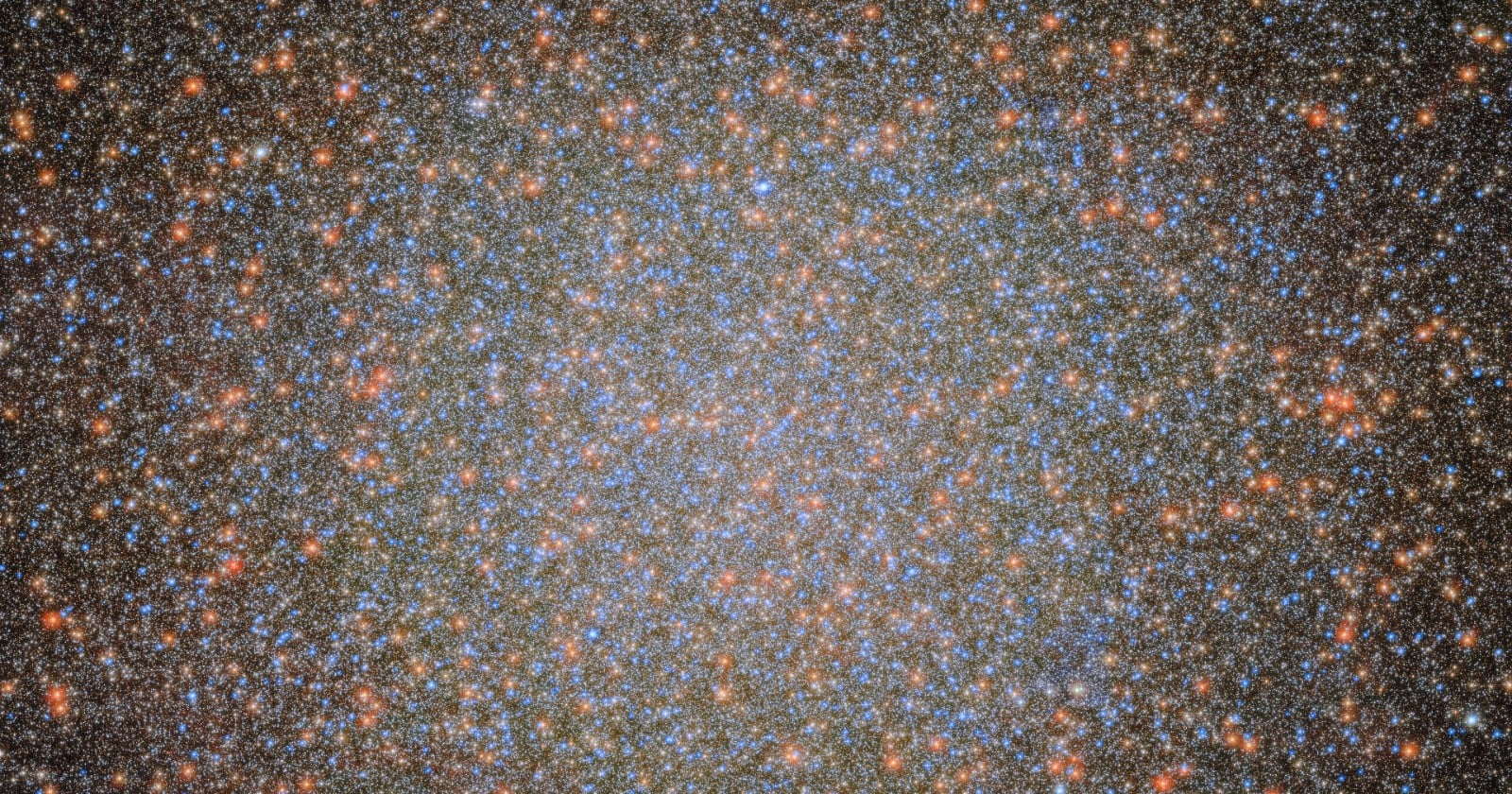
Omega Centauri is a crowded place to hide anything. Roughly ten million stars are packed into the Milky Way’s most massive globular cluster, and its oldest massive stars died billions of years ago. Simulations therefore predict a substantial population of stellar-mass black holes, perhaps numbering in the thousands.
Until 2026, astronomers had not individually identified one of those smaller black holes in the cluster. The first was finally exposed not by light from the object itself, but by the path of an ordinary star being pulled around something dark and too massive to be a neutron star.
The object is called oMEGACat BH-2. Its companion’s best-fitting orbit lasts about 94 years, despite the observational record covering only 23. That may sound like trying to reconstruct a circle from a short pencil mark, but the team caught the most informative part of the path: the close, fast turn around periastron.
The result is a lesson in what astronomers mean by detection. The black hole was not photographed and it was not glowing as it swallowed gas. Its gravity was measured through the changing position of a visible star, one fraction of a telescope pixel at a time.
Why thousands of black holes could remain unseen
Omega Centauri lies about 18,000 light-years away and is approximately 12 billion years old. Massive stars born early in its history should have exhausted their fuel, exploded or collapsed, and left behind compact remnants. Because black holes are heavier than most surviving stars, gravitational encounters tend to move them toward denser parts of a cluster.
NASA’s announcement of the 2026 result says dynamical models have suggested Omega Centauri may retain about 10,000 stellar-mass black holes. The paper itself treats that estimate cautiously. It is a model-dependent prediction, not a count, and the true number depends on how the remnants formed, how many were kicked out and whether a much larger central black hole changes the cluster’s dynamics.
Most black holes would be quiet. Radio and X-ray searches work best when gas falls onto a black hole and becomes hot enough to radiate. Radial-velocity surveys work best when a companion moves toward and away from Earth strongly enough to shift its spectrum. A wide binary viewed in an inconvenient orientation can escape both approaches.
Astrometry offers another route. Instead of measuring brightness or a Doppler shift, it measures a star’s changing position across the sky. If that path bends around an unseen mass, the orbit can reveal what is there.
The discovery was assembled from 23 years of positions
The discovery paper in The Astrophysical Journal Letters was led by Matthew Whitaker of the University of Utah. The international team combined Hubble Space Telescope astrometry from 2002 through 2023 with James Webb Space Telescope observations from 2024 and 2025.
The Hubble record comprised 351 exposures. The Webb measurements added near-infrared positions with a different instrument, extending the time baseline and improving the fit. Aligning images taken years apart required corrections for detector distortion and careful separation of the target’s motion from the general movement of stars through the cluster.
The luminous member of the binary is a main-sequence turnoff star, meaning it is near the stage at which an old star begins leaving the main sequence. The team estimated its mass at 0.78 times the Sun’s. That visible mass matters because orbital mechanics constrains the total system; determining the companion requires knowing what the star contributes.
A previous team had already noticed unusual motion and proposed that the dark companion might be a neutron star. With more Hubble epochs and the Webb data, Whitaker’s team detected enough curvature and acceleration to revise the orbit and raise the companion’s inferred mass into black-hole territory.
Why part of a 94-year orbit could still give a mass
The headline values are best estimates with meaningful uncertainty. The period is 94 years, with a one-standard-deviation range extending 42 years lower and 63 years higher. The semimajor axis is about 31 astronomical units, with a range of roughly 19 to 46. The eccentricity is approximately 0.72, describing a strongly elongated orbit rather than a near-circle.
Twenty-three years is less than one complete orbit, but the information in an orbital segment is not evenly distributed. Near the distant end, called apastron, the star moves slowly and its path can resemble a nearly straight proper motion. Near periastron, it accelerates, changes direction more sharply and sweeps through the orbit faster.
The observations happened to include that close passage. The measured arc therefore contained the bend and speed change needed to constrain the gravitational pull. As the public preprint explains, catching the system near periastron made the black-hole mass comparatively well constrained even while the total period remained broad.
This is why saying astronomers followed the star through “part” of the orbit is more informative than it may appear. A random 23-year section might not have been enough. This particular 23-year section was unusually valuable.
Four and a half solar masses rules out the ordinary alternative
The team inferred a dark-companion mass of 4.46 solar masses, with an uncertainty of plus 1.22 and minus 1.01. The visible star adds another 0.78 solar masses. No light attributable to a second ordinary star appears in the system, so the companion must be compact and dark.
A neutron star is the main alternative, but the most massive securely measured neutron star is only a little above two solar masses. The Nature Astronomy research highlight notes that the fitted dark mass is heavier than the 2.08-solar-mass record holder. Although the exact theoretical maximum for neutron stars depends on uncertain ultra-dense physics, 4.46 solar masses lies well beyond the credible ordinary range.
That makes a stellar-mass black hole the overwhelmingly likely explanation. “Directly detected,” however, should not be read as “directly imaged.” The telescope did not resolve a black disk or collect photons emitted by the black hole. Astronomers individually detected its gravitational influence in a fitted astrometric orbit.
That distinction does not weaken the result. Many of astronomy’s strongest detections are dynamical. It distinguishes this object from a population inferred statistically through the cluster’s overall motion. SpaceDaily’s earlier report on oMEGACat BH-2 covered the discovery and its record-long black-hole binary period; the partial-orbit geometry is the reason that discovery could be made now.
The binary is both unexpectedly light and temporary
Omega Centauri is metal-poor, meaning its stars formed with very small proportions of elements heavier than helium. Massive metal-poor stars lose less material through winds before collapse, so models often predict that they should leave relatively heavy black holes. A black hole near 4.5 solar masses is unexpectedly light in that environment.
The result shows that at least some low-mass black holes can form at metallicity below one-thousandth. It does not yet reveal exactly how. The progenitor may have lost mass through binary interaction, received a supernova kick or followed an evolutionary path not captured well by present models.
The current binary also probably did not begin as one system. Its wide, eccentric orbit is consistent with dynamical formation, in which repeated encounters in the dense cluster caused the black hole and star to capture or exchange into a partnership.
That partnership is fragile. The paper classifies it as a soft binary, loosely bound enough that later stellar encounters tend to disrupt rather than tighten it. The expected disruption time is about 800 million years. That sounds long by human standards but is brief compared with Omega Centauri’s 12-billion-year history, suggesting astronomers have caught a temporary arrangement.
This is not the cluster’s proposed central giant
Omega Centauri is also at the centre of a separate argument about an intermediate-mass black hole. In 2024, researchers reported seven fast-moving stars near the cluster centre and interpreted them as evidence for a central object of at least 8,200 solar masses. Other models have tested whether a compact concentration of stellar remnants could mimic some of that signature.
oMEGACat BH-2 is not that object. It is a roughly 4.5-solar-mass member of a binary, discovered through a single companion’s orbit. Its existence neither confirms nor disproves the proposed central intermediate-mass black hole. The two questions involve different mass scales and different evidence.
Finding one smaller black hole nevertheless validates a search method for the hidden population. Continued Webb observations should reduce the period and mass uncertainties. Hubble’s archive can be examined for other accelerating stars, and future wide-field astrometry may monitor many crowded systems often enough to catch their informative turns.
The thousands have not suddenly become visible. Astronomers found one black hole because two telescopes repeatedly measured one star, across two decades, during the lucky portion of an orbit that may outlast a human life. That is a narrow success, but in a cluster full of invisible remnants it may be the first reliable doorway into the population models have been predicting all along.
