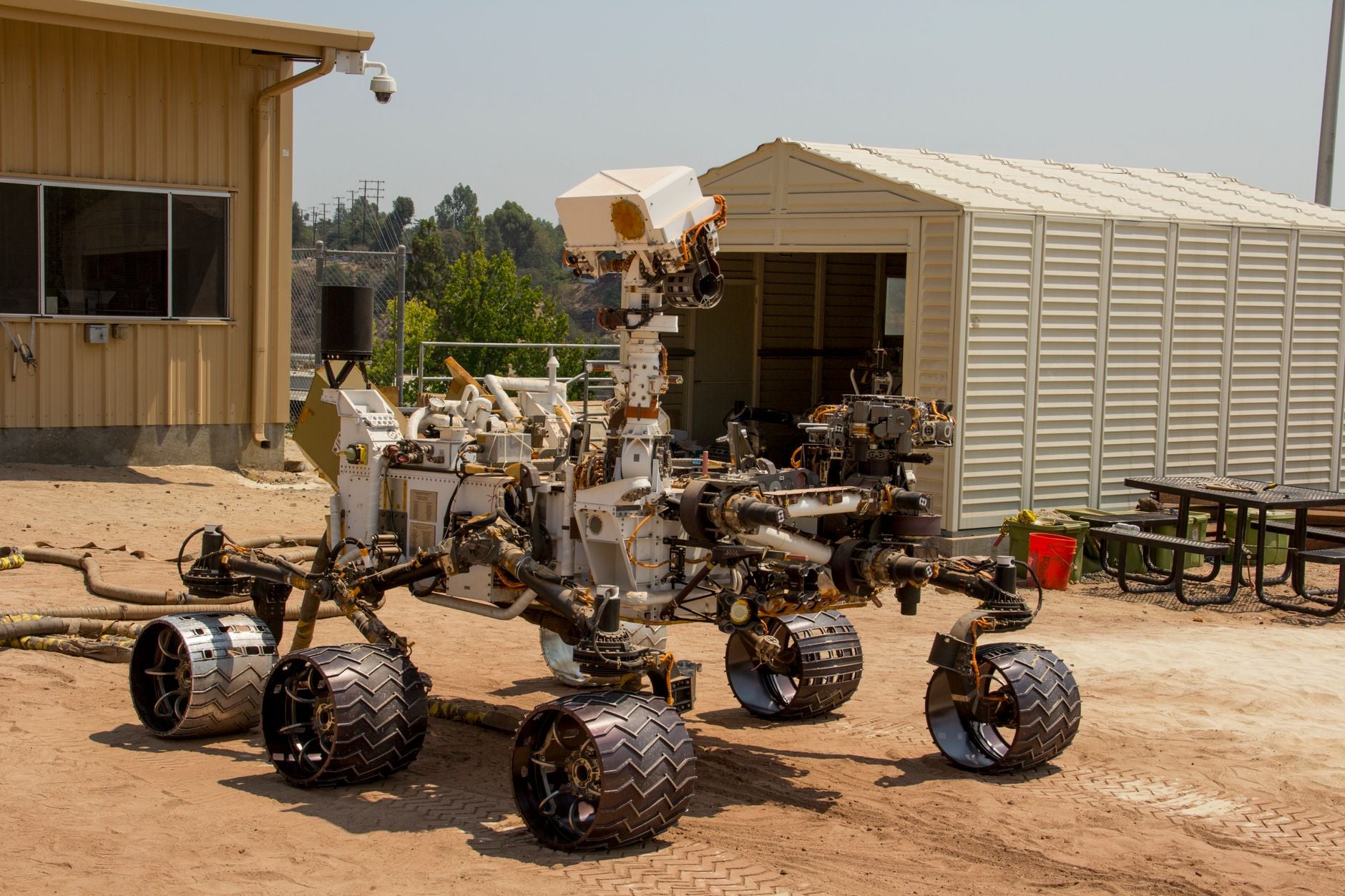
The strangest thing about MOXIE is that 122 grams can sound both tiny and enormous.
On Earth, it is a little over the mass of a chocolate bar. On Mars, it was the total amount of oxygen that a machine made from the planet’s own atmosphere, 225 million kilometres from the nearest repair bench.
NASA compared it with the amount a small dog breathes in about 10 hours. That is a charming way to make the number tangible, but it can also obscure what the experiment was designed to prove.
MOXIE was not an oxygen factory. It was a technology demonstration, tucked inside the Perseverance rover, built to answer a narrower question: can a machine take the carbon dioxide in real Martian air and reliably turn some of it into oxygen?
Between 2021 and 2023, the answer became yes.
What MOXIE actually did
MOXIE stands for Mars Oxygen In-Situ Resource Utilization Experiment. NASA called it roughly toaster-sized, although it was a dense toaster: the unit had a mass of about 17 kilograms and drew roughly 300 watts while operating.
The instrument pulled in Mars’s thin air with a pump. Because that atmosphere is about 95 per cent carbon dioxide, it offered a ready supply of molecules containing oxygen. Inside a solid oxide electrolyser heated to about 800 degrees Celsius, MOXIE separated one oxygen atom from each carbon dioxide molecule. The process produced molecular oxygen, with carbon monoxide as a by-product.
NASA’s description of the system makes an important point that is easy to miss in summaries of the mission: the gases were analysed for quantity, purity and efficiency, then vented back into the Martian atmosphere after each run. MOXIE did not fill a tank, feed a habitat or supply an engine.
Its first run took place on 20 April 2021. After warming up, it made about 5.4 grams of oxygen. Across 16 runs, ending on 7 August 2023, it produced 122 grams in total. At its most efficient it reached 12 grams an hour, twice NASA’s original target, at a purity of at least 98 per cent.
So “breathable oxygen” describes what this oxygen could ultimately be used for after collection and integration into a life-support system. Nobody could simply put their face near MOXIE’s outlet and take a breath.
The dog comparison hides the reason astronauts need so much oxygen
When we hear oxygen, most of us think of breathing. On a crewed Mars mission, however, lungs may be the smaller demand.
NASA has used a reference case in which getting four astronauts off Mars would require about 25 tonnes of oxygen and seven tonnes of rocket fuel. The oxygen allows that fuel to burn. A crew living on the surface for a year might consume roughly one tonne for breathing, according to the same NASA explanation.
This is also where the language needs care. Strictly speaking, MOXIE did not make rocket fuel. It made the oxidiser that would be combined with a fuel such as methane to create rocket propellant. Everyday accounts often call the whole mixture “fuel”, but the distinction matters because a future mission would still need to bring or manufacture the methane separately.
The scale gap is almost comical. MOXIE’s entire 122-gram output was about one two-hundred-thousandth of the 25 tonnes in that reference ascent plan. A practical plant would not run occasional one-hour experiments either. MOXIE principal investigator Michael Hecht wrote that a successor would need to produce roughly two to three kilograms of oxygen an hour, using about 25 kilowatts of power, to accumulate tens of tonnes.
That does not diminish MOXIE. It tells us what kind of proof it supplied. The experiment showed that the chemistry and machinery can work in the atmosphere they were designed for. It did not show that one small box could be copied thousands of times and switched on.
A technology demonstration answers a deliberately narrow question
I recently wrote about how Ingenuity turned a five-flight technology demonstration into 72 flights. MOXIE travelled to Mars on the same mission, but its success has a quieter shape.
There was no spectacular flight path to follow. Engineers instead ran the unit during different times of day and seasons, as Martian temperature and atmospheric pressure changed. NASA says MOXIE completed all its technical requirements across a full Mars year.
The peer-reviewed account of its first seven runs, published in Science Advances in 2022, described it as the first demonstration of in-situ resource use on another planet. That phrase is more significant than it may sound.
Nearly every consumable sent to Mars must first survive launch from Earth, the interplanetary journey and landing. If explorers can turn local air, ice or rock into useful material, the mass they need to launch from Earth falls. In theory, that can make a mission cheaper and give a crew more ways to recover from delays.
MOXIE supplied evidence for one link in that chain. A pump could collect the thin atmosphere. The electrolysis stack could reach operating temperature. The system could produce high-purity oxygen under actual Martian conditions. Those are no longer only laboratory assumptions.
Mars still controls the engineering problem
In another recent article, I looked at why Mars’s thin, cold and irradiated surface makes survival so difficult. MOXIE is a neat inversion of that problem. It treats the carbon dioxide-dominated atmosphere not only as a hazard, but as feedstock.
Yet the planet does not become cooperative simply because the raw material is present.
A crew-scale oxygen plant would have to collect far more low-pressure air, manage an 800-degree electrolysis system, reject waste heat, handle carbon monoxide, and operate through daily and seasonal changes. It would need power on the scale of tens of kilowatts. It would also need to keep working for many months with no technician standing beside it.
Then comes the part MOXIE did not attempt: liquefying the oxygen and storing it without unacceptable losses. For a return rocket, making oxygen is useful only if it can be accumulated safely and transferred into the vehicle.
This is the same compounding difficulty I explored in an earlier piece about trying to build a home on Mars. A system can be scientifically sound and still fail as settlement infrastructure because it is too power-hungry, too fragile or too difficult to repair.
MOXIE benefited from Perseverance’s power, computers and protective body. A standalone plant would need its own integrated support system. It would probably have to arrive before the astronauts and demonstrate that the return propellant was ready before they left Earth or committed to landing.
The next machine cannot simply be a larger MOXIE
NASA closed MOXIE’s operations after its 16th run, but the team did not describe the obvious successor as “MOXIE 2.0”. Hecht argued that the next step should be a full-scale system combining an oxygen generator with machinery to liquefy and store the product.
That is the milestone worth watching. A future experiment would need to prove continuous production at kilograms per hour, not grams per hour, while enduring enough operating cycles to fill a large tank autonomously.
There is still a long distance between that machine and astronauts climbing into a Mars ascent vehicle. Mission architectures may change. Power systems, engines and propellant choices may change with them. MOXIE did not settle those decisions, and it did not make a crewed Mars mission inevitable.
What it did was retire one uncertainty. For 16 brief runs, a small machine on another world inhaled Martian air and returned oxygen. The amount would keep a small dog going for part of a day. The process, scaled and integrated with storage, could help lift people off an entire planet.
On Mars, 122 grams can be both very little and quite enough to matter.