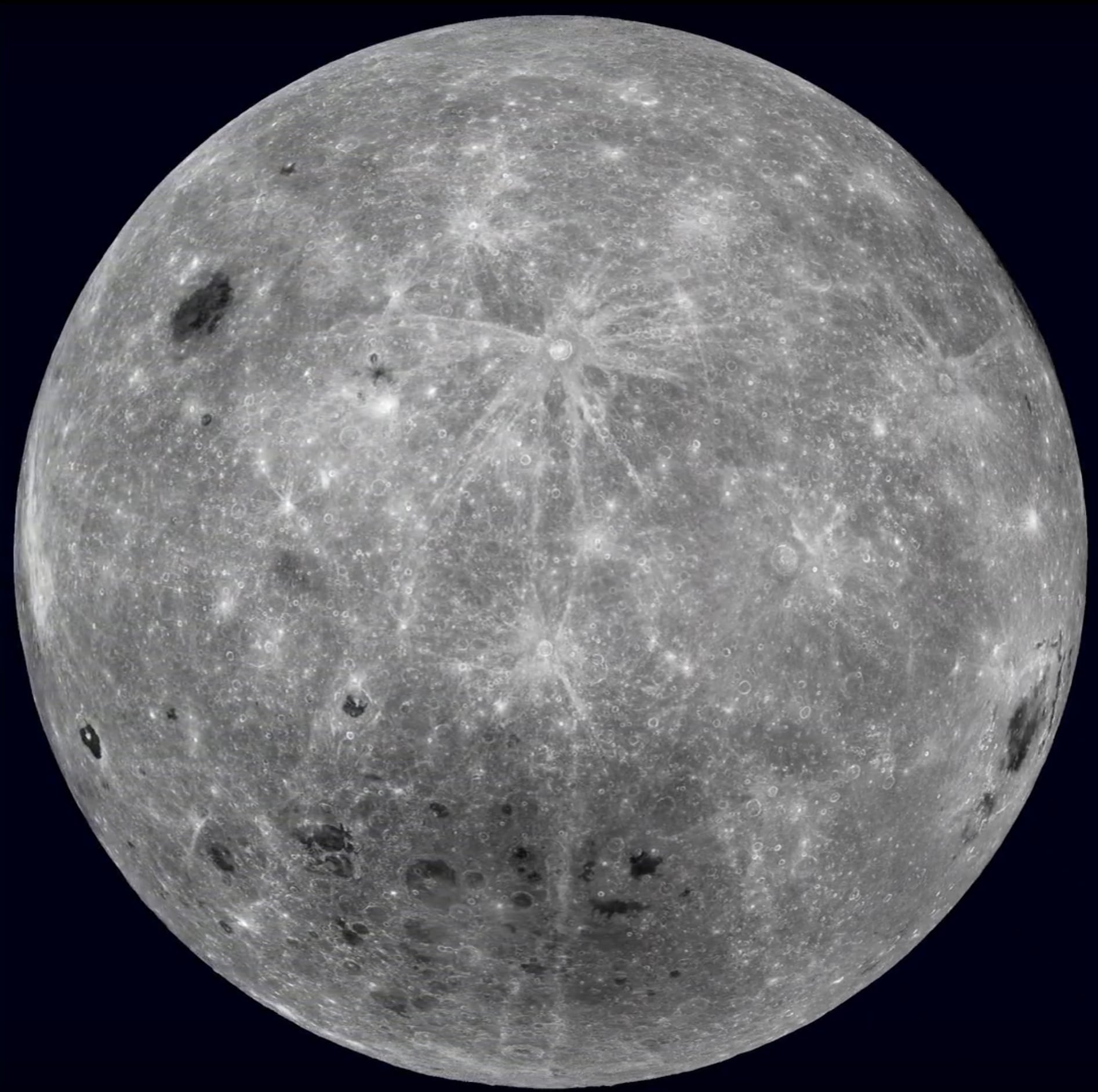
The Moon’s far side spends as much time in sunlight as the hemisphere facing Earth. What makes it look different is geology: densely cratered highlands dominate the hidden face, while broad dark volcanic plains cover much of the familiar one.
NASA summarises one major difference by describing far-side crust about 60 kilometres thick and near-side crust about 40 kilometres thick. Those are representative rounded figures, not uniform shell measurements. Modern gravity models give lower global averages and enormous local variation, but agree that the far-side crust is substantially thicker.
That extra rock made it harder for magma to reach the surface after ancient impacts formed basins. Yet the simple image of asteroids punching holes and releasing lava misses important steps. The impacts excavated and fractured crust; mantle-derived magma rose through some of those weakened regions later. The near side also contained more heat-producing elements and a warmer mantle.
The result is a hemispheric difference written across the sky. Much of the “Man in the Moon” is basalt that erased an older landscape. On the far side, the ancient battered crust remains more exposed.
Far side and dark side describe different things
The Moon rotates once during each orbit around Earth, a synchronised state called tidal locking. It therefore keeps nearly the same hemisphere pointed towards us. This fixes the view from Earth, not the direction of sunlight.
At full moon the near side faces the Sun and the far side is in night. At new moon the geometry reverses, with the far side broadly illuminated and the familiar face dark. NASA’s Moon facts guide states plainly that the far side is not a permanent night hemisphere.
A full day-and-night cycle at one lunar location lasts about 29.5 Earth days. Away from unusual terrain near the poles, that means roughly two weeks of daylight followed by two weeks of darkness. Permanently shadowed crater floors do exist near both poles, but they are local pockets created by the Moon’s small axial tilt and surrounding topography.
Space Daily has previously traced how Luna 3 first photographed the sunlit far side in October 1959. The blurred frames revealed that the hidden hemisphere lacked the vast dark plains visible from Earth. It was a geological surprise, not the discovery of a lightless world.
The roughness is an older surface left exposed
The pale lunar highlands formed very early. As the young Moon’s magma ocean cooled, buoyant plagioclase-rich material rose and accumulated into a primary crust. Billions of impacts then shattered, mixed and cratered its upper layers, producing regolith at the surface and a much deeper zone of broken bedrock called the megaregolith.
The far side is not rough because it necessarily suffered a dramatically greater bombardment. Large basins and smaller craters formed across both hemispheres, and estimates generally do not require a major near-to-far difference in impact rate.
The main visual difference is preservation. Basalt later resurfaced large areas of the near side, burying smaller craters, filling depressions and smoothing basin floors. With far less volcanic resurfacing, the opposite hemisphere retained more overlapping craters, ejecta and ancient highland relief.
The dark areas are maria, the plural of the Latin word mare, or sea. They contain no water oceans. They are iron-rich basalt plains whose lower reflectivity makes them contrast with brighter highland rocks rich in aluminium and calcium. Some of the largest impacts prepared the basins; volcanic eruptions supplied most of the dark fill.
Sixty and 40 kilometres are useful rounded values
NASA’s current guide to lunar composition gives about 60 kilometres for the far side and 40 kilometres for the near side. The comparison captures the scale and direction of the asymmetry. It should not be read as two constant layers with a sharp step at the lunar limb.
Crustal thickness cannot be observed directly across a whole planet. Scientists infer it from topography, gravity, rock density and the depth of the crust-mantle boundary. Apollo seismometers supplied early local constraints, all from the near side. NASA’s GRAIL mission transformed the global picture in 2012.
GRAIL’s two spacecraft flew in formation and used radio signals to measure tiny changes in the distance between them. A region with extra mass tugged the leading probe slightly more before pulling on the trailing one. Combining the resulting gravity map with Lunar Reconnaissance Orbiter topography let researchers separate surface relief from hidden structure.
A 2013 analysis of GRAIL data placed the Moon’s global average crustal thickness between 34 and 43 kilometres, roughly 10 to 20 kilometres below several pre-GRAIL estimates. The range depends on assumed crustal density, mantle density and porosity.
Local values depart radically from every average. Several enormous basins retain only a few kilometres of crust, and models put parts of some far-side highlands near 80 kilometres. The enduring result is not that every far-side point measures 60 and every near-side point 40. It is that the farside highlands carry a substantially thicker crustal column overall.
Impacts opened basins but did not pour out lava instantly
The headline’s “punch through” wording is a physical shorthand. A basin-forming impact releases enormous energy, excavates rock, fractures the remaining crust and can generate a pool of impact melt. That melt is rock liquefied by the collision itself. It is not the source of most mare basalt.
The dark plains were built mainly by magma produced through partial melting in the mantle. It rose later through dikes and fissures, erupted from vents and spread in repeated sheets across low basin floors. In some locations, a long interval separated the basin-forming impact from the youngest lava that filled it.
This distinction changes how crustal thickness works. Basaltic magma is denser than the pale anorthositic upper crust, so a thick column creates both a gravitational and mechanical obstacle. Fractures may stall before reaching the surface, and rising magma can freeze within the crust. An impact basin reduces the distance and supplies weaknesses, making eruption more likely without behaving like an open pipe to a global magma reservoir.
On the thinner, lower near side, more magma completed that journey. Thick far-side crust suppressed many routes but did not seal the hemisphere absolutely. Mare Moscoviense, Mare Ingenii and dark deposits within South Pole–Aitken show that far-side volcanism occurred where local crust, temperature and stress permitted it.
The near side also made and retained more melt
Much of the near side belongs to the Procellarum KREEP Terrane. KREEP is a compositional label built from potassium’s chemical symbol K, rare-earth elements and phosphorus. The region is also enriched in uranium and thorium compared with most of the far side.
Radioactive isotopes of potassium, uranium and thorium release heat as they decay. Their concentration could keep parts of the near-side mantle warmer and capable of partial melting for longer. A thinner crust then made it easier for that melt to erupt, so magma supply and escape route reinforced one another.
The thermal difference may not be entirely ancient. A 2025 analysis of GRAIL’s time-varying gravity found a two to three per cent difference in mantle rigidity between the hemispheres. The authors favoured a present-day near-side mantle roughly 100 to 200 kelvin warmer than the far-side mantle.
Space Daily reported how the Moon’s monthly tidal response exposed that deep asymmetry. The GRAIL spacecraft had ended their mission in 2012, but their precision tracking data preserved how Earth’s changing pull deformed the Moon, allowing researchers to infer differences far below the mapped crust.
Why the asymmetry began remains unsettled. Proposed explanations include uneven crystallisation of the lunar magma ocean, mantle overturn that concentrated late-forming material on one hemisphere, heat from the nearby post-impact Earth, and one or more enormous impacts that reorganised the crust and mantle. Crustal thickness helps explain the visible result without, by itself, explaining the original lopsided Moon.
South Pole–Aitken prevents an overly simple answer
The South Pole–Aitken basin is roughly 2,500 kilometres across and occupies a vast part of the far-side southern hemisphere. Its impact excavated and thinned the crust more severely than almost anywhere on the Moon. If a thin crust alone guaranteed mare flooding, this basin should be a dark plain comparable to the great near-side maria. It is not.
There are basalt deposits within South Pole–Aitken, including old buried plains called cryptomaria and younger exposed patches. They underfill the basin dramatically. The mismatch shows that melt supply and the thermal evolution of the lithosphere mattered alongside the depth of the crust.
A 2024 study of the basin’s volcanic underfilling proposed a sequence in which the oblique impact stripped away much of the roughly 60-kilometre highland crust and its insulating megaregolith. The exposed basin then lost heat unusually quickly. As the lithosphere cooled and thickened, it became harder for later buoyant magma to rise even though the crust itself remained thin.
That model is a proposed history rather than a final verdict, but it illustrates the coupled controls. Impacts can simultaneously open eruption routes and accelerate cooling. A basin favourable to early lava may become resistant later.
Chang’e-6 returned the far side’s volcanic record
China’s Chang’e-6 landed in the Apollo basin within South Pole–Aitken and returned 1,935.3 grams of soil and rock in June 2024. It was the first physical material collected from the lunar far side.
Space Daily’s account of the Chang’e-6 sample return described why the rocks finally allowed a laboratory comparison with Apollo, Luna and Chang’e-5 material from the near side. The landing site itself is a rare dark volcanic unit inside a hemisphere dominated by highlands.
A study of Chang’e-6 basalt fragments dated the main eruption at 2.807 billion years ago and identified a much older volcanic fragment formed about 4.2 billion years ago. Those endpoints show that known far-side mare volcanism persisted for at least 1.4 billion years.
The younger basalt came from a mantle source depleted in KREEP and its heat-producing elements. That creates a useful constraint: scarce radiogenic fuel did not prevent every later far-side eruption. Local mantle conditions and the exceptionally thinned crust of South Pole–Aitken still permitted magma to reach the surface.
Mare and buried cryptomare deposits cover about 18 per cent of the Moon overall, according to the study, with roughly 93 per cent of that volcanic terrain on the near side and seven per cent on the far side. The contrast is overwhelming but not absolute.
The two faces record one connected history
The visual difference grew from several linked asymmetries. The far side preserved more thick ancient highland crust. The near side generated more melt and offered it shorter, warmer routes to low impact-basin floors. Lava buried much of the familiar hemisphere’s earlier roughness and created the dark pattern recognised from Earth.
Sixty versus 40 kilometres is a useful doorway into that story, not a complete model or a measurement that applies everywhere. Ancient impacts did not simply strike a subterranean ocean of lava. They created basins and fractures whose later volcanic fate depended on crust, mantle temperature, chemistry, elevation and time.
The far side is neither permanently dark nor wholly without volcanic plains. It is the more lightly resurfaced hemisphere, where an older, thicker and rougher Moon remains exposed.