

The phrase “dark side of the Moon” has survived because it compresses two kinds of invisibility into one. The Moon has a day side and a night side, determined by sunlight. It also has a near side and a far side, determined by the view from Earth. Those divisions are not the same.
Sunlight moves across both lunar hemispheres. The far side was hidden for most of human history not because the Sun never reached it, but because the Moon keeps nearly the same face turned towards Earth. Only a spacecraft could carry a camera far enough around the lunar limb to reveal the missing terrain.
The Soviet Luna 3 probe did that in October 1959. The timing gives the achievement an unusually sharp historical scale. Its first far-side photograph was made on 7 October, exactly 71 days short of the 56th anniversary of the Wright brothers’ first powered flight.
The far side gets days and nights
At any moment, the Sun illuminates half of the Moon, just as it illuminates half of Earth. Which half is bright changes continuously as the Moon moves. NASA’s Moon Facts guide makes the geometry plain: at full moon, the Earth-facing hemisphere is in sunlight; at new moon, the far side is broadly illuminated while the near side is having its night.
A complete cycle from one lunar noon to the next lasts about 29.5 Earth days. At many locations, that produces roughly two Earth weeks of daylight followed by roughly two weeks of night. Averaged across the two hemispheres over time, the far side does not receive less sunlight simply because it faces away from Earth.
There is a local exception that should not be confused with the old phrase. Deep craters near the lunar poles contain permanently shadowed regions whose floors the Sun never reaches because of the Moon’s small axial tilt and the surrounding terrain. These are particular pockets of darkness near both poles, not a permanently unlit far-side hemisphere.
Tidal locking hides geography, not sunlight
The Moon turns on its axis. It happens to complete one rotation in about the same time it completes one orbit around Earth, a state called synchronous rotation or tidal locking. As NASA’s explanation of tidal locking shows, each rotation is matched to one journey around Earth, keeping the same hemisphere directed towards us.
The alignment is not perfectly rigid from an observer’s perspective. The Moon’s elliptical orbit, tilt and viewing geometry produce an apparent wobble called libration. By watching over time, people on Earth can glimpse narrow areas beyond the average limb and see about 59 per cent of the total lunar surface.
That makes “humanity had never seen the far side” useful shorthand rather than a claim that every square metre beyond an exact dividing line was unknown. Libration exposed slivers around the edges. The great central expanse of the far-side hemisphere remained beyond direct human sight and beyond the reach of any Earthbound telescope.
We have previously explained why the far side is not permanently dark. Luna 3 adds a second story to that geometry: the moment an inaccessible viewpoint became an engineering problem that could be solved.
Luna 3 carried the camera beyond the limb
The Soviet Union launched the spacecraft then known as the Automatic Interplanetary Station on 4 October 1959. After passing over the Moon’s southern polar region at an altitude of roughly 7,900 kilometres, it swung behind the Moon and looked back at the side illuminated by the Sun.
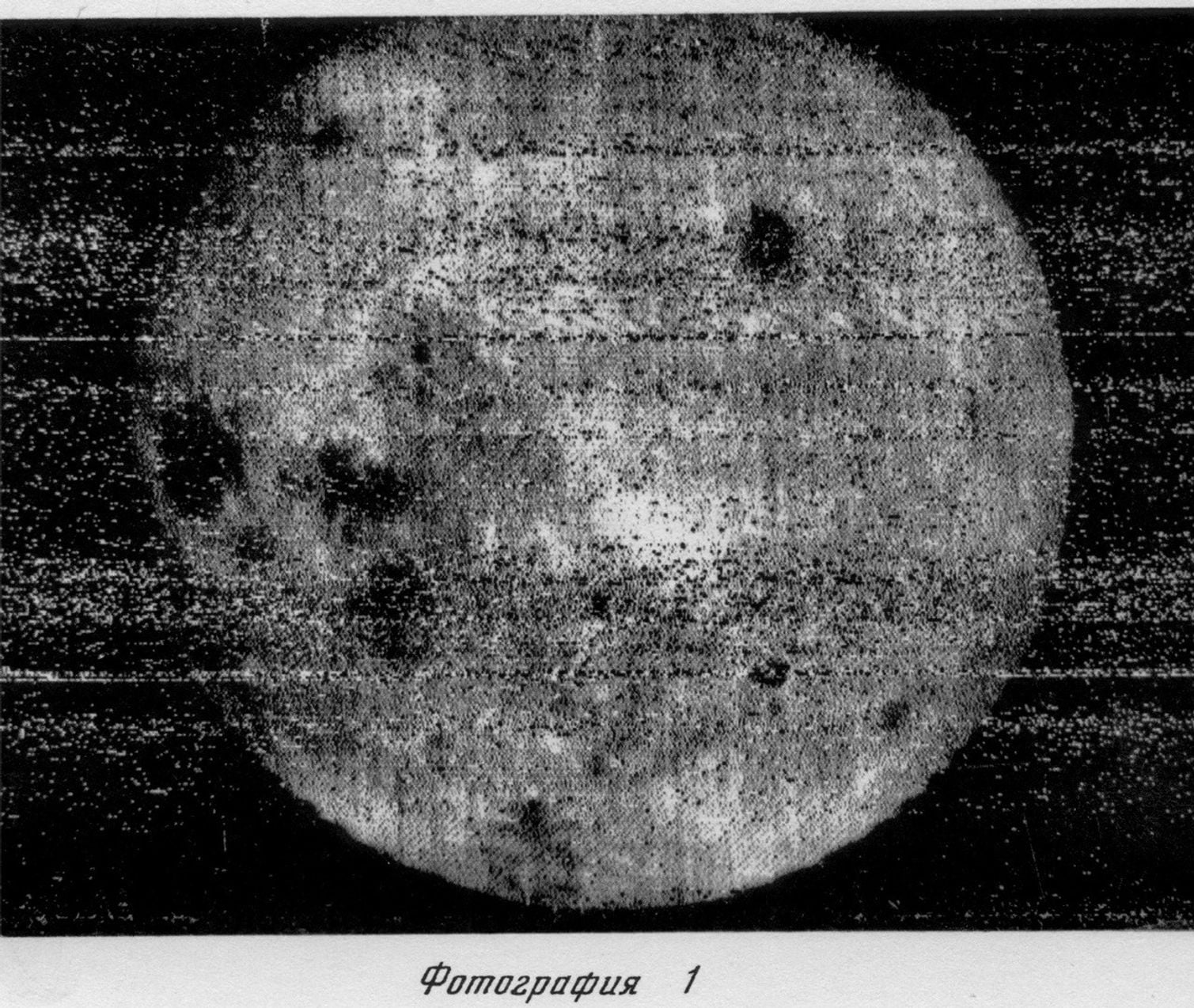
According to NASA’s record of the first close-up, Luna 3 began taking pictures at 03:30 UT on 7 October from about 63,500 kilometres away. It exposed 29 photographs over roughly 40 minutes, covering about 70 per cent of the far side. The pictures were noisy, low-resolution and difficult to interpret, but recognisable features emerged from them.
The lighting is important. Luna 3 did not somehow photograph terrain hidden in permanent darkness. It arranged its flight so that the previously unseen hemisphere was sunlit when the camera looked back. The mission succeeded by changing the observer’s position, not by finding light where none had existed.
The pictures came from a flying darkroom
The mission preceded digital photography. Luna 3 recorded its frames on 35-millimetre film, then developed the film automatically inside the spacecraft. The resulting negatives were scanned line by line and converted into an analogue signal for transmission to receiving stations on Earth.
A NASA history of the early Luna programme compares the process to a facsimile. The camera first had to orient towards the Moon. The film chemistry then had to develop usable negatives in flight, a scanner had to read them, and radio equipment had to send a weak representation of those frames across hundreds of thousands of kilometres.
Not every exposure survived that chain in useful form. Seventeen images were good enough to contribute to an early map. Their streaks and noise are part of the record. They show not only the Moon but the limits of the imaging and communications system that had reached it.
The calendar puts the achievement in perspective
On 17 December 1903, Orville Wright piloted the Flyer for 12 seconds over the sand at Kitty Hawk, North Carolina. The first successful powered, controlled flight covered 36 metres. The Smithsonian’s account of the 1903 Wright Flyer records three more flights that morning, with the final attempt lasting 59 seconds.
Luna 3 opened its camera shutter 55 years, nine months and 20 days after that first flight. The interval was shorter than an ordinary human lifetime. Someone old enough to remember news of Kitty Hawk could have watched the first rough image of the Moon’s hidden hemisphere appear in newspapers.
The comparison should not be mistaken for a simple line of descent. The Wright Flyer and Luna 3 came from different countries, institutions, technologies and political circumstances. Between them lay two world wars, rocketry, radio, electronics, high-altitude research and the opening phase of Cold War competition. Still, the dates show how quickly the scale of the engineering problem changed, from sustaining a piloted machine just above a beach to guiding an automatic camera around another world.
The blur revealed a different Moon
Even at low resolution, the far side did not resemble the familiar lunar face. The near side is marked by broad, dark plains called maria, ancient impact basins later flooded with basaltic lava. Luna 3 showed that such plains were much less extensive on the opposite hemisphere, which appeared more densely cratered. NASA’s history of lunar exploration identifies that contrast as one of the mission’s immediate discoveries.
The early images supported the naming of features including Mare Moscoviense, and later missions steadily replaced the blurred first outline with global maps. NASA’s Lunar Reconnaissance Orbiter can now reconstruct Luna 3’s viewing geometry and show the same terrain in fine detail. Apollo 8’s Frank Borman, Jim Lovell and William Anders became the first humans to see the far side directly with their own eyes in December 1968.
That sequence is worth keeping precise. The far side was never an unlit half-world. It was a sunlit and shadowed landscape withheld by geometry, partly glimpsed at the margins and finally photographed from beyond Earth. Luna 3’s grainy frames changed the Moon from a globe with a largely blank hemisphere into a place that could be mapped.
Less than 56 years separated the Wright Flyer’s first 12 seconds in the air from that transmission across space. The images were poor. The change in human perspective was not.