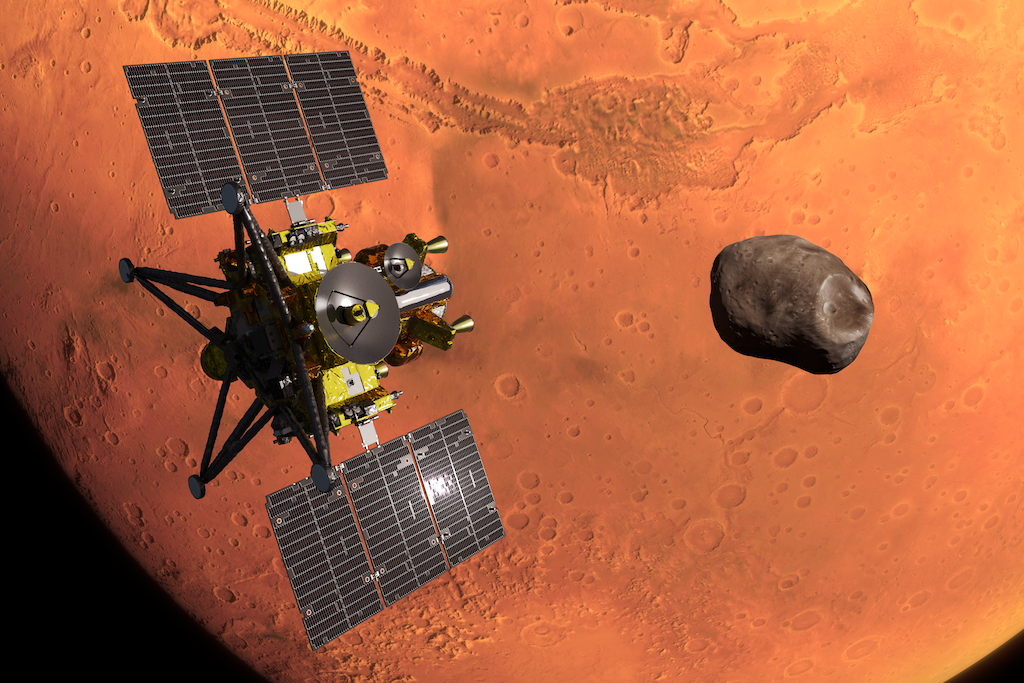
If the schedule holds, a small Japanese capsule will cross the Australian sky in the 2031 fiscal year and land carrying more than 10 grams of material gathered from Phobos, the larger of Mars’s two moons.
Ten grams is about two teaspoons of dry dust. Yet mixed through it may be something much more difficult to collect: fragments of Mars knocked from the planet by ancient impacts and deposited on Phobos over hundreds of millions of years.
That possibility is one of the most interesting parts of JAXA’s Martian Moons eXploration mission, or MMX. The spacecraft is scheduled to launch in the Japanese fiscal year 2026, reach Mars in 2027, collect samples from Phobos and send its return capsule back towards Earth in 2031. MMX has not launched yet, and spaceflight calendars move, so every date in that sentence remains a plan rather than a completed event.
What I keep coming back to is the oddness of the archive. Perseverance is choosing individual Martian rocks because scientists know exactly where each one came from. MMX will collect material from a moon. Some of its most valuable grains, however, may have been delivered there by Mars itself.
Phobos has been sweeping up pieces of Mars
Mars has been hit by asteroids throughout its history. A large impact does not merely excavate a crater. It launches a plume of pulverised and melted rock above the surface, and some of that debris travels fast enough to reach space.
A fraction escapes Mars entirely and, after a long journey, occasionally falls to Earth as a Martian meteorite. Another fraction remains in the Mars system. Phobos orbits only about 6,000 kilometres above the Martian surface, close enough to intercept some of the ejecta.
This gives the moon an unexpected second identity. It is not only an object with an origin that planetary scientists want to determine. It is also a natural dust collector that has spent an immense span of time passing through material thrown off the planet below.
I recently wrote about Phobos’s exceptionally fast orbit, which carries it around Mars more than three times each Martian day. The detail that stayed with me afterwards was that MMX may answer two questions with the same handful of dust. The bulk chemistry could help establish whether Phobos is a captured asteroid or material assembled near Mars, while stray Martian grains could preserve pieces of the planet’s own history.
Ten grams may contain several dozen Martian grains
A 2019 study led by Ryuki Hyodo and published in Scientific Reports modelled how ejecta from Martian impacts could reach Phobos. The authors estimated that regolith mixed by impacts over the past 500 million years should contain at least about 340 parts per million of Martian material on average.
Apply that concentration to a 10-gram sample and the total Martian component is only about 3.4 milligrams. The paper then assumed representative grains around 0.3 millimetres across and roughly one ten-thousandth of a gram each. On those assumptions, the sample would contain at least about 34 identifiable grains from Mars.
That is a model result, not a promise that 34 grains will be waiting in the capsule. The true number will depend on where MMX samples, how evenly ejecta are mixed, the sizes of the grains and whether laboratory teams can recognise them among the native Phobos material. JAXA plans to use two different sampling mechanisms and obtain material at more than one location, which should improve the odds of returning a representative collection.
The attraction is not just quantity. Martian meteorites found on Earth must survive the violence required to escape Mars, a journey through interplanetary space and entry through our atmosphere. Material delivered to nearby Phobos can arrive at lower speeds. Hyodo’s team argues that these grains should, on average, be less heavily shocked and could include more fragile sedimentary material than the meteorites available in terrestrial collections.
Because impacts have occurred in different places and at different times, a small scoop might also contain grains from more than one Martian terrain and geological era. Their original locations would be unknown, which is a serious limitation, but their variety could make them a remarkably broad reconnaissance sample.
A random archive is different from a carefully chosen core
This is where the contrast with NASA’s Perseverance rover becomes useful. Perseverance is drilling rocks in Jezero crater after examining their textures, chemistry and geological setting. The tubes themselves were made to extraordinary cleanliness standards because, as the Space Daily editorial team explained in its article on the sample system, a trace of terrestrial contamination could complicate the search for ancient Martian organic chemistry.
That context is the strength of the Perseverance collection. If a sample eventually reaches Earth, researchers will know which rock unit it came from and what lay around it.
A Martian grain extracted from Phobos is almost the inverse. It may have lost its address, but it may come from a part of Mars no rover has visited. A single MMX sample could therefore trade geological context for breadth. The two approaches do not compete so much as answer different questions.
Space Daily’s editorial team recently placed MMX alongside Perseverance and several asteroid missions in its overview of the coming sample-return missions. What makes the Phobos sample unusual within that wider programme is the chance that one container will hold two histories: the history of a moon and a shuffled selection of debris from the planet it circles.
Organic chemistry would not, by itself, mean life
The most tempting version of this story is that MMX could bring traces of ancient Martian life to Earth. It is possible to describe a scientifically defensible path to that result, but every step in the path is conditional.
Mars would first have needed to host life. A relevant rock would then have had to preserve a biosignature, survive being blasted from the surface, land on Phobos, remain in a sampled area and retain something recognisable after exposure to radiation and further impacts. The returned grain would finally have to be found inside a much larger quantity of Phobos dust and distinguished from contamination and non-biological chemistry.
Organic molecules are not proof of biology. They can form without life, and meteorites deliver them throughout the Solar System. Even textures and mineral associations that look suggestive can have several explanations. Space Daily’s coverage of the Cheyava Falls sample and its potential biosignatures is a good example of why the word potential matters.
A more realistic first hope is that MMX returns Martian grains containing well-preserved minerals, isotopic ratios or organic compounds that reveal something about the environment in which they formed. If any pattern points towards biology, it would need to survive comparison with non-biological alternatives and, ideally, appear in more than one line of evidence.
Why JAXA says the sample is safe to return
There is an obvious question here. If Phobos might hold pieces of ancient Mars, why is its material treated differently from samples brought directly from the Martian surface?
JAXA’s planetary-protection assessment considered how much Martian material could reach the planned sampling area, how long it would be exposed to the harsh surface environment and the probability that any organism could remain viable. In 2019 the agency reported that the probability of a viable Martian microorganism being present in the returned MMX sample was below one in a million with 99 per cent confidence. COSPAR accepted the assessment, allowing the mission to be treated at the same return-safety level as Hayabusa2 rather than as a restricted Earth return from Mars.
That does not contradict the search for ancient traces. A chemical signature left in rock billions of years ago is different from a living organism capable of surviving the trip. Planetary protection has to keep those ideas separate.
The issue runs in both directions. In my article on why Cassini was deliberately sent into Saturn, I looked at the effort required to prevent an Earth spacecraft from contaminating a potentially habitable moon. With MMX, the concern is material coming home. Both cases rely on probability, sterilisation history and the particular environment involved, rather than on a blanket rule that every world is either dangerous or harmless.
The capsule is still five years and one launch away
JAXA’s current sequence has MMX leaving from Tanegashima in fiscal year 2026, arriving at Mars in 2027, studying and sampling Phobos through the end of the decade, departing Mars in 2030 and returning its capsule in fiscal year 2031. Australia has given in-principle support for a landing area, drawing on the recovery experience built around Hayabusa and Hayabusa2.
Once the capsule is recovered, the painstaking work begins. JAXA’s curation team says it is preparing to catalogue the material and begin distributing allocated samples to researchers within roughly three months of the return. Identifying Martian grains will require laboratory measurements detailed enough to separate them from Phobos material and from any terrestrial contamination.
There are several points at which the plan could change. Launch dates slip. Sampling a moon with extremely weak gravity is technically difficult. A 10-gram target is not the same thing as 10 grams safely sealed on Earth.
Still, the scientific idea is beautifully economical. MMX does not have to land on Mars to collect Mars. The planet has been throwing pieces of itself into space for billions of years, and Phobos may have kept a small, disordered portion of them within reach.
If the capsule arrives in Australia in 2031, its most consequential contents may not be the material the spacecraft travelled to collect. They may be the accidental passengers mixed through it.