Imagine placing two thermometers on Mars at noon. One lies flat against dark, sunlit soil near the equator. The other hangs roughly at the height of a standing person’s head.
The lower thermometer could read 24 degrees Celsius, a mild spring day by Earth standards. The upper one could remain at or below freezing. Nothing separates them except about two metres of the thinnest lower atmosphere any person in a spacesuit is likely to encounter.
NASA uses almost exactly this comparison in its Mars facts guide: spring at your feet and winter at your head. It sounds like a piece of planetary trivia, but it captures something fundamental about Martian weather. On Earth, the air is usually effective enough at moving heat that we treat the temperature of the ground and the temperature of the atmosphere as parts of the same experience. On Mars, they can behave like neighbouring but weakly connected systems.
The 24-degree figure is a plausible local surface temperature, not a promise about every equatorial noon. Season, dust, slope, colour, elevation and the material underfoot all matter. The real point is the vertical contrast. Sunlight can briefly warm the ground above freezing while the sparse gas above it stays bitterly cold.
The first trick is that ground temperature is not air temperature
A weather report on Earth normally gives air temperature measured in shade, not the temperature of sunlit concrete or beach sand. Those surfaces may be far hotter than the reported maximum. We know the distinction in daily life, but the atmosphere mixes enough heat through its lowest layers that a standing person does not ordinarily place their shoes in one season and their face in another.
Mars pushes the same distinction to an extreme. The ground absorbs sunlight and converts it to heat. A thermal infrared instrument can measure the energy radiated by that skin of dust and rock. A separate sensor measures the gas surrounding a rover. Both values are real, but they describe different material with very different capacities to absorb, store and transport energy.
That is why the warmest number quoted for Mars is usually a surface temperature. The air is much less willing to follow it. Even at the equator, a patch of ground that has crossed zero degrees does not imply a warm afternoon atmosphere.
There is almost no air available to carry the heat
The atmosphere at the Martian surface has less than one per cent of the pressure of Earth’s atmosphere at sea level. It is mostly carbon dioxide, but the abundance of a greenhouse gas by percentage is not enough to make a strong greenhouse blanket. The total quantity of gas overhead is small.
On Earth, molecules colliding with warm ground pick up energy. Convection, turbulence and wind then move that energy upward and sideways. Water vapour, clouds and oceans store and redistribute still more heat. Mars has weather, clouds and vigorous dust storms, but its near-surface gas contains far fewer molecules through which heat can travel.
This thinness has appeared repeatedly in the Mars machines I have written about. Ingenuity had to spin unusually large rotors at extraordinary speed to fly in air around one per cent as dense as Earth’s. MOXIE needed a pump to gather enough carbon dioxide before it could make oxygen. The same scarcity that makes lift and gas collection difficult also weakens the exchange of heat between soil and atmosphere.
The result is not zero heat transfer. The warmed surface drives turbulence and convective vortices, including dust devils. It simply cannot force the lowest two metres towards one uniform temperature as efficiently as Earth’s denser air usually does.
Perseverance measured the gradient directly
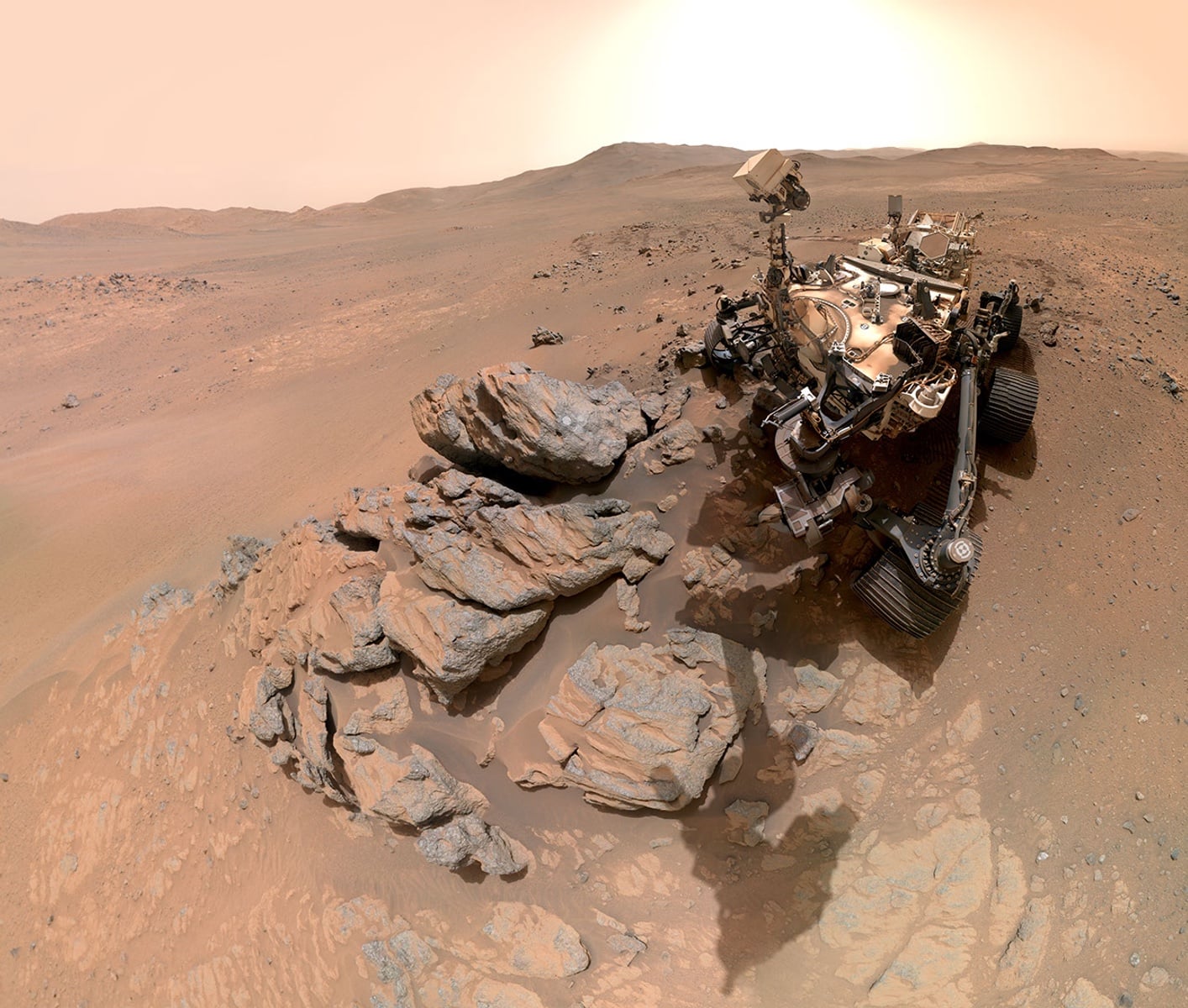
This is no longer only a thought experiment. The Mars Environmental Dynamics Analyzer, or MEDA, on Perseverance measures temperatures in and around Jezero Crater. Its sensors distinguish the surface from atmospheric layers at different heights.
NASA reported typical early MEDA observations in which the surface rose from about minus 83 degrees Celsius before dawn to 5 degrees at noon, while the air remained between about minus 83 and minus 23 degrees. Those particular days did not reproduce the 24-degree example, but they showed the same separation between a rapidly heated surface and colder air.
A 2023 analysis of MEDA measurements in the Journal of Geophysical Research: Planets quantified the vertical structure. For a set of repeatedly observed sols, the daytime temperature difference was concentrated in the first 1.45 metres above the ground. Near noon, the gradient reached about 26 degrees Celsius per metre.
The precise value changes with conditions, and it should not be applied to every place and season. Yet it gives physical substance to NASA’s spring-and-winter comparison. The lowest part of the Martian atmosphere can contain an enormous temperature change across the height of one human body.
Curiosity saw the distinction too. In one early sequence at Gale Crater, ground temperatures ranged from 3 to minus 91 degrees Celsius while air temperatures ranged from minus 2 to minus 75. The ground achieved both the warmer daytime peak and the colder nighttime minimum. It responded faster in both directions.
The kind of ground beneath the boots matters
Not every Martian surface heats at the same rate. Fine, loose dust has low thermal inertia. It changes temperature quickly when sunlight arrives and quickly loses that heat after sunset. Solid rock conducts and stores more energy, so it warms and cools more slowly. Particle size, cementation and material buried beneath the surface all affect the curve.
Planetary scientists use thermal inertia to interpret those differences from orbit. A region that remains relatively warm after sunset may contain rock, bedrock or coarser material. A dusty surface may produce a sharper afternoon peak and a steeper fall into night.
Colour and orientation matter as well. Darker ground generally absorbs more sunlight. A slope facing the Sun receives energy at a more direct angle than a shaded one. Airborne dust can reduce the sunlight reaching the surface while also changing how radiation moves through the atmosphere. Elevation changes the already low pressure.
There is therefore no single Martian noon temperature. I made a related point when writing about the immense, gently rising landscape of Olympus Mons: a global description can conceal what a person would encounter at ground level. On Mars, even two nearby patches of terrain can follow different thermal schedules.
A warm sole would not make a comfortable astronaut
The image of warm boots risks making an equatorial noon sound more hospitable than it is. An unprotected person could not stand there and compare sensations. The pressure is too low for the human body, the atmosphere contains almost no oxygen, ultraviolet and ionising radiation reach the surface, and liquid water is unstable under most present conditions.
A real astronaut would be separated from both ground and air by a pressure suit, insulation, boots and a controlled thermal system. The suit would manage heat generated by the body while limiting heat gained from sunlight and lost through radiation, contact and the surrounding gas. It would not simply transmit a pleasant 24 degrees from the soil to the foot.
There is another counterintuitive detail. Mars can have fast winds, but because the gas is so thin, those winds carry less force and exchange less heat than winds of the same speed on Earth. The cold air at head height would not feel like an ordinary terrestrial winter gale. Without a suit, the low pressure would be the immediate emergency. With one, thermal engineering determines the experience.
This is why my earlier look at the difficulty of building a home on Mars could not reduce the problem to an average temperature. A habitat must survive daily cycling, cold-soaked nights, sunlit surfaces, dust, radiation and a near-vacuum while maintaining one narrow indoor climate for people and equipment.
Mars loses the afternoon almost as quickly as it gains it
The warm ground is temporary. Once the Sun drops, a dusty surface radiates energy into the cold sky and has little atmosphere above it to return that energy. The same weak coupling that allows soil to become much warmer than the air at noon permits it to plunge below the air during the night.
That daily swing has shaped the history of Mars exploration. Solar-powered rovers conserve energy through cold periods and use heaters to keep critical components within operating limits. Batteries, lubricants, cameras and electronics experience a thermal environment that expands and contracts every sol. Opportunity ultimately endured far beyond its original design, but as I wrote in the account of its fourteen-and-a-half-year journey, sunlight remained both its power source and its final vulnerability.
The spring-underfoot image lasts only because sunlight is arriving faster than the particular ground can shed it. It says nothing about the night before, the night ahead or a shaded patch a few steps away.
One body can reveal a whole climate system
There is something useful about reducing Martian climate to the height of a person. Global averages tell us that Mars is cold. Pressure figures tell us that its atmosphere is thin. A vertical temperature profile shows what those statements mean together.
Sunlight crosses the sparse atmosphere and heats the soil. The soil tries to warm the gas touching it. There are too few molecules to distribute that energy efficiently, so a steep gradient forms just above the surface. Turbulence carries some heat upward, but the afternoon never becomes uniform. Then sunset removes the source and the ground rapidly gives back what it gained.
On Earth, weather surrounds us. On Mars, the most dramatic piece of weather may fit between the soles of a pair of boots and the top of a helmet.
NASA’s comparison is memorable because it compresses an alien climate into human proportions. Spring and winter can occupy the same standing person, not because Mars has found a loophole in temperature, but because it lacks the thick, mixing atmosphere that quietly makes our own experience of temperature feel coherent.