

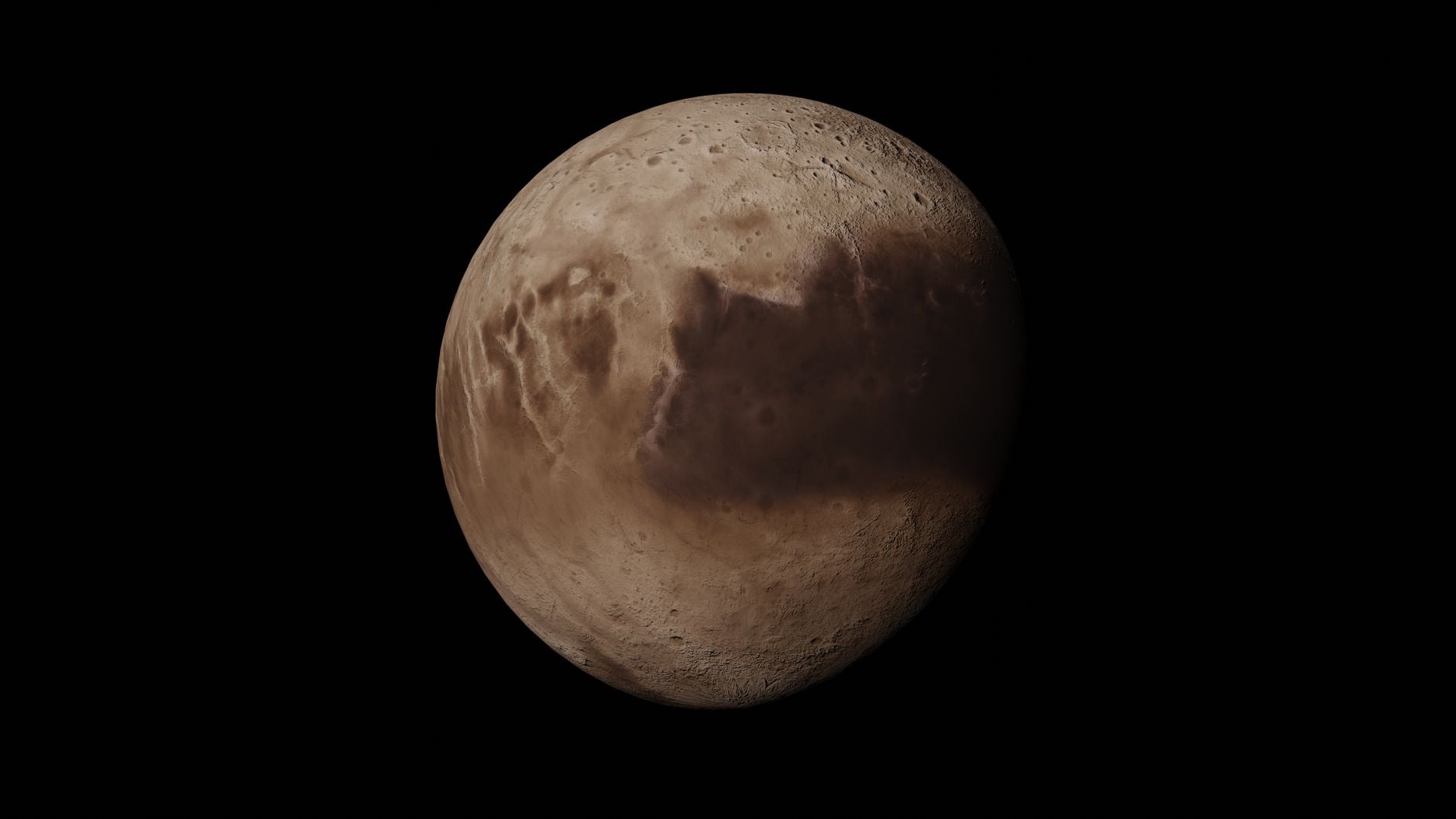
Mars has advertised its hemispheric divide for billions of years. Northern terrain lies low and is dominated by broad, comparatively smooth plains. The south rises into ancient, densely cratered highlands. Beneath those contrasting landscapes, however, planetary scientists have often started with an interior built from uniform spherical shells.
A Nature analysis of Mars’s changing gravity now indicates that the simplification misses a planet-scale feature. The mantle beneath the southern highlands may be 200 to 400 degrees Celsius warmer than the mantle beneath the northern lowlands.
The result came from a team led by Alexander Berne, who developed the method during his doctoral work at Caltech and is now at the University of Arizona. A Caltech account of the study describes the interior as thermally asymmetric and connects the result to the planet’s long geological history.
No probe measured that heat directly. The researchers inferred it from tiny seasonal variations in gravity recorded through the motion of spacecraft. The study detects an unusual mechanical response, translates that response through mineral physics and then asks which interior structures could produce it.
A visible division may extend into the mantle
The crustal dichotomy is among the largest and oldest features on a rocky world. Southern crust is thicker and generally stands several kilometres above the north. It preserves older surfaces, more impact craters and much stronger remanent magnetic fields.
The boundary is not a neat equator. Its irregular outline separates a lower, younger-looking northern province from the rough highlands that dominate much of the south. Competing explanations have invoked internal convection, crustal production and an enormous early collision.
A recent SpaceDaily examination of the same gravity result followed those origin stories and the seismic context. The new treatment here concentrates on the measurement chain and its limits: what the orbiters detected, how rigidity becomes temperature, and where partial melt enters the interpretation.
The Sun turns Mars into an experiment
Mars follows an eccentric orbit and completes one circuit of the Sun in about 687 Earth days. The changing distance and the tilt of the planet’s spin axis vary the solar gravitational forcing over that cycle. Solid rock flexes slightly under this tide.
A body made of perfectly concentric, laterally uniform layers would respond in a predictable set of broad gravity patterns. Mars does not. The team found degree-three components in the time-variable field that differed by as much as 300 percent from the symmetrical prediction.
The approach is known as tidal tomography. Instead of sending waves through a body as a medical scanner does, it recovers lateral structure from a world’s response to a known, changing pull. The NASA planetary gravity solution used by the researchers combines tracking over a long interval so the faint repeating signal can emerge.
Seasonal carbon dioxide complicates the measurement. Gas freezes onto the winter pole and later returns to the atmosphere, shifting mass around Mars and altering gravity. The analysis modelled this atmospheric loading before attributing the remaining pattern to the deeper tide.
Three old spacecraft supplied the evidence
The record came from radio tracking of Mars Global Surveyor, Mars Odyssey and Mars Reconnaissance Orbiter. Together, their measurements cover nearly two decades, including many repetitions of the Martian seasonal cycle.
Ground stations sent radio signals to the orbiters and measured the returning frequency. A spacecraft accelerating toward Earth compresses the signal, while one receding stretches it. Once navigation models account for known forces, minute Doppler residuals reveal changes in the gravitational field through which the spacecraft moved.
The spacecraft were not built as a coordinated Mars gravity constellation. Their value came from longevity, precision navigation and repeated coverage. Combining missions converted routine tracking needed to operate the orbiters into a probe of the mantle hundreds of kilometres below the surfaces they observed.
Rigidity is the measured bridge to temperature
The gravity coefficients do not directly state a temperature. Modelling instead attributes them to a greater-than-20-percent north-south variation in effective shear modulus, the property describing how strongly material resists being distorted sideways.
At seismic timescales, ordinary crystalline temperature differences would have to exceed an implausible 1,000 kelvin to create the required contrast. At the much longer period of a Martian year, laboratory descriptions of olivine predict that effective rigidity becomes roughly 15 to 20 times more sensitive to temperature.
That long-period behaviour leads to the 200-to-400-Celsius-degree estimate. The accepted manuscript archived by NASA calls it a preserved present-day thermal anomaly beneath the southern highlands and identifies regional convection or insulation by thick crust as viable explanations.
This is a hemispheric contrast, not an absolute thermometer reading and not a claim that every point below the highlands shares one temperature. The inversion resolves broad structure. Its preferred rigidity difference has substantial uncertainty, and multiple combinations of temperature, depth and composition can fit parts of the signal.
Composition cannot be ignored
Iron content affects mantle density and mechanical properties, so a compositional contrast could imitate some effects of heat. The acceptable models allow the southern mantle to be enriched in iron by as much as about 5 percent relative to the north.
A separate geometrical constraint limits that option. Mars’s centre of mass sits only a short distance from its centre of figure. A composition-only explanation large enough to create the recovered rigidity pattern would generate an offset roughly 50 times greater than observed.
The authors therefore favour temperature as the main driver, while allowing a smaller compositional contribution. That distinction matters for planetary history. Heat can be maintained or redistributed by convection and insulation; an iron difference would record how ancient melting, crust formation or an impact separated material.
Partial melt is permitted, not detected
A southern mantle hundreds of degrees warmer could approach the melting point of some minerals. The models consequently allow localized pockets of partially molten rock below the lithosphere. Those pockets might rise and then stall within the thick crust.
The paper explicitly says melt is not required by the gravity result. It does not show a magma ocean beneath half of Mars, map individual magma chambers or demonstrate that the southern highlands are volcanically active today. Partial melting is a physical consequence that some permitted temperature structures could produce.
Seismic attenuation also sets a boundary. Waves from the southern Terra Cimmeria region appear to lose more energy than waves associated with northern Cerberus Fossae, consistent with warmer material. Yet the southern quality factors remain well above values expected for extensively molten olivine.
Several histories can preserve southern heat
One possibility is a broad mantle upwelling. Mars lacks Earth’s mobile plate system, so a long-lived circulation pattern beneath its stagnant outer lid could preserve a one-hemisphere thermal structure far longer than a similar feature might survive on Earth.
Another reverses the direction of cause. The already thick southern crust could behave as a thermal blanket, slowing heat loss from the mantle below for billions of years. A greater abundance of radioactive heat-producing elements in that crust could strengthen the insulation.
A giant impact remains relevant because it could have excavated the northern lowlands, changed crustal thickness and depleted iron in the affected northern mantle. Impact heat alone is unlikely to explain a several-hundred-degree difference after more than four billion years, but an impact followed by asymmetric convection or insulation could.
The gravity result cannot choose decisively among those scenarios. It supplies a new present-day constraint that any successful history must reproduce: a mechanical and thermal contrast aligned broadly with the ancient surface divide.
Volcanism and magnetism complicate the picture
If southern mantle is warmer, why is the clearest geologically recent volcanism concentrated at Cerberus Fossae in the north? One answer is that producing melt and erupting it are separate problems. Thick southern crust gives buoyant magma farther to travel and more opportunity to freeze or collect as intrusions.
Tectonic stress provides a second filter. Much of the southern highlands is under compression, which tends to close pathways. Cerberus Fossae is an extensional setting where fractures can open. The location of young surface lava therefore need not identify the warmest mantle.
High-resolution static gravity measurements might eventually reveal dense or light intrusions hidden inside the southern crust. Rock samples from widely separated provinces could also test whether volcanic products record different mantle temperatures and iron contents.
Mars has no global dynamo today, but ancient southern crust is strongly magnetized. Regional upwelling could once have heated crust above the temperature at which magnetic minerals lose their alignment, then allowed it to cool and acquire magnetization before the dynamo stopped.
Alternatively, enhanced heat flow at the southern core-mantle boundary might have driven stronger local convection in the liquid core. That could have made the ancient dynamo itself uneven. Both ideas connect a present mantle pattern to a record written into crust more than four billion years ago.
Neither explanation follows automatically from the new gravity field. The alignment makes them testable possibilities, not established history. Magnetic observations record ancient conditions, whereas tidal tomography constrains how Mars responds now.
A first map that needs independent tests
A network of seismometers could compare wave speeds and attenuation across many paths instead of relying on one InSight station. Electromagnetic sounding could distinguish isolated conductive melt pockets from a connected molten layer. A purpose-built gravity mission could recover finer lateral structure in less time.
Those measurements would test the most consequential parts of the interpretation: how deep the anomaly extends, whether any rock is molten, and whether temperature or composition varies most strongly. They could also show whether the apparent hemispheric pattern breaks into smaller regional cells.
For now, the study replaces an assumed symmetry with a measurable one-sided response. Mars’s southern highlands appear to overlie markedly warmer mantle, but the heat’s origin and the presence of melt remain separate questions. Gravity has drawn the outline; future instruments must determine what fills it.