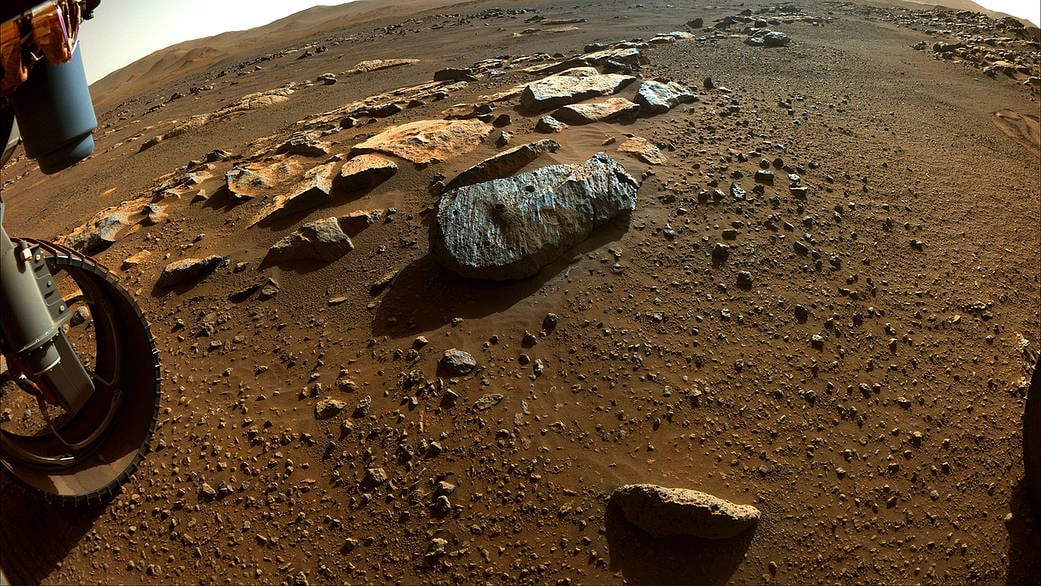
Mars does not need an exotic poison cloud to create a chemical problem for astronauts. The material underfoot is enough. In 2008, NASA’s Phoenix lander mixed scoops of northern Martian soil with water inside its Wet Chemistry Laboratory and detected perchlorate at 0.4 to 0.6 per cent by mass.
At 0.5 per cent, a kilogram of soil contains roughly five grams of perchlorate. These salts can interfere with the thyroid’s uptake of iodide. Fine soil carried back on spacesuits could therefore become more than a cleaning nuisance if it enters a pressurised habitat day after day.
I am a writer, not a toxicologist. This is reporting on a mission-design hazard, not medical advice, and the risk depends on dose, exposure route and the controls built into a habitat.
Phoenix measured the chemistry on Mars
The 2009 Science paper led by Michael Hecht reported 0.4 to 0.6 per cent perchlorate leached from each of the soil samples analysed by Phoenix. The lander had scooped material from the surface and from near an ice table about five centimetres down at its northern plains landing site. The soluble chemistry was similar in both.
There is a useful distinction hidden inside the word “sample”. Phoenix conducted its experiment on Mars. It did not return the material to Earth, and no mission has yet delivered authentic airborne Martian dust to a terrestrial toxicology laboratory. NASA must still infer its human effects from rover and lander chemistry, manufactured simulants, terrestrial compounds and what Apollo taught engineers about dust ingress.
Later measurements by Curiosity and other instruments found oxychlorine compounds elsewhere on Mars. The precise mix can be difficult to separate into perchlorate and chlorate with existing instruments, and abundance need not be identical everywhere. Still, the Phoenix result was not dismissed as a lone instrument anomaly.
Why perchlorate can affect the thyroid
The thyroid needs iodide to make hormones. Perchlorate is carried by the same sodium-iodide transport system and can compete with iodide for entry into thyroid cells. A review catalogued by the US Environmental Protection Agency describes the mechanism as competitive inhibition of iodide transport. At a sufficient dose sustained for long enough, reduced iodide uptake can lower thyroid hormone production.
That mechanism is well established.
The astronaut exposure is not.
Concentration in soil is not the same as a dose in a person. The amount that becomes airborne, the fraction inhaled or swallowed, particle size, exposure time, filtration and cleaning all sit between the 0.5 per cent measurement and an actual health effect. It would be inaccurate to say that merely touching Martian ground causes thyroid disease.
The suit brings the outside problem indoors
A spacesuit returning from a surface excursion is an obvious delivery route. Fine grains can settle into fabric, bearings and seals, then escape during suit removal or airlock repressurisation. They can also scratch visors, obstruct joints and degrade the seals that keep a habitat pressurised. NASA has exposed candidate spacesuit materials carried by Perseverance to the Martian environment partly to understand that wear.
“Impossible to keep out” is best read as the operational problem, not a literal engineering verdict. A well-designed base can keep most dust outside and remove much of what crosses the boundary. The difficulty is doing that reliably after repeated excursions, using equipment that must function for months without a replacement shipment.
As I wrote in an earlier article about the difficulty of making Mars a second home, life there would be life inside maintained machinery. Dust control belongs inside that same life-support problem.
NASA’s 2026 assessment is more reassuring than the headline
In July 2026, a NASA working group proposed limiting Martian particles smaller than 10 micrometres in habitat air to a 24-hour time-weighted average of 0.1 milligrams per cubic metre for exposure periods lasting up to 30 days. Its published assessment of Martian dust limits judged perchlorate a low inhalation risk if that overall fine-dust limit is maintained.
This is the qualification the scary version of the Mars-dirt story often loses. At a soil concentration near 0.5 per cent, controlling the total airborne dust also controls the perchlorate carried within it. NASA’s panel regarded total particle mass as the main near-term engineering concern and recommended planning for short exposure spikes after an excursion.
The proposed limit is an initial standard for early short-stay missions, not a permanent answer for a settlement. NASA reduced an established lunar value by an uncertainty factor because the chemistry, shape and biological effects of real Martian airborne particles remain incompletely known. A mission lasting hundreds of days may require a different evidence base.
Ingestion creates a separate route
Dust in cabin air is only one path. If crews extract water from local ice, process regolith or grow food in soil-derived material, soluble perchlorate could enter water and crops. NASA’s 2026 group therefore recommended broader agency-level management across intake routes even while judging inhalation low-risk under its dust limit.
Possible controls include exterior suitports, segmented airlocks, dust-resistant fabrics, cleaning stages and fine-particle filters. Water and regolith processing would need their own chemical treatment. NASA has funded early work on using engineered microbes to reduce perchlorate, but that remains a technology concept rather than hardware assigned to a crewed mission.
The red soil is not an automatic death sentence, and current NASA analysis does not treat inhaled perchlorate as the leading Martian dust danger. It is a genuine constituent that turns housekeeping into environmental control. Until authentic airborne dust is returned and tested, the standard remains deliberately provisional.