

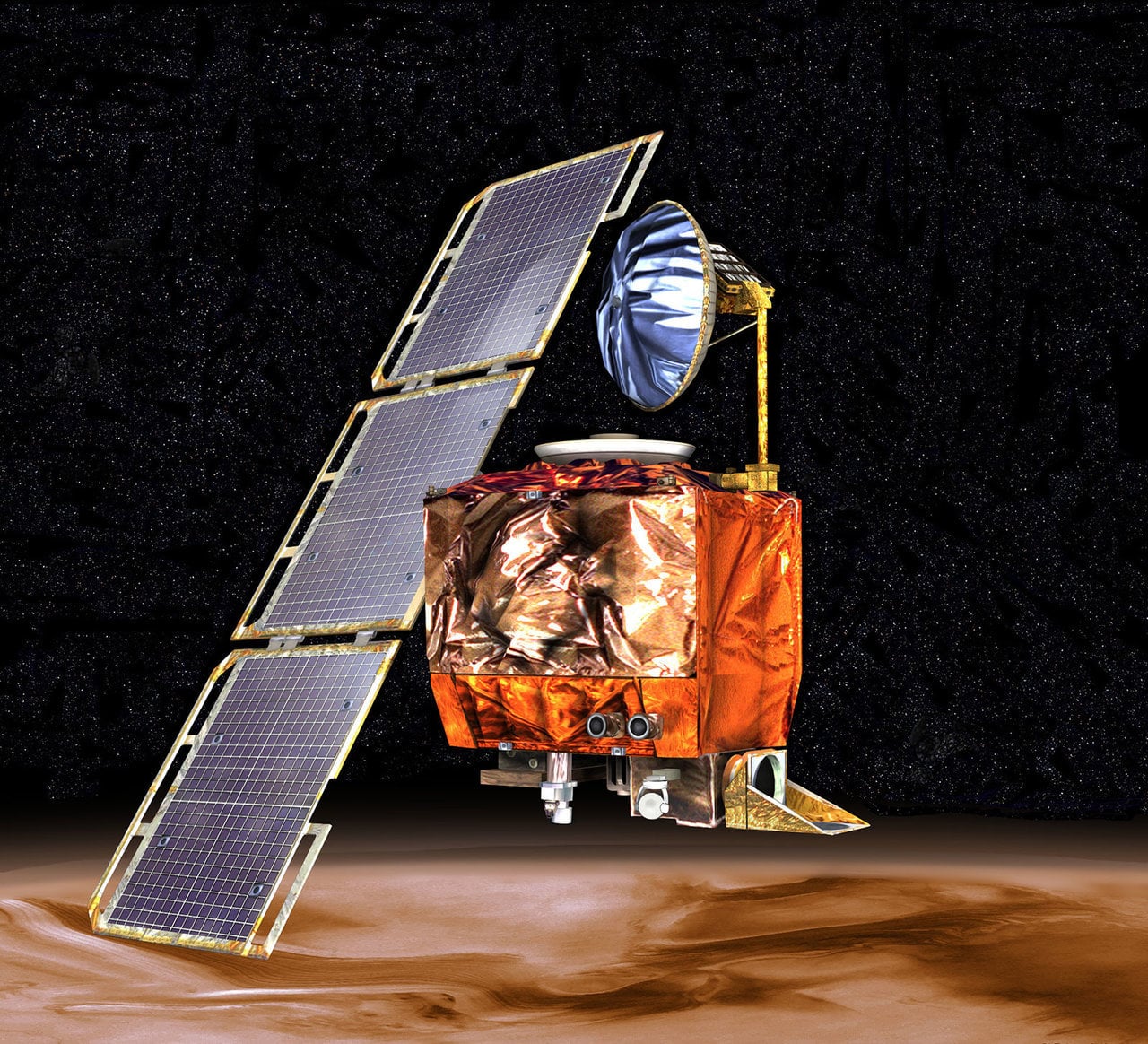
At 09:00:46 UTC on 23 September 1999, Mars Climate Orbiter began firing its main engine exactly as planned.
Five minutes later, the spacecraft slipped behind Mars from Earth’s point of view. Its radio carrier vanished at 09:04:52, 49 seconds earlier than mission controllers expected. The silence itself was normal during an occultation. What was not normal was that, after the predicted 21-minute blackout, the signal never came back. JPL’s announcement that morning said the craft appeared to have passed at about 60 kilometres rather than the planned 150 kilometres, already below its estimated survival limit.
The Delta II rocket had done its job nine months earlier. The spacecraft had survived the cruise from Earth. The orbit-insertion engine started on schedule and the vehicle obeyed the commands it received. Mars Climate Orbiter was lost because the people navigating it did not have an accurate model of where it was going.
Space Daily has covered the broad metric-versus-imperial story before. The closer account is more useful. No flight computer suddenly decided that Mars was measured in feet. No operator typed one catastrophic number into a console. The error sat in a ground-software interface, attached to many small thruster firings, and accumulated while several warnings failed to trigger an effective response.
The spacecraft’s own software was using metric correctly
Mars Climate Orbiter used reaction wheels to control its orientation. By changing the speed of these internal flywheels, a spacecraft can turn without firing a thruster. But the wheels cannot absorb momentum indefinitely. External forces, including the pressure of sunlight on the craft’s large, asymmetrical solar array, gradually pushed them towards their operating limits.
From time to time, small thrusters fired to unload that stored momentum. Engineers called these events angular momentum desaturations. The firings were meant to manage attitude, but a thruster produces a physical impulse whether or not navigation is its primary purpose. Each event nudged the spacecraft’s velocity and therefore had to be included in the ground team’s trajectory estimate.
The software aboard the spacecraft calculated the thruster performance in metric units and did so correctly. The failure occurred on the ground. A program called SM_FORCES generated an Angular Momentum Desaturation file for the navigation team. According to the NASA mishap investigation report, the software interface specification required its output in newton-seconds. Instead, the impulse values were supplied in pound-force-seconds.
That distinction is not cosmetic. A newton-second and a pound-force-second both measure impulse, meaning force applied over time, but one pound-force-second equals about 4.45 newton-seconds. The receiving navigation algorithm trusted that the file followed its specification. It read the numbers as metric and consequently modeled the effect of each firing as only about 22 percent of its real value.
This is why the familiar phrase “NASA forgot to convert to metric” is both correct and too vague. The number crossed a boundary between contractor software and the JPL navigation system with one meaning, then was consumed with another. The unit was specified. The producing system did not follow the specification, and the receiving system did not verify what it had been given.
Many tiny kicks became one large navigational error
A single momentum-unloading event did not send the spacecraft into Mars. The error grew through repetition.
Mars Climate Orbiter’s angular momentum desaturations occurred 10 to 14 times more frequently than the operations navigation team expected. The reason was the spacecraft’s single, off-centre solar array. Sunlight exerted a persistent torque on that asymmetric shape, loading the reaction wheels faster than the team had anticipated from its experience with Mars Global Surveyor, which had symmetrical arrays.
An earlier operating concept would have turned the orbiter 180 degrees each day, a so-called barbecue mode intended to cancel some of the momentum build-up. Later engineering work concluded that the manoeuvre was unnecessary, so it was removed. The mishap board found that the consequences of this change were not adequately communicated to the navigation team.
More desaturations meant more unmodeled impulse. The spacecraft travelled through space along its real trajectory, responding to the full force of every thruster firing. The navigation model travelled along a cleaner imagined path, accounting for less than a quarter of each effect. Over the nine-month cruise, those two paths diverged.
Lockheed Martin Astronautics was NASA’s prime contractor for the spacecraft, and the noncompliant ground output came from the contractor side of the interface. But stopping the account there turns a systems failure into a simple story of vendor blame. NASA’s board identified one root cause and eight contributing causes spread across software validation, staffing, training, communication, systems engineering and operations. An interface between two organisations belongs to both sides if a mission depends on it.
The warning appeared months before Mars
The bad data did not remain perfectly hidden until orbit insertion. During the first four months of cruise, navigation could not use the Angular Momentum Desaturation files at all because they contained format errors and incorrect attitude specifications. Staff instead learned the timing of thruster events by email and tried to model the perturbations themselves.
When corrected-format files finally became available in April 1999, the numbers looked anomalous within a week. Tracking data also contained residuals, differences between the motion the model predicted and the motion the Deep Space Network observed. The main thrust component was unfortunately close to perpendicular to the Earth-spacecraft line of sight, making its full size difficult to see directly in Doppler measurements. Difficult is not the same as invisible, however. The board found that a detectable line-of-sight error was present but its significance was not understood.
The operations navigation team had come aboard shortly before launch. It had not participated in the design reviews or ground-software testing, and it was not intimately familiar with the orbiter’s attitude-control behaviour. Concerns about mismodeling persisted through the spring and summer, but they were handled too informally. The report describes teams relying on email rather than the formal Incident, Surprise, Anomaly process that could have assigned ownership and forced closure.
Space Daily’s contemporaneous report carried the unusually accurate headline “Process, Not Newton More To Blame”. That remains the right frame. The wrong unit mattered because the surrounding organisation allowed contradictory evidence to circulate without producing a decisive test.
The predicted altitude kept falling
On 15 September, the spacecraft performed its fourth planned trajectory correction. That manoeuvre was intended to produce a first periapsis, the lowest point of the initial Mars orbit, of 226 kilometres. A second pass at 210 kilometres would begin weeks of controlled aerobraking, using the upper atmosphere to lower and circularise the orbit gradually.
During the week after the correction, navigation solutions pushed the expected first periapsis down to between 150 and 170 kilometres. In the final 24 hours, as Mars’s gravity made the trajectory easier to measure, the estimate fell further. About one hour before orbit insertion, the team calculated that the spacecraft might pass as low as 110 kilometres. The minimum altitude considered survivable was about 80 kilometres.
There were also unresolved differences among the navigation methods. Solutions using only Doppler data consistently placed the flight path closer to Mars than solutions using other combinations of range and Doppler measurements. These disagreements did not receive a satisfactory explanation before the encounter.
A fifth trajectory correction manoeuvre existed as a contingency and, in principle, could have raised a dangerously low approach. A request to perform it was discussed verbally shortly before orbit insertion, but the necessary analysis, tests and procedures had not been completed. The operations timeline left no comfortable margin to upload, execute and verify the burn, and the critical need for it was not fully understood. TCM-5 was never performed.
The real periapsis was about 57 kilometres
After the spacecraft disappeared, investigators corrected the small-force data and reconstructed the approach using the tracking information available up to loss of signal. Their estimate put the initial periapsis at about 57 kilometres, roughly 170 kilometres below the 226-kilometre target and well beneath the altitude judged survivable.
That reconstruction also explains the early occultation. Mars blocked the radio signal 49 seconds sooner than predicted because the spacecraft was passing much closer to the planet than the navigation solution said.
The exact physical ending cannot be replayed. The 1999 board said Mars Climate Orbiter either was destroyed in the atmosphere or emerged into a heliocentric orbit after the encounter. NASA’s current mission history describes it as having burned up. What is certain is that the vehicle could not have entered the intended operational orbit and was never contacted again.
Its loss also removed a planned communications relay for Mars Polar Lander and the Deep Space 2 microprobes due to arrive that December. Mars Global Surveyor was prepared to take over relay duties. It could not save the sister mission, which also vanished during arrival for unrelated and less certain reasons.
This was not one careless programmer
The board’s list of contributing causes is less memorable than the unit mismatch, but more valuable: undetected modeling errors, insufficient spacecraft knowledge within navigation, failure to execute the fifth correction, a weak transition from development to operations, poor communication, inadequate navigation staffing, inadequate training, and verification and validation that did not properly cover ground software.
The mission was operating under NASA’s “Faster, Better, Cheaper” approach. The Phase II board found that the Mars Surveyor programme accepted significant cuts in personnel and money compared with earlier projects but did not add enough process discipline to control the resulting risk. Our December 1999 analysis, “Beyond BFC,” argued that the conversion error would not have become fatal if the organisation had caught it at one of the many available checkpoints. The formal investigation reached essentially the same conclusion.
A well-defended system would have made units part of the data, not merely a sentence in an interface document. It would have tested the producing and receiving software together. It would have compared the ground file with the correct metric calculation already being transmitted by the spacecraft. It would have reconciled competing navigation solutions and converted unexplained residuals into a formally tracked mission risk. NASA’s later software-development lesson record accordingly called for mission-critical interfaces to receive joined reviews involving systems engineers, developers and end users, along with inspection of acceptance-test results.
Spaceflight cannot eliminate human error. Complex projects produce mistakes, ambiguous signals and misunderstood behaviour constantly. Reliability comes from arranging independent layers so that one mistake is caught by the next person, test, model or instrument before it reaches an irreversible event.
The famous unit error is really an interface error
Mars Climate Orbiter belongs to the same family of cautionary tales as Mariner 1 and its missing overbar. Both stories are often compressed until one tiny technical error seems to carry the whole explanation. In both, the durable lesson lies in asking why a small error had a clear path to mission loss.
Pound-force-seconds were not a foolish unit. Newton-seconds were not magically safer. Both are legitimate measures of impulse. The danger was that the same bare number meant different physical quantities on opposite sides of a software and organisational boundary.
That is why the case remains relevant long after aerospace engineers adopted the report’s specific recommendations. Modern systems are assembled from services, contractors, sensors, models and teams that exchange data constantly. Every boundary carries assumptions about units, reference frames, timestamps, coordinate systems, signs, precision and meaning. A value can be numerically tidy, syntactically valid and disastrously wrong.
Mars Climate Orbiter survived launch, vacuum, radiation and nine months of interplanetary flight. The hardware did not betray it. A sequence of small, correctly executed thruster firings changed its real path while the ground model recorded only a fraction of their effect. The spacecraft was not lost because space is unforgiving, although it is. It was lost because an interface was trusted more than it was tested.