

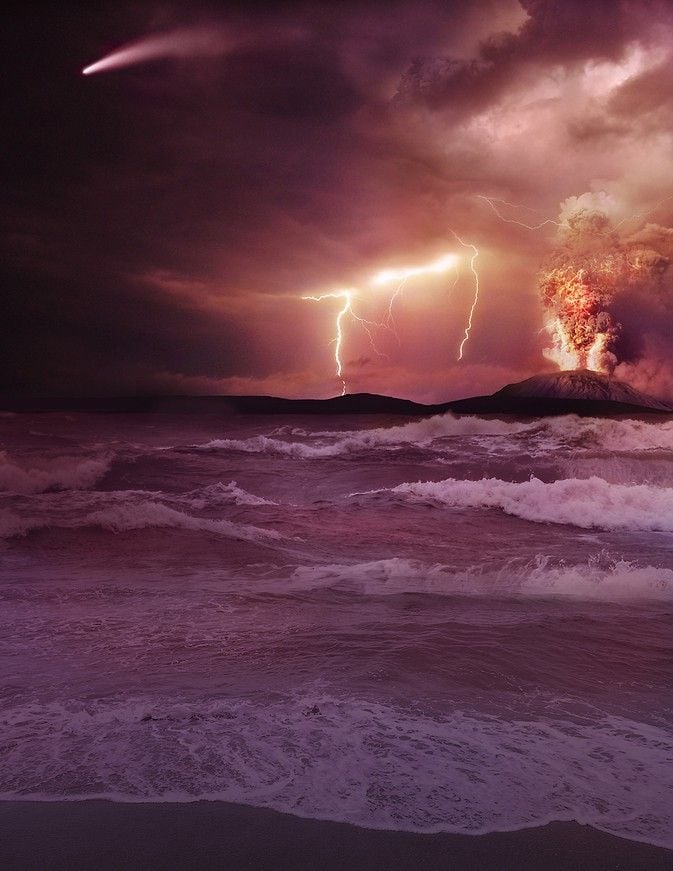
Earth formed about 4.54 billion years ago, collided with the body that helped make the Moon and cooled from an ocean of magma. Large objects continued to strike it, volcanoes released the gases of a new atmosphere, and free oxygen was essentially absent. Against that compressed geological background, an estimated age of 4.2 billion years for life’s last universal common ancestor looks astonishingly early.
The result does not date the origin of life. LUCA, short for last universal common ancestor, is the latest ancestral population shared by all cellular organisms with descendants alive today. Life had to exist before LUCA, perhaps through a long and branching period whose other lineages later vanished.
Nor is 4.2 billion years a fossil date. It is the central estimate from a molecular-clock analysis, with preferred model ranges spanning roughly 4.09 to 4.33 billion years ago. That makes it a quantitative reconstruction built from genes, fossils and isotope constraints, not a preserved Hadean cell recovered from rock.
LUCA is the common trunk, not the first life
Every cellular organism uses related machinery to translate genetic information into proteins, employs ATP as an energy currency and shares a nearly universal genetic code. Those deep commonalities support descent from a shared population before the bacterial and archaeal branches separated. Eukaryotes, including animals, plants and fungi, arose later from within that ancient history.
The name can be misleading. “Last” means most recent in relation to all living lineages, while “universal” refers to the sampled cellular tree. LUCA was not necessarily one individual, the only organism alive, or the first self-replicating system. It is better imagined as a population whose descendants won a vast evolutionary survival contest.
The 2024 Nature Ecology & Evolution study explicitly depicts other contemporary lineages that left no sampled cellular descendants. Some may have transferred genes into LUCA’s descendants before disappearing, leaving fragments of extinct histories inside the surviving tree.
This boundary changes the timing implication. If LUCA already lived 4.2 billion years ago, the origin of life must be older still. The estimate does not say how much older, because lineages that vanished without contributing genes cannot be reconstructed from modern genomes.
Five ancient gene duplications supplied the clock
Dating the root of life is unusually difficult. There is no biological outgroup older than all life that can anchor the tree, and the fossil record becomes sparse and disputed long before the Hadean. Evolutionary rates also vary among genes and lineages rather than ticking at one fixed speed.
The research team approached the problem with paralogues, related genes created by duplication before LUCA. After a gene duplicated, both copies passed through the same later species divergences. That produces mirrored nodes on two sides of a gene tree, allowing the same geological calibration to constrain the timing twice.
The analysis used five sets of pre-LUCA paralogues involved in basic cellular functions, including ATP synthase, translation factors, protein targeting and aminoacyl-tRNA synthetases. It applied 13 fossil and isotope calibrations in Bayesian relaxed-clock models. The team called the method cross-bracing because ages for matching nodes were linked across the duplicated branches.
Under the preferred independent-rates model, the 95 percent interval for LUCA was 4.09 to 4.33 billion years; an autocorrelated-rates model returned 4.18 to 4.33 billion years. The University of Bristol’s account summarizes the result as about 4.2 billion years, roughly 400 million years after Earth formed.
A molecular clock is still a model. Its output depends on the gene alignments, tree topology, evolutionary-rate assumptions and interpretation of the calibrations. The researchers tested alternative datasets and rate models, but deep-time uncertainty cannot be eliminated.
Seven hundred modern genomes were traced backwards
Dating LUCA was only part of the work. To reconstruct its biology, the team sampled 350 bacterial and 350 archaeal genomes and built a species tree from 57 widely shared marker genes. Eukaryotes were excluded from that sampling because their cellular ancestry combines archaeal and bacterial histories.
Individual gene trees do not always match the species tree. Microbes exchange genes horizontally, duplicate them and lose them. The researchers used probabilistic reconciliation to model those events and estimate the chance that each gene family existed at the LUCA node.
A conservative set contained 399 gene families with high support and representation in both prokaryotic domains. By integrating probabilities across thousands of families and comparing them with modern prokaryotes, the model estimated a genome of about 2.75 million base pairs and 2,657 protein-coding genes. The reported intervals were 2.49 to 2.99 megabases and 2,451 to 2,855 proteins.
Those numbers do not amount to a recovered genome sequence. Researchers cannot write LUCA’s chromosomes base by base. They estimate genome scale and the probability that functional gene families were present, while acknowledging that later transfer and loss blur ancient histories.
Its metabolism fitted an oxygen-free world
The reconstructed gene content points to a prokaryote-grade anaerobe. The team found no support for terminal oxidases used in oxygen respiration and no evidence that LUCA performed oxygenic or anoxygenic photosynthesis. “Almost entirely devoid of oxygen” refers here to free molecular oxygen in the atmosphere, not oxygen atoms locked inside water, carbon dioxide or minerals.
LUCA may instead have used the Wood-Ljungdahl pathway, a biochemical route that combines carbon dioxide with hydrogen to build organic carbon and produce acetate. Some modern acetogens use this ancient-looking chemistry in oxygen-free sediments and hydrothermal environments.
The reconstruction also supported ATP synthase, parts of central carbon metabolism and an early Cas defence system. The latter was not necessarily a complete modern CRISPR immune system, but it suggests that cells and virus-like genetic parasites were already engaged in an evolutionary arms race.
This anoxic biology fits a planet that would have looked lifeless to an oxygen-seeking telescope. SpaceDaily’s examination of early Earth as a biosignature false negative explains why substantial life can exist for immense spans before atmospheric oxygen becomes remotely detectable.
LUCA probably lived inside an ecosystem
The inferred organism was not a bare protocell dependent on one accidental chemical reaction. A genome comparable in scale to modern prokaryotes, carbon fixation, energy conservation and defence together imply extensive evolution before the common ancestral population.
The researchers proposed that LUCA’s acetate and organic matter could feed other microbes. Methanogens, if present, might recycle hydrogen through methane released to the atmosphere and broken apart by sunlight. In this picture, the young biosphere already contained connected producers and consumers.
The researchers’ explanation of their reconstruction stresses that organisms without surviving descendants remain largely invisible. Calling the ecosystem “established” is therefore an inference from LUCA’s metabolism and possible interactions, not a census of Hadean species.
The early Cas result carries the same caution. Gene families in modern organisms can reveal ancient ancestry, but their exact function may have changed. Evidence of an ancestral RNA-targeting defence supports biological conflict by LUCA’s time; it does not identify a particular virus from 4.2 billion years ago.
Hadean Earth had habitable intervals
The oldest rocks have been recycled, so much of the first half-billion years must be reconstructed from resilient mineral grains, lunar craters and models. NASA’s overview of Earth after formation places the cooling atmosphere, oceans and continuing bombardment in that sequence. A 4.404-billion-year-old zircon from Western Australia provided chemical evidence consistent with crust and a liquid hydrosphere. The interpretation does not map a global ocean, but it shows that parts of Earth cooled early.
Volcanism remained intense and impacts could be devastating. A NASA-supported bombardment model found that early collisions repeatedly melted, mixed and buried large portions of the Hadean crust. Crucially, the intervals between giant impacts could still leave locally clement environments.
Liquid water and a solid crust do not by themselves prove habitability everywhere. Temperature, chemistry, ultraviolet radiation and impact heating varied across the planet. Deep ocean crust, hydrothermal systems and the subsurface could also preserve environments when the exposed surface was hostile.
SpaceDaily’s report on water retained during Earth’s magma-ocean stage adds another part of that context: the planet’s volatile inventory was exchanged among its mantle, atmosphere and surface rather than simply being lost in one initial furnace.
The late heavy bombardment is not a fixed deadline
Older estimates sometimes forced LUCA to be younger than about 3.9 billion years because life was assumed unable to survive a late heavy bombardment. The 2024 genetic study rejected that event as a credible maximum-age constraint.
The late heavy bombardment remains a hypothesis built largely from lunar impact melts, crater chronology and dynamical models. Researchers debate whether the inner Solar System experienced a sharp cataclysm, a broader declining flux, sampling bias in Apollo rocks or some combination.
“Relentless impacts” is reasonable as a description of the violent early environment relative to modern Earth. It should not mean that every square kilometre was continuously molten or that every impact sterilized the entire planet. Severity, spacing and refuge depth determine biological survival.
An old LUCA can be compatible with heavy bombardment if habitats recovered between events or if organisms survived in protected crustal or seafloor settings. The genetic date does not identify such a refuge; it removes the need to assume that a disputed impact spike erased all earlier life.
Oxygen arrived much later than life
LUCA’s inferred anaerobic metabolism matches a world with negligible free oxygen. Photosynthesis was not reconstructed in LUCA, and oxygenic photosynthesis had not yet transformed the atmosphere. For early organisms, oxygen was unnecessary and could be chemically damaging.
The major atmospheric rise came roughly 2.4 billion years ago during the Great Oxidation Event, almost two billion years after the central LUCA estimate. SpaceDaily’s account of cyanobacteria and Earth’s oxygen transition follows the later biological process that made an oxygen-rich world possible.
The 4.2-billion-year estimate therefore narrows the apparent interval between a cooling, water-bearing Earth and a developed cellular ecosystem. It does not show that life appears quickly on every habitable planet. Earth supplies one surviving example, filtered by extinctions and billions of years of gene transfer.
What the analysis establishes is more precise and more limited: modern genomes retain a statistical signal consistent with a very ancient common ancestor. They do not reveal where life began, how many origins failed, which chemistry first crossed into heredity or the exact day Earth became habitable. The foothold looks early; the route to it remains unknown.