

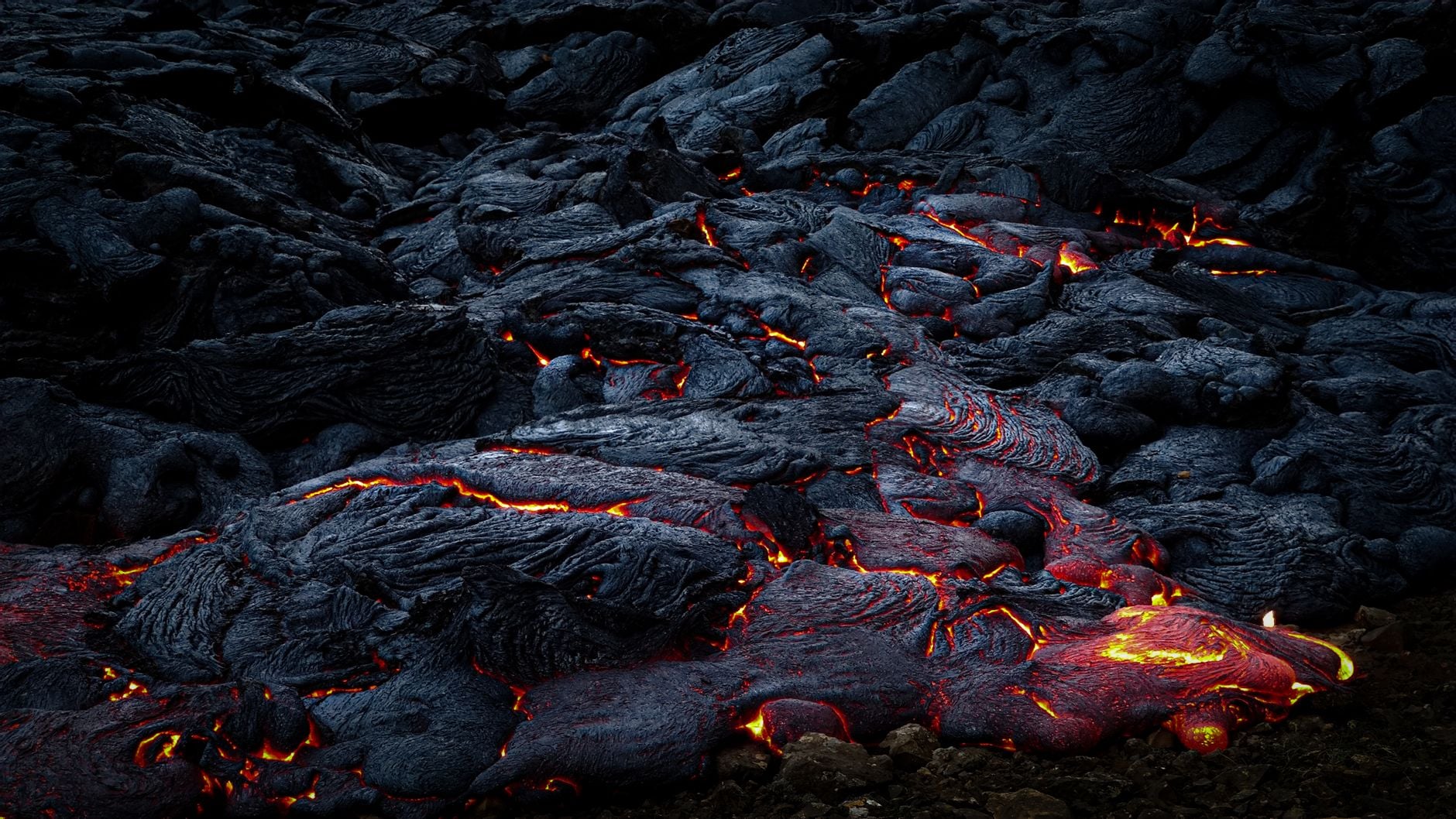
To understand this result, it helps to begin with an Earth that looks nothing like Earth.
There is no blue ocean and probably no durable surface. The young planet is being assembled through collisions, and at least one of those impacts is large enough to be associated with the Moon’s formation. Rock is not merely erupting through a crust. Much of the mantle itself is molten, creating a global or near-global magma ocean thousands of kilometres deep.
Water is already part of the planet, but it is not sitting in a familiar sea. At magma-ocean temperatures it is dissolved through molten silicate, mixed into the same liquid rock from which the mantle will crystallise. That creates a basic problem. As Earth cools and minerals form, does the water stay with the melt, eventually rising towards the atmosphere and surface, or can the growing crystals carry a meaningful share down into the solid planet?
A 2025 paper in Science by Wenhua Lu and colleagues gives bridgmanite, the dominant mineral of the lower mantle, a much larger role in that story. Their experiments suggest that hot, newly crystallising bridgmanite could incorporate far more water than previous lower-temperature measurements implied. When the team put those measurements into a model of a cooling magma ocean, the early solid mantle retained an estimated 0.08 to one present-day ocean of water.
This is one study, not settled consensus. The experiments measured how water divided between tiny samples of crystal and melt under extreme conditions. The ocean-sized result came from applying those measurements to a model of early Earth. No one has sampled an intact Hadean water reservoir from the lower mantle.
First, meet the most abundant mineral you have probably never seen
Bridgmanite is a magnesium-iron silicate with a compact crystal structure that becomes stable under immense pressure. It dominates the lower mantle, the enormous layer running from about 660 kilometres below the surface to the boundary with the core at roughly 2,890 kilometres.
It is often described as Earth’s most abundant mineral, which sounds odd because there is no bridgmanite outcrop to visit. The explanation is pressure. Bring lower-mantle material towards the surface and bridgmanite transforms into other structures. Natural grains have been identified in meteorites shocked by violent impacts, where pressure briefly reproduced deep-Earth conditions, but the mineral beneath our feet is largely inaccessible.
Its abundance is what makes a seemingly tiny water concentration important. Imagine adding two grams of water-related material to a kilogram of rock. That does not sound like a reservoir. Now extend the same proportion through a mineral that fills much of the largest rocky layer on Earth. The multiplication changes the scale completely.
Bridgmanite also appears early in models of a deep magma ocean’s cooling. It is expected to crystallise first and remain a major solid through much of the process. Whatever it accepts or rejects can influence where elements and volatiles finish when the planet stops being mostly molten.
The team recreated a sliver of the magma ocean between diamonds
There is no direct journey to the lower mantle, so the researchers brought lower-mantle conditions into the laboratory. Their high-pressure experimental programme used diamond anvil cells, devices that squeeze a microscopic sample between the tips of two diamonds. Lasers heated the compressed material while a four-colour temperature-mapping system tracked how hot the tiny experimental region became.
The experiments reached pressures up to 71 gigapascals, roughly 700,000 times atmospheric pressure, and temperatures of about 3,600 to 4,500 kelvin. At the hot end, that is above 4,200 degrees Celsius. These are not today’s ordinary lower-mantle conditions. They are intended to approach the much hotter environment in which a deep magma ocean would have crystallised.
Confirming what happened inside such a small sample required several techniques. Raman spectroscopy and electron diffraction identified bridgmanite. NanoSIMS, a highly sensitive form of secondary-ion mass spectrometry, measured water in both the crystal and its neighbouring silicate melt. Atom-probe tomography examined the distribution of hydrogen at still smaller scales.
The bridgmanite contained water concentrations reaching roughly 0.2 per cent by weight, or about 2,000 parts per million. Atom-probe results showed hydrogen spread through the bridgmanite rather than gathered in water-rich inclusions. That check is essential. Without it, a wet speck trapped inside a nominally dry crystal could masquerade as water held by the mineral itself.
An ocean inside rock is not an underground ocean
The phrase “an ocean’s worth of water” is easy to picture incorrectly. The study does not propose a hollow layer filled with liquid water. In bridgmanite, hydrogen is accommodated within the crystal structure, commonly described in terms of hydroxyl-related defects. The material remains solid rock.
The ocean is a unit of comparison. Earth’s modern oceans contain about 1.4 billion cubic kilometres of water. If a widely distributed population of mantle minerals contains only a fraction of a per cent by weight, the total can still approach the mass of that surface reservoir.
This is also different from the better-known water story in the mantle transition zone. Ringwoodite, stable mostly between about 520 and 660 kilometres depth, can hold substantial water in its structure. A 2014 analysis of ringwoodite trapped inside a diamond provided rare direct evidence that at least part of that zone is hydrated. SpaceDaily has previously explained why reports of water held by ringwoodite should not be read as a subterranean sea.
Lu’s study looks deeper and further back. Its question is not mainly how surface water is recycled into today’s transition zone. It asks how much primordial water could enter solids as the early lower mantle first formed.
The important number is a ratio between crystal and melt
Geochemists describe this behaviour with a partition coefficient: the concentration of water in the crystal divided by its concentration in the coexisting melt. If the value is very low, the crystallising mineral strongly rejects water. The water then becomes concentrated in the liquid that remains. If the coefficient rises, more water leaves the melt with the solid.
Previous experiments at lower temperatures suggested bridgmanite was nearly dry. Lu and colleagues found that water partitioning into bridgmanite increased sharply with temperature. Their measured coefficients were one to two orders of magnitude larger than earlier estimates. In other words, a mineral that appeared reluctant to hold water under cooler experimental conditions behaved differently at the temperatures relevant to a magma ocean.
The mineral still did not take everything. Water generally preferred the melt. But bridgmanite did not need to win that competition molecule by molecule. It was crystallising in immense quantities. A modest concentration multiplied through enough solid rock can remove a large total mass of water from the liquid.
The team’s crystallisation model estimated that the early solid mantle retained between 0.08 and one modern ocean. The upper end is where the headline’s “ocean’s worth” comes from. It is not the single value measured in the laboratory, and it should not be reported as though one complete ocean was certainly sealed away. The modelled range spans more than a factor of 12, reflecting uncertainty about the early water inventory, mineral proportions, changing temperature and the details of crystallisation.
Cooling Earth was sorting water, not choosing between all or nothing
Here is the process in slow motion. Bridgmanite begins to crystallise from the deep magma ocean. Some water enters those crystals. More remains in the melt, which becomes progressively enriched as solidification continues. Other minerals appear, and the final water distribution depends on how each phase partitions water and where the remaining melt moves.
A 2024 experimental study of a hydrous magma ocean showed why the late stages can become complicated: residual melts may grow extremely water-rich, change buoyancy and collect temporarily near the top of the lower mantle before migrating. The mantle does not freeze like water in an ice tray. Crystals, liquids, density and pressure evolve together.
Water that stays in the melt may eventually outgas into a hot atmosphere. Some can later condense as the surface cools. Some can react with rock, and some atmospheric hydrogen can be lost to space. Water incorporated into deep crystals takes another route, sheltered inside the solid mantle and released only if melting and circulation later move it.
This is where the headline requires care. The Science study did not model atmospheric escape and did not calculate how many water molecules avoided space. It tested deep partitioning. Its result makes an important alternative plausible: a meaningful fraction of Earth’s early water did not have to pass through the atmosphere immediately. The planet could retain water internally while its surface was still hostile.
Could any of that first reservoir still be down there?
Four and a half billion years is a long time for a reservoir to remain untouched. Mantle convection slowly stirs solid rock. Plumes carry deep material upwards. Volcanism releases water, while subducting plates return surface water to the interior. Today’s mantle water is therefore a mixture with a history, not a labelled bottle from planetary formation.
The 2025 experiments cannot establish how much of their modelled reservoir survives. They describe the starting distribution after magma-ocean crystallisation, then argue that circulation of early stored water could have influenced later mantle dynamics.
There is, however, independent evidence that some early mantle material escaped complete mixing. A 2026 Nature study of lavas from Fani Maoré in the Comoros archipelago found neodymium isotope patterns consistent with a contribution from bridgmanite-rich material formed during Hadean magma-ocean solidification. The model required roughly 9 to 11 per cent of this ancient material in the lava source, plus a small recycled sediment component.
That result supports the survival of Hadean bridgmanite-rich material. It does not show that the material still carries its original water. The distinction is narrow but important. An ancient mineralogical and isotopic reservoir can survive while its hydrogen inventory is altered by later exchange.
The picture is still moving. A 2026 high-pressure study of ferropericlase, another lower-mantle mineral, found it could hold even more water than bridgmanite under some magma-ocean conditions. Its authors proposed that hydrated material could remain near the core-mantle boundary. That adjacent result does not erase Lu’s work, but it shows why the exact shares assigned to different minerals remain open.
The deeper story is about how a planet becomes habitable
Water inside mantle rock is geologically active even when it is not liquid. It can lower melting temperatures, alter viscosity and influence how readily material circulates. Over time, mantle melting can return stored water to the surface through volcanism. The interior reservoir and surface ocean are connected parts of a planet-wide cycle.
This complicates the old mental picture of Earth receiving water and then trying not to lose it. Retention was not only an atmospheric problem. It was also a mineral-physics problem. The fate of water depended partly on which crystals formed, at what pressure and temperature, and how much hydrogen their structures accepted.
The tempting version of the story is that bridgmanite saved Earth’s ocean. The study cannot carry that sentence. It does not settle where all terrestrial water came from, prove that one ocean remains in the lower mantle or show that deep storage automatically creates plate tectonics and life.
What it does offer is a more interesting early Earth. As the molten planet cooled, it may have divided its water between two futures. One fraction moved towards an atmosphere and eventual surface ocean. Another entered the solid mantle before the familiar Earth existed. Some of that deep inheritance may have circulated back out, and some may remain beyond our reach.