The James Webb Space Telescope did not photograph a Solar-System-sized star with a black hole visible at its center. It found an unresolved red point whose spectrum is extraordinarily difficult to make with stars. A Nature paper published on August 12 argues that the cleanest explanation is an accreting black hole hidden inside a dense, almost dust-free envelope of hydrogen.
The object is called MoM-BH*-1. Its redshift of 7.7569 means the light left it when the universe was about 660 million years old. The modelled total output is around 80 to 100 billion times the Sun’s luminosity.
This is one paper and one model, not a directly imaged new class of star.
What Webb actually measured
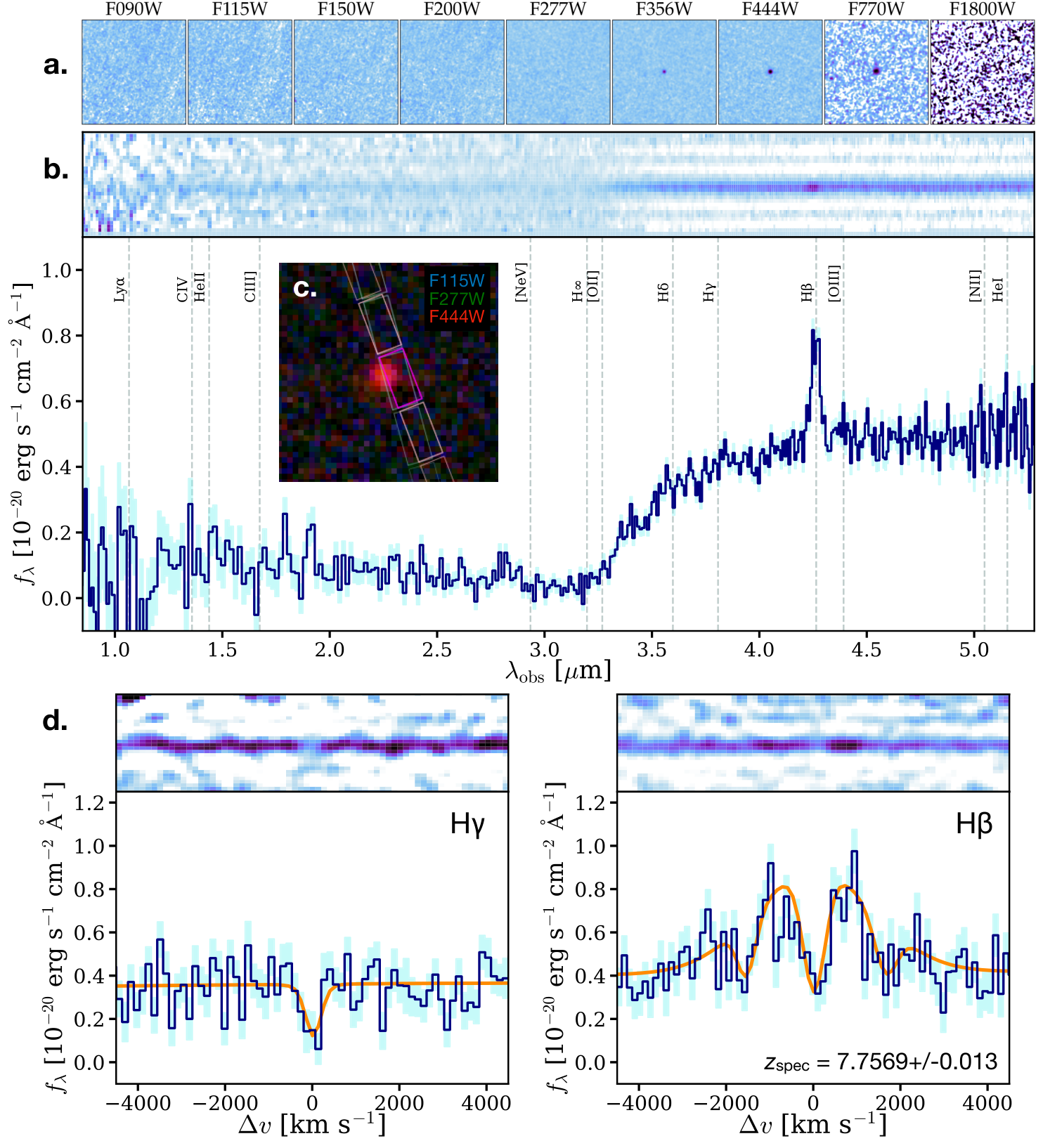
MoM-BH*-1 stood out as the reddest source in a roughly 250-square-arcminute JWST field. It was bright in the longer-wavelength NIRCam filters, nearly disappeared at shorter wavelengths and remained unresolved. The team combined a 4.5-hour NIRSpec prism observation from December 2024 with an earlier 1.5-hour, higher-resolution spectrum.
The decisive feature is an enormous Balmer break, a steep change in brightness shaped by hydrogen. Its measured strength was 7.7, with a plausible range extending from about 6.3 to 10. Normal dust-free stellar populations should peak around 3. Even an artificial population composed entirely of A-type stars, which produce particularly strong Balmer breaks, should remain below 5.
Webb also recorded hydrogen-beta emission roughly 3,000 kilometers per second wide, deep hydrogen absorption and a tentative narrow oxygen signal. The processed spectra are in a public Zenodo archive.
Why astronomers say it looks like a star
“Star-like” describes the escaping light, not the central engine. The source is point-like in Webb’s images, while its spectrum combines a blackbody-like continuum with absorption features usually associated with stellar atmospheres.
A normal star pays for that light through nuclear fusion in its core. MoM-BH*-1 appears to use a different energy source: gas falling toward a black hole, heating up and converting gravitational energy into radiation. The black hole itself remains dark. Its accretion flow provides the power, and the surrounding hydrogen reshapes that power before it escapes.
NASA’s comparison of the spectrum and model shows the fit. “Black hole star” names the whole configuration, not a fusion-powered black hole.
The Solar System scale comes from a model
Webb constrains the source’s effective radius only to less than 117 parsecs. That observational ceiling is millions of times wider than the Solar System. The far smaller scale in the title comes from the physical model, not from resolving the envelope in an image.
The paper places the dense gas roughly 10 to 100 astronomical units from the central source, with a representative calculation using about 40 AU. One AU is the average Earth-Sun distance, and Neptune orbits at roughly 30 AU. Calling the proposed envelope Solar-System-sized is therefore a useful visual guide, provided it is not mistaken for a measured outer edge.
Why the answer is roughly 100 billion Suns
The paper’s envelope model gives a bolometric luminosity near 1044.5 ergs per second. Dividing that by the Sun’s output gives a little over 80 billion solar luminosities, reasonably rounded to 100 billion.
This is not a brightness read from one Webb filter. It is a model-based estimate across the full spectrum. Individual stars can radiate millions of Suns, but MoM-BH*-1 still exceeds a normal single star by thousands of times.
Luminosity alone would not prove there is a black hole. A compact unresolved galaxy can contain many luminous stars. The extreme Balmer break, broad emission, deep absorption and possible variability are what push the interpretation toward one accreting central engine.
Dense hydrogen is doing the work usually assigned to dust
The team’s representative calculation begins with an active black-hole spectrum and passes it through extreme gas. The hydrogen density reaches about 100 billion particles per cubic centimeter, the column is thick enough to block even energetic radiation, and turbulent speeds approach 500 kilometers per second. Dust attenuation remains small.
That hydrogen absorbs, scatters and re-emits the central light. It can produce the deep Balmer absorption and steep rollover while helping explain why the source is weak in X-rays. Redness here comes mainly from gas opacity, not from the dusty screen commonly invoked around active galactic nuclei.
A separate Nature study of Little Red Dots found evidence that many may be young black holes inside dense ionized cocoons. MoM-BH*-1’s host appears faint enough for the central component to dominate the observed light.
“Best explanation” is not the same as a final answer
The authors write that it is difficult to escape the conclusion that a normal stellar population does not make this spectrum. Their black-hole-envelope model is strong because one physical arrangement accounts for the continuum, emission and absorption together.
They are equally clear about its limits. Despite testing close to a million combinations, the parameter space remains degenerate. The paper calls the model simple and idealized, and cautions against inferences beyond the feasibility of an accretion disk embedded in dense gas.
Other exotic ideas have not disappeared. A supermassive metal-free star model has reproduced important parts of MoM-BH*-1’s spectrum. Such an object would be nothing like an ordinary star, but its existence is one reason “best” is more defensible than “only.”
The growth problem is why this matters. As I noted in an earlier look at Webb’s overmassive early black holes, the first billion years leaves little time to build them. A dense envelope could feed a seed while trapping or redistributing radiation that would otherwise slow the inflow.
The most accurate mental picture is less theatrical than a black hole photographed inside a giant star.
Webb found a red point and an unusual hydrogen spectrum.
A feeding black hole inside a Solar-System-scale gas envelope is the model that currently makes those pieces fit best.