
For years, astronomers have used the phrase “little red dots” because the James Webb Space Telescope was showing them objects that resisted a better name. One of those points, MoM-BH*-1, is now the clearest case for something stranger: an accreting black hole hidden inside such a dense envelope of gas that the whole system acquires a star-like spectrum.
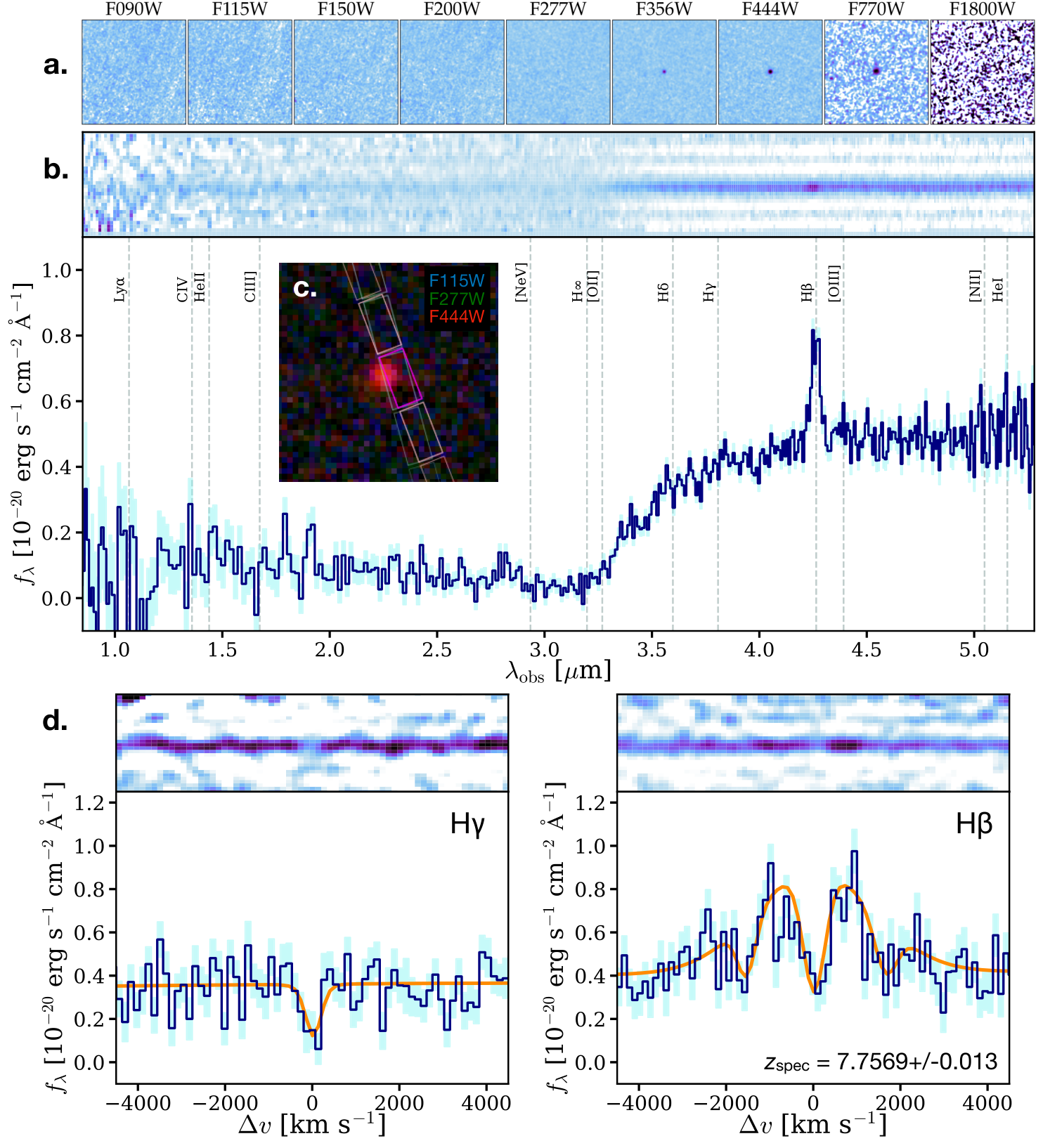
The source is seen at redshift 7.7569, when the universe was about 660 million years old. It appears unresolved in Webb images, and the modelled envelope spans tens of astronomical units, comparable to the scale of the Solar System. Its total power is of order 100 billion Suns. That last comparison needs care: the measurement is not 100 billion times the brightness of every known star. It is roughly hundreds of billions of times the Sun’s luminosity, and it is derived from a model of the full spectrum.
The “black hole star” interpretation is compelling because it explains several otherwise awkward observations together. It is still an interpretation, not a direct photograph of a black hole inside a shell and not the only model researchers are testing.
What Webb actually found
MoM-BH*-1 was selected from the PRIMER imaging of the UDS extragalactic field because it was exceptionally red. It was bright in Webb’s longer-wavelength NIRCam filters and nearly disappeared at shorter wavelengths. A 4.5-hour NIRSpec prism observation in December 2024, combined with an earlier higher-resolution spectrum, established the redshift and exposed the physics behind the colour.
In the team’s open preprint, the decisive feature is an enormous Balmer break. Across a narrow part of the spectrum associated with hydrogen, the flux changes by more than a factor of 20. The measured break strength is 7.7, compared with a theoretical maximum near 3 for an ordinary dust-free stellar population. Even an artificial population made entirely of A-type stars, which have especially prominent Balmer breaks, should remain below 5.
That is accompanied by broad hydrogen-beta emission with a width of about 3,000 kilometres per second, deep hydrogen absorption and a much narrower, tentative oxygen signal. No ordinary collection of stars readily makes that combination.
The Solar System size is a model, not a Webb image
Webb sees MoM-BH*-1 as a point. The observational upper limit on its size is 117 parsecs, far larger than the Solar System. The much more dramatic scale in the headline comes from the physical model: a black hole surrounded by Compton-thick gas extending roughly 10 to 100 astronomical units, with a representative calculation using about 40 AU.
One astronomical unit is the average Earth-Sun distance. Neptune orbits at about 30 AU, so a 40-AU radius would place the effective atmosphere beyond Neptune’s orbit. That makes “the size of our Solar System” a reasonable picture of the proposed gas envelope, provided it is not mistaken for a directly resolved measurement.
The team also reports a 30 per cent brightening over 56 rest-frame days, although the two measurements came from different instruments. Genuine variability on that timescale would fit a compact accreting source, but the authors treat the comparison as a hint rather than proof.
How bright is 100 billion Suns?
The paper gives a bolometric luminosity near 1045 ergs per second. Dividing that by the Sun’s output gives roughly 260 billion solar luminosities, close enough that “100 billion Suns” communicates the right order of magnitude. It does not mean 100 billion times brighter than the brightest star known. Very luminous individual stars already radiate millions of times more power than the Sun.
MoM-BH*-1 would still outshine any normal single star by many thousands of times. More importantly, the number refers to power across the spectrum after modelling, not simply the brightness in one Webb image. In my reading, that distinction makes the object more interesting, not less: the extraordinary output has to be produced inside a volume associated with one compact central engine.
A black hole wearing a false stellar atmosphere
The proposed engine is a black hole gaining mass. Material falling towards it releases gravitational energy close to the event horizon. The black hole itself emits no light, but its accretion flow does. In the model, extremely dense, turbulent and almost dust-free gas surrounds that flow. Photons are absorbed, scattered and re-emitted before escaping, so observers see an effective photosphere with some of the spectral behaviour of a star.
The required gas is extraordinary. The representative model uses a hydrogen density of 1011 particles per cubic centimetre and turbulent speeds near 500 kilometres per second. Those conditions naturally produce hydrogen absorption while also allowing broad emission from the central region. They can also suppress X-rays, helping explain why many little red dots look unlike conventional unobscured quasars.
This idea now has population-level support. A Nature study of little red dots concluded that many are young supermassive black holes inside dense ionised cocoons. A separate 2026 search reported 241 candidate black hole stars across redshifts from about 1.5 to 9.5. MoM-BH*-1 matters because its host appears faint enough for the central component to be studied with less contamination from starlight.
“The only thing” is stronger than the evidence
The spectrum firmly rules out a straightforward normal stellar population, but astronomy is not yet at the point of declaring one inescapable interior. The discovery team explicitly calls its calculation simple and idealised. Depending on how the gas motions and dust are treated, conventional scaling relations give black hole masses from tens to hundreds of millions of Suns, while a resonant-scattering interpretation can push the estimate down towards one million Suns.
There is also a serious stellar alternative. An Astrophysical Journal study found that a metal-free supermassive star of around one million solar masses could reproduce the spectral shape and luminosity of MoM-BH*-1. Such an object would itself be exotic, short-lived and closely connected to black hole formation, but it shows why “only explanation” should be read as a forceful summary of the leading case, not a closed verdict.
The wider little-red-dot population may also be diverse. Some objects could be black hole envelopes, some may mix a central engine with substantial host-galaxy light, and a few could arise from other rare configurations. The evidence is moving towards buried black holes without requiring every red point to have an identical anatomy. SpaceDaily’s earlier guide to black hole stars and little red dots explains how newer spectra are separating the compact source from its host.
Why one red point matters for the first black holes
Astronomers have found billion-solar-mass black holes less than 700 million years after the Big Bang. Starting with the remnant of an ordinary massive star and growing at the conventional Eddington limit leaves very little time to reach that scale. MoM-BH*-1 may expose a phase that helps solve the timing problem.
A thick gas envelope can provide fuel while trapping or redistributing radiation that would otherwise halt the inflow. The system might therefore sustain super-Eddington accretion, allowing a seed black hole to gain mass far faster than familiar quasars. The team estimates that MoM-BH*-1 could contain a black hole somewhere around one million to ten million solar masses under the envelope-based interpretation, although the uncertainty remains substantial.
The next tests are concrete. More NIRSpec observations can map hydrogen absorption and search for additional lines. Repeated imaging can establish whether the 30 per cent variability is real. X-ray and radio limits can constrain how completely the gas hides the central engine, while deeper imaging can measure the faint host galaxy. MoM-BH*-1 has not ended the little-red-dot mystery. It has turned a vague red speck into a specific physical hypothesis that telescopes can now try to break.