

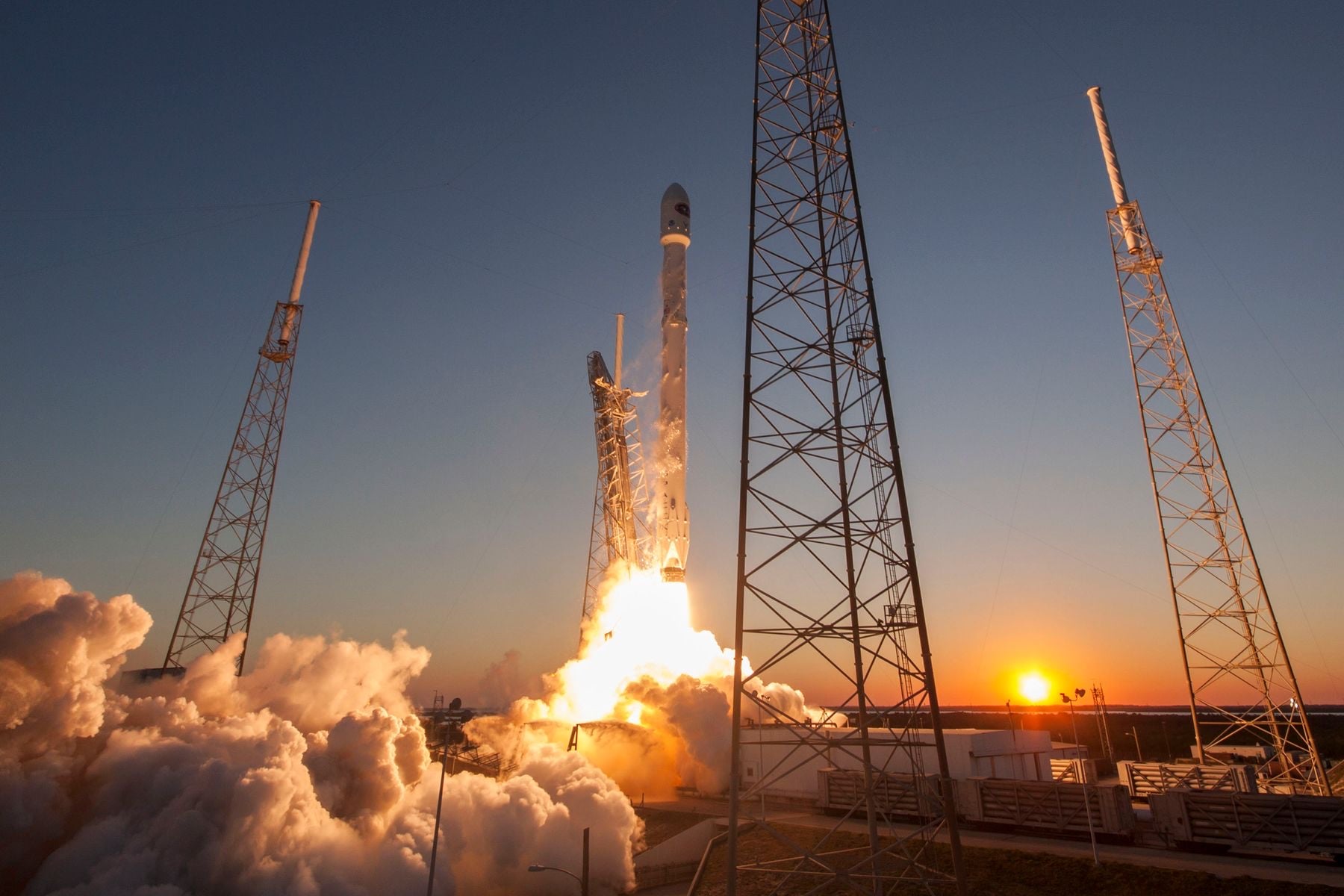
At 10:12 pm local time on 5 September, a slender white rocket rose from an island above the Arctic Circle. The flight began at Isar Aerospace’s dedicated launch complex at Andøya Spaceport in northern Norway and ended with five small satellites released in orbit.
Between those events, the 28-metre Spectrum passed maximum aerodynamic pressure, shut down its nine first-stage engines, separated, ignited its upper stage, crossed the 100-kilometre Kármán line and discarded its payload fairing.
Isar said the second stage then reached orbital velocity, performed a circularisation burn and completed spacecraft separation. It was the full sequence the German startup had failed to approach on Spectrum’s debut 17 months earlier.
The result is a genuine European first, provided the geography is stated precisely. This was the first successful orbital launch from Western European territory. It was not the first European-built rocket to place a satellite in orbit, nor the first launch from the wider geographical continent if Russia is included.
It was also a beginning, not proof of a mature launch service. One successful qualification flight cannot establish reliability or cadence. Isar now has something more fundamental: evidence that its rocket can perform the complete job at least once.
The flight that reached orbit
The mission was named “Onward and Upward.” According to Isar’s official flight update, Spectrum lifted off at 10:12 pm CEST, or 20:12 UTC, from the company’s launch complex at Andøya Space.
The rocket cleared the portion of ascent where aerodynamic forces are greatest, reached main-engine cutoff and separated its first and second stages. Its vacuum engine ignited, the fairing came away and the vehicle continued accelerating.
Reaching space was only an intermediate step. A sounding rocket can cross the Kármán line and fall back without coming close to orbit. Orbit requires enough sideways speed for the vehicle and its payloads to keep falling around Earth rather than returning immediately.
Isar reported that Spectrum achieved that speed and completed a circularisation burn before releasing the spacecraft. The company did not immediately publish a detailed set of independently confirmed orbital parameters in its first announcement.
It did say spacecraft separation was successful. At the same time, Isar was working with customers to confirm the status of the satellites. That distinction matters: release from the rocket is a launch success, while establishing power, communications and control belongs to each spacecraft’s commissioning process.
A debut that lasted 30 seconds
Spectrum’s first flight on 30 March 2025 ended almost as soon as the vehicle had cleared the tower. It began to roll, lost attitude control and received a termination command about 30 seconds after liftoff. The unpowered rocket descended into the sea.
Isar’s investigation later identified an unintended opening of a vent valve as the initiating event. The problem caused the loss of control at the start of the planned roll manoeuvre. The flight-termination system itself worked as designed, and the company said the public was never at risk.
The fiery ending looked definitive, but the mission had been framed as a test without payloads. Isar had said in advance that it did not expect to reach orbit and that even 30 seconds of flight would produce useful data.
As SpaceDaily reported before that first attempt, the debut was already historically unusual: it was the first vertical launch of an orbital-class vehicle from the European continent outside Russia.
The second Spectrum did far more than survive longer. It demonstrated stage separation, upper-stage propulsion, fairing release, an orbital burn and payload deployment. These are coupled events, and a failure in any one can strand a mission short of orbit.
Five CubeSats crossed the finish line
The five deployed spacecraft came from a mixture of universities and commercial teams across Europe. Their presence turned the qualification mission into Spectrum’s first flight carrying customer hardware.
CyBEEsat was developed at TU Berlin. TriSat-S came from the University of Maribor and SkyLabs in Slovenia. SpaceTeamSat1 came from the TU Wien Space Team in Austria.
Norway’s contribution was FramSat-1 from the Norwegian University of Science and Technology. Platform 6 came from EnduroSat, the Bulgarian small-satellite company.
A sixth passenger remained attached to the rocket. “Let It Go,” supplied by German space-hardware company Dcubed, was a non-separable experiment rather than a free-flying satellite.
The official mission manifest lists all six payloads. The flight was supported by the European Space Agency’s Boost! programme, and the passengers were selected after Isar won the first Microlauncher Competition run by the German Space Agency at DLR.
Exolaunch integrated the five satellites into its EXOpod Nova deployer in Berlin. Earlier SpaceDaily coverage followed that integration, months before repeated scrubs finally gave way to the September launch.
Why “from Europe” needs an asterisk
Europe has designed, built and operated successful orbital rockets for decades. Ariane launchers have carried commercial, scientific and government spacecraft since 1979. Vega joined them for smaller payloads.
Those rockets normally leave from the Guiana Space Centre at Kourou. French Guiana is constitutionally part of France and the European Union, but it lies on the northeastern coast of South America. The location close to the equator gives eastbound missions a useful contribution from Earth’s rotation.
Britain’s Black Arrow placed the Prospero satellite into orbit in 1971, but launched from Woomera in Australia. In January 2023, Virgin Orbit’s carrier aircraft took off from Cornwall with an orbital rocket, but the rocket suffered an anomaly after release and failed to reach orbit.
Russia complicates any claim about the first orbital launch from “Europe.” Plesetsk and other Russian sites have conducted many orbital missions from locations geographically west of the Urals. That is why Western Europe, or the European continent excluding Russia, is the defensible qualification.
Andøya itself is an island off Norway’s coast, so “continental Europe” should not be read as literal mainland geography. ESA and the company use the phrase in the political and industrial sense. The concrete fact is simpler: no rocket had previously reached orbit after launching from Western European soil.
A rocket built for the smaller end of the market
Spectrum stands 28 metres tall and two metres wide. It is a two-stage, expendable launcher built largely in-house by Isar Aerospace, which was founded near Munich in 2018.
Nine Aquila engines power the first stage, each rated at 75 kilonewtons of thrust. A vacuum-optimised Aquila engine rated at 95 kilonewtons powers the second. Both stages burn liquid oxygen and liquid propane.
Isar advertises capacity for up to 1,000 kilograms in low Earth orbit or 700 kilograms in sun-synchronous orbit. The September payload was a qualification manifest, not a demonstration of those maximum figures.
The vehicle is aimed at customers whose satellites are too small to need a heavy rocket but whose schedules or orbital requirements may not fit neatly into a large rideshare mission. A dedicated small launcher can offer control over destination and timing, although it must compete against the low per-kilogram prices of rideshare flights.
Spectrum is not reusable. Its economic case depends on manufacturing efficiency, launch frequency and mission flexibility rather than recovering its first stage.
Why an Arctic spaceport can be useful
Andøya’s latitude is a disadvantage for some eastbound missions, but an advantage for polar and sun-synchronous trajectories. Many Earth-observation spacecraft need these steeply inclined orbits so they can pass over most of the planet under consistent lighting conditions.
From northern Norway, a rocket can head over open ocean while avoiding flight above densely populated regions. Safe downrange corridors are one reason remote coastal and island sites recur across launch geography.
The orbital spaceport opened in 2023. Isar has exclusive access to its first launch complex, giving the company a home range without having to fit every mission into the schedule at Kourou.
Norway also wants the site to support its own spacecraft. A Norwegian Space Agency agreement covered previously by SpaceDaily calls for Spectrum to launch two Arctic Ocean surveillance satellites by 2028.
One qualification flight does not guarantee that contract will fly on time. It does, however, turn Andøya from an operational spaceport awaiting an orbital success into a site that has hosted one.
The larger European launch gap
Europe’s concern about autonomous access to space intensified after several systems became unavailable at once. Cooperation on Russian Soyuz launches ended after Russia’s 2022 invasion of Ukraine. Ariane 5 retired in 2023, Ariane 6 arrived later than planned, and Vega C spent an extended period grounded after a 2022 failure.
Ariane 6 and Vega C have since restored important capacity, but both belong to the established institutional launcher system and fly from French Guiana. European governments also want several commercial providers that can respond to smaller missions from European sites.
ESA’s Boost! support for Spectrum sits inside that effort. Isar is also one of five companies chosen for the European Launcher Challenge, which requires providers to demonstrate an orbital launch by the end of 2027 before competing for later service contracts.
Spectrum has now cleared that technical milestone ahead of the deadline. It has not settled the commercial contest. Germany’s Rocket Factory Augsburg, France’s MaiaSpace and Latitude, Spain’s PLD Space and other firms are pursuing different vehicles and launch sites.
The useful measure will be sustained service, not how many times a company can describe one mission as historic. Customers need predictable schedules, accurate insertion, working payloads and a provider that remains solvent between launches.
From one success to a launch business
Isar says Spectrum vehicles three through seven are already in production. Its new 40,000-square-metre factory near Munich is designed eventually to support as many as 40 launch vehicles per year.
Factory capacity and completed launches are different quantities. Building at that scale requires a stable supply chain, repeatable testing, range availability and a sufficiently large order book. Launching at that scale also demands a reliability record that one orbital flight cannot provide.
The second mission’s delayed campaign shows how much operational maturity remains to be built. Attempts were postponed by weather, a pressurisation-valve problem, a boat entering the danger area, a composite pressure-vessel leak and off-nominal behaviour in the vehicle’s fluid systems.
Scrubs are not failures when they keep an unsafe or unready vehicle on the ground. They do affect cadence and customer planning. A commercial launcher must become good at both flying and deciding efficiently when not to fly.
Isar is also constructing a launch complex in Nova Scotia, Canada. Multiple sites could widen its range of inclinations and customers, but each adds regulation, infrastructure and logistics that have to work with the same rocket.
What changed on 5 September
Before this flight, Spectrum was a promising design with 30 seconds of troubled flight history. After it, the vehicle had crossed the atmosphere, operated both stages, reached orbital speed and released spacecraft.
That does not erase the first failure. The diagnosis and redesign are part of the achievement. An unintended valve opening on one vehicle became a set of corrective changes that the next vehicle carried all the way to orbit.
It is too early to know whether Spectrum will become a regular, affordable launcher or a rocket remembered mainly for a first. Satellite health checks, post-flight analysis and the performance of the next missions will supply the less dramatic but more important evidence.
For now, the milestone can be stated without embellishment. A privately developed German rocket has carried satellites from Arctic Norway into orbit on its second flight.
Western Europe has joined the small group of regions able to build a rocket, operate a local orbital range and complete a satellite launch from its own soil. The next test is whether it can do so routinely.