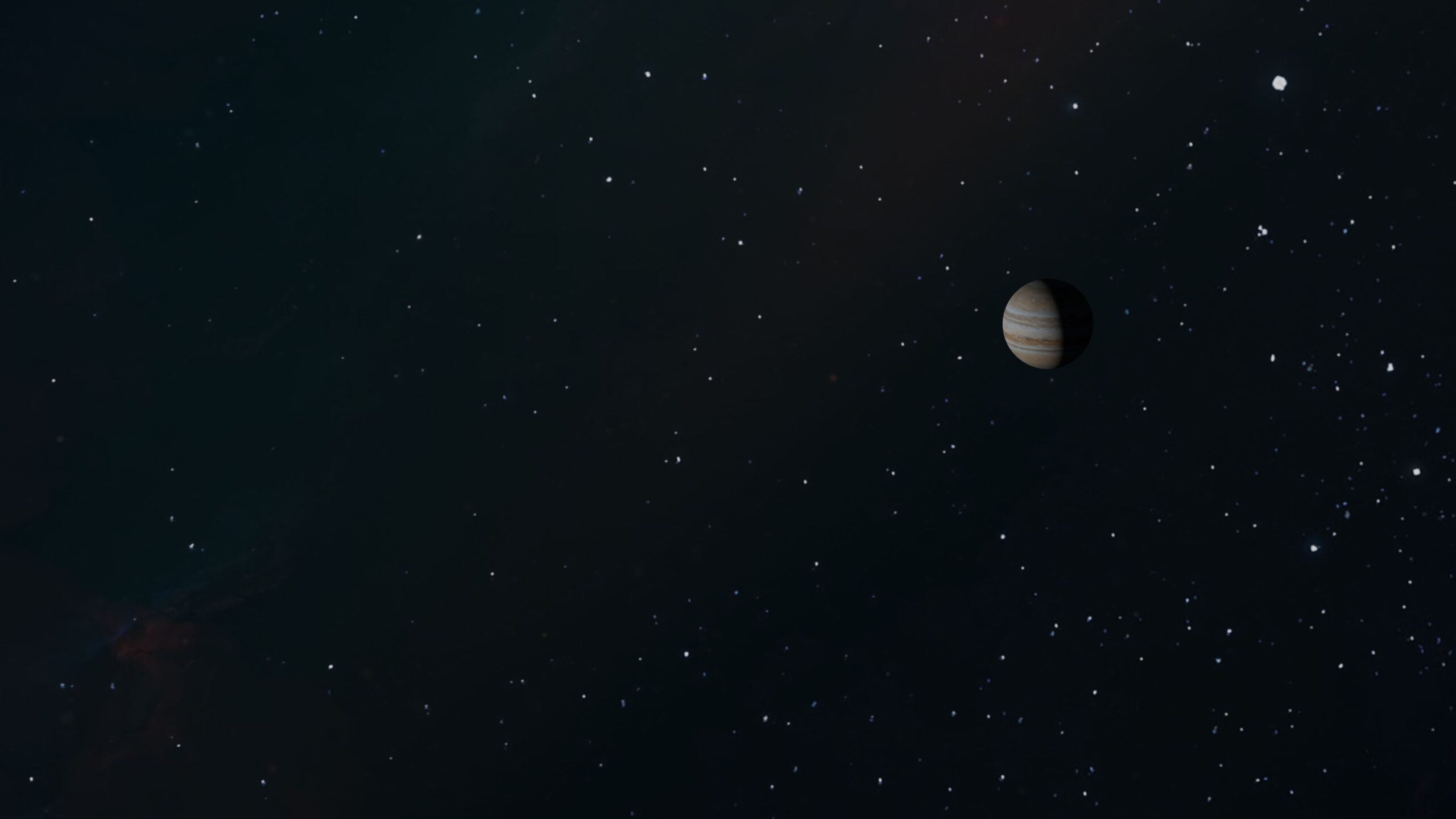
In June 1961, a UCLA graduate student called Michael Minovitch took a summer job at the Jet Propulsion Laboratory. His actual assignment was narrower than what he ended up doing with it: work out the trajectory of a free-fall spacecraft moving between two points under the Sun’s gravity alone. On his own time, not as part of that assignment, he kept pushing at a harder, unsolved problem sitting right next to it, and by August he had worked out something that would eventually let humanity visit every planet in the solar system on a fraction of the fuel anyone thought was required.
I wrote a few days ago about how NASA timed Voyager 2’s 1977 launch to catch a rare planetary alignment, letting it slingshot past Jupiter, Saturn, Uranus and Neptune on what I called borrowed gravity. Minovitch is the person who worked out that borrowing was possible in the first place, sixteen years before Voyager left the ground.
A problem solved by brute force, on a machine the size of a room
The three-body problem, working out how three objects move under each other’s gravity, has no general exact solution. Minovitch’s way around that was to stop looking for one. Using an IBM 7090, one of the earliest transistorized computers and among the fastest machines available anywhere at the time, he numerically simulated thousands of possible trajectories rather than trying to solve the equations in closed form. The insight that mattered most came from switching perspective: viewed from the planet a spacecraft is flying past, its speed going in and its speed coming out are the same. Viewed from the Sun, they can be very different, because the planet itself is moving, and that motion gets partly transferred to the spacecraft. His original paper, presented that August, was typed on a typewriter, with the geometry sketched by hand and the Greek symbols added afterward with a pen.
The part that still trips me up
The detail I find hardest to hold in my head is that none of this involves any thrust at all. A spacecraft can leave a planetary flyby considerably faster than it arrived, and for the entire encounter it experiences no acceleration a person aboard would feel, just a continuous, gentle sense of falling. The plainest way I’ve found to picture it is a ball bounced off the front of an oncoming train. Relative to the train, the ball simply bounces back at the same speed it arrived. Relative to the ground, it comes back much faster, because the train’s own motion got added to the bounce. A spacecraft passing a planet is doing the same trick, at a scale where a person doesn’t feel a thing, and the ball’s motion added to it, ever so slightly, is stolen from the train.
Stolen isn’t really the right word, though it’s the one I keep reaching for. The planet does lose an infinitesimal, genuinely unmeasurable amount of its own orbital energy in the exchange. Jupiter has been doing this favor for spacecraft since 1973 and its orbit hasn’t budged by anything anyone could detect.
From a side project to real missions
Pioneer 10 gave the first real demonstration of what this looked like off paper. Its flyby of Jupiter in December 1973 accelerated it to roughly 132,000 kilometres an hour, and Pioneer 11’s own Jupiter encounter a year later, deliberately aimed to redirect it toward Saturn rather than just observe Jupiter, pushed it further still, to somewhere around 173,000 kilometres an hour. Neither spacecraft needed a rocket motor for that boost. They needed a planet in the right place, and a trajectory designed years in advance to make use of it.
A discovery that didn’t go uncontested
It would be tidy to end the story there, but the historical record is messier than that, and I don’t think it’s fair to leave that part out. Minovitch spent much of his later career arguing, including in court, that his contribution to the technique wasn’t fully credited, and he sued several people, including Richard Battin, who had published his own paper touching on related trajectory mathematics back in 1958. Minovitch lost that case. He continued working on trajectory mathematics for decades afterward and died in September 2022. Priority disputes like this are common enough in the history of science that I don’t think it says much about the underlying physics, but it feels dishonest to tell this story as a clean, uncomplicated triumph when the person at the center of it spent years insisting it wasn’t being told fairly.
What stays with me
What I keep coming back to isn’t the mathematics, which is well beyond me, but the fact that a technique now used on almost every mission to the outer solar system started as an unassigned side project during a summer internship, worked out on a machine that would be considered primitive today, by someone who wasn’t asked to solve that particular problem at all.