
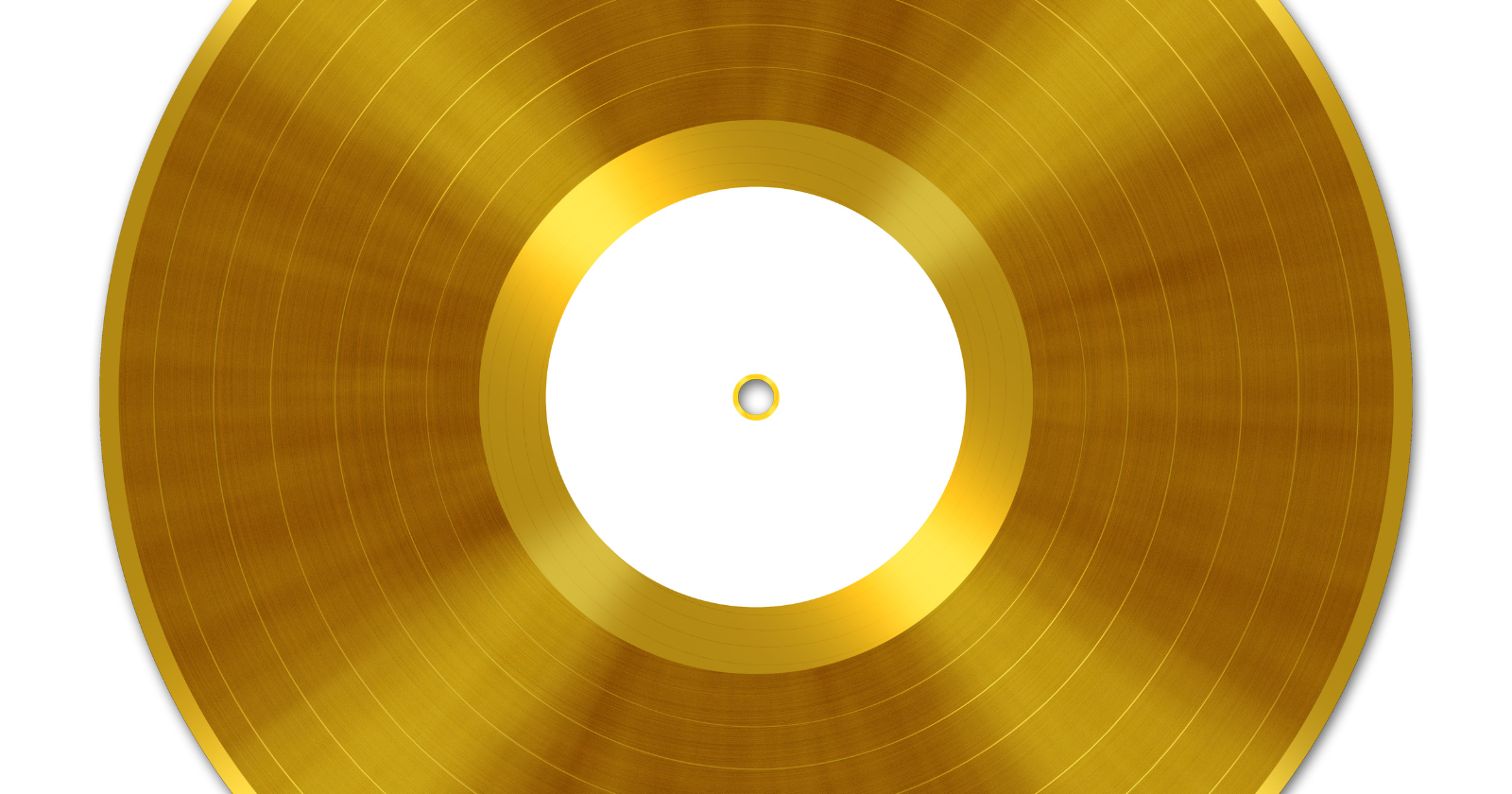
In the late summer of 1977, NASA bolted a gold-plated copper phonograph record to the side of each of the two Voyager spacecraft. The committee that chose what went on it, chaired by the astronomer Carl Sagan, had less than six weeks and a tiny working budget, often described as about fifteen hundred dollars. What they assembled, according to NASA’s own account of the record, was 115 images encoded in analog form, greetings in 55 languages, around 90 minutes of music, and a sound essay of Earth: surf, wind, thunder, birdsong, whales, a kiss, a baby, footsteps, laughter.
The disc was engineered to survive for something on the order of a billion years in the vacuum of interstellar space. That figure is the part worth sitting with. It is far longer than the spacecraft will keep transmitting. It is far longer than any institution that made the record will exist. It is, on most reasonable timescales, far longer than the civilisation that produced it.
So the record is a strange object to examine closely. It was built as a message, with instructions for playback etched into its aluminium cover. But the conditions under which anyone could ever receive it are so remote that calling it a message at all starts to feel like a category error.
What the record was built to outlast
The Voyager probes are not aimed at any target civilisation, or even at a close encounter with a particular star. Voyager 1 is now well beyond the edge of the heliosphere, the farthest human-made object from Earth, moving outward at tens of thousands of kilometres per hour. It will take tens of thousands of years just to approach the rough distance of the nearest stars, and it is not heading toward any of them in particular. The Planetary Society, in its summary of the project, describes the discs as “letters of introduction” to a passing civilisation that might one day stop and inspect the craft. The phrasing is generous. It might also be the longest-odds delivery ever attempted.
This is not a criticism of the people who made it. They understood the odds. Sagan said as much at the time: the record would only ever be played if there were advanced spacefaring civilisations out there to find it, and even then, only by chance. The team built for permanence anyway. They chose a billion years of durability for an object whose realistic chance of being read by its stated audience rounds close to zero.
Which raises the obvious question of who the record was really for. The answer is not the one the cover etchings imply.
The most personal thing bolted to the spacecraft
The strangest single item on the record is also the one that points most clearly at its real audience. Among the sounds of Earth is a recording of Ann Druyan’s brainwaves. Druyan was the project’s creative director. She proposed putting a person’s electroencephalogram on the disc, compressed into audio, on the theory that a civilisation capable of retrieving the spacecraft might also be capable of reading the thoughts behind the signal.
She volunteered herself. According to the account she later gave, the recording was made in early June 1977, and she went into it with a prepared list of things to think about: the history of Earth, the development of civilisation, the problems a technological species faces. She had also, days earlier, fallen in love with Sagan. The two had recently agreed to marry. Druyan has acknowledged that her state of mind during the recording was shaped by that, and that some of what the EEG captured was a person thinking about being in love.
Almost certainly, no alien recipient is going to decode that as a readable transmission of human consciousness. It is closer to a keepsake. The detail that makes the brainwave recording famous is exactly the detail that has no plausible function as interstellar communication. It functions instead as the kind of thing people leave behind when they want a private fact about themselves to persist somewhere beyond the reach of their own lives.
A self-portrait, edited
Look at the contents as a whole and the same pattern holds. The greetings begin with Akkadian, a language last widely spoken thousands of years ago, and end with a modern Chinese dialect. The music runs from Bach and Beethoven to a Georgian folk song to Chuck Berry. There are printed messages from President Carter and from the United Nations Secretary-General. It is, as the Planetary Society puts it, a kind of greatest-hits package.
The phrase greatest hits is the tell. A greatest-hits selection is not a neutral description of a thing. It is a curated and flattering one. The record carries surf and birdsong and a mother with a child. It does not carry war, or famine, or the sounds of a species doing damage to itself and its planet. Druyan has said she wanted a fuller range of human experience represented, including conflict, and that this did not make the final cut. The committee, given six weeks to introduce humanity, introduced the version of humanity worth introducing.
That editing is not dishonest, exactly. Anyone assembling a self-portrait for an unknown stranger does the same thing. But it tells you the record is a self-portrait rather than a documentary, and self-portraits are made as much for the maker as for any viewer. The version of ourselves we send outward is the version we would like to be true.
The older impulse underneath it
None of this is unique to space. The urge to place a durable, idealised trace of yourself somewhere beyond your own lifespan is one of the oldest human habits there is. Grave goods are this. Monuments are this. The school time capsule buried in a car park is a domestic, low-stakes version of the same impulse, sealed against a future the burying children will mostly not see. The Golden Record is that gesture carried out with NASA’s engineering and Sagan’s reach, aimed not at a future generation of humans but at the darkness beyond the heliosphere.
Read that way, the audience problem resolves. The record was always going to be received, just not by aliens. It was received the moment it was made, by the people who made it, and it has been received again by everyone who has since learned what is on it and felt something. The recipient is us. The reaching outward is the point, and the reaching is legible here, now, on Earth, in a way it will almost certainly never be legible anywhere else.
This is the part the standard telling tends to miss. The Golden Record is usually framed as our message to the cosmos, a hopeful note in a bottle. It works far better understood as a mirror. We learn very little about any future finder from it. We learn a great deal about a small group of people in 1977 who, asked what humanity was, chose to answer with music and greetings and one woman’s recorded thoughts of love rather than with anything harder.
The discs are still out there, bolted to two probes that are slowly being powered down and will one day fall silent. Nothing is likely to scratch them. They will keep their cargo of idealised Earth intact for a span of time that makes the question of an audience almost beside the point. The record will outlast the senders, and the spacecraft’s working life, and very possibly the world described on it. What it was built to do, it has already done.
