Most dinosaur fossils give us the scaffolding. Teeth, vertebrae and limb bones can tell palaeontologists how an animal fed, moved and grew, but they rarely preserve the surface that made the living animal recognisable.
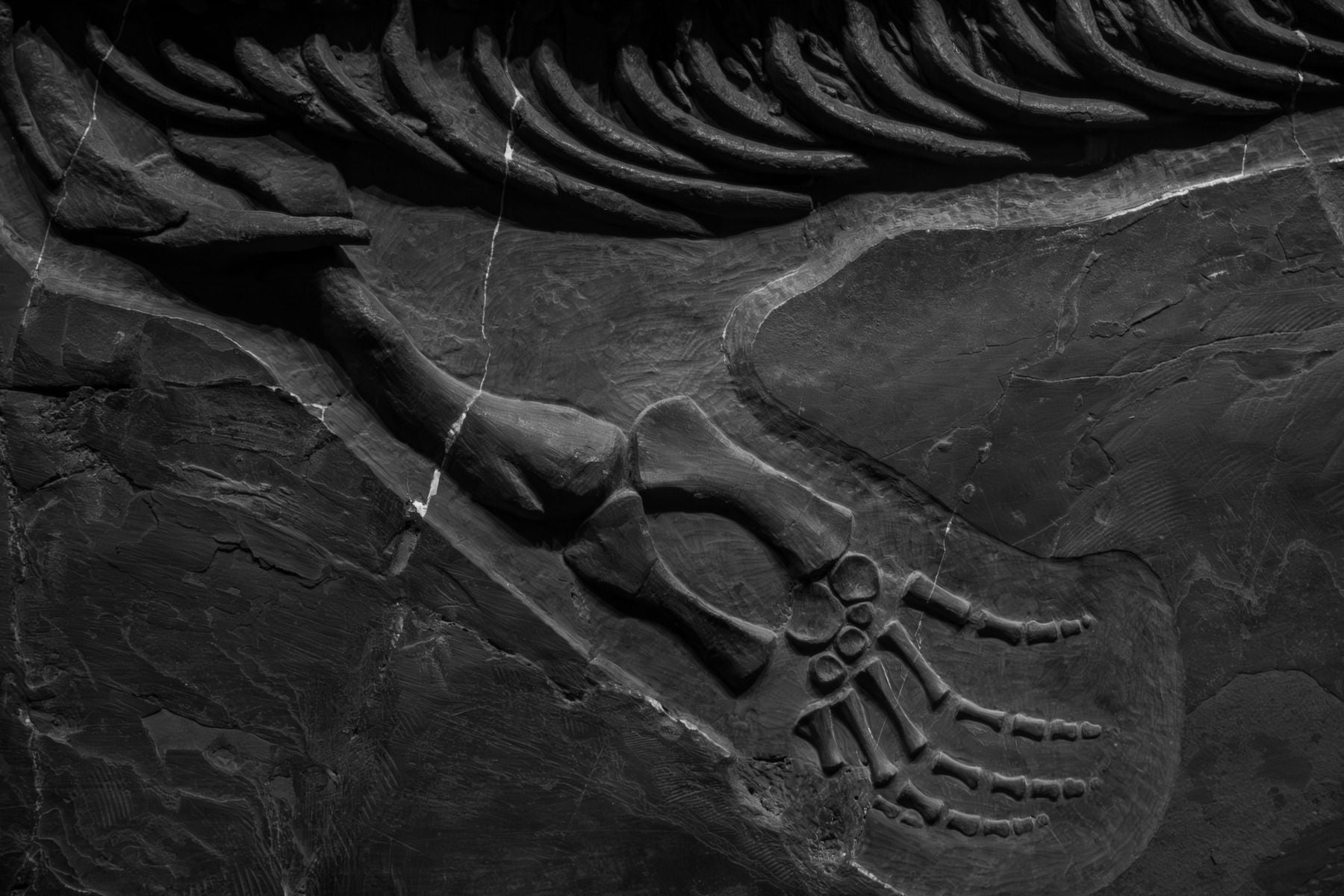
Haolong dongi is different. The newly described iguanodontian from northeastern China is represented by a nearly complete, articulated juvenile about 2.45 metres long. Around its neck, back and sides, the fossil retains scales interspersed with hollow spikes.
A paper published in Nature Ecology & Evolution in February 2026 reports that those spikes preserve skin architecture at cellular resolution. The authors could distinguish an outer cornified layer, a multilayered epidermis and individual keratinocytes, including structures interpreted as their nuclei.
That result does more than add an unexpected silhouette to the dinosaur books. It exposes a part of dinosaur anatomy that the normal fossil record is poorly equipped to keep.
The cells were not loose inside an empty tube
The phrase “skin cells inside hollow spikes” creates the wrong mental picture. The researchers did not find intact cells floating in a cavity. Tomographic scans and thin histological sections revealed the cellular construction of the spike wall.
On the outside was a thickened stratum corneum, the tough, cornified surface of the epidermis. Beneath it were multiple epidermal layers containing keratinocytes preserved to nuclear-level detail. Those layers surrounded a porous central dermal pulp.
In other words, the hollow part was not simply empty space. In life, the dermal core may have carried blood vessels, nerves and other tissues that supported the growing appendage. The fossil preserves enough of the layout for the researchers to describe the spike as a skin organ rather than a pointed scale or a piece of bone.
“Preserved cells” also does not mean cells that could be revived or sampled for DNA. These are mineralised anatomical replicas and traces. The organic machinery has gone. What crossed 125 million years was form at a microscopic scale.
I find that distinction makes the fossil more interesting, not less. A chemical process acting soon after death copied fragile biological architecture before it collapsed, then the rock protected that copy across almost the whole history of flowering plants.
“Porcupine-like” describes an effect, not the anatomy
The porcupine comparison is visually useful, but it can make Haolong sound far more extravagantly armed than the fossil supports.
Most of its spikes were only around two to three millimetres long. Medium examples reached five to seven millimetres. A few larger structures may have extended beyond four centimetres, although the longest are less completely preserved and their full dimensions require more caution.
The spikes were concentrated around the posterior neck, back and sides, apparently pointing rearward. At life size, much of this covering may have looked more like a rough or prickly surface than the conspicuous quills of a modern porcupine.
The similarity is not one of inheritance. Porcupine quills are modified mammalian hairs. The Haolong spikes differed in microscopic construction from known protofeathers in non-avian dinosaurs. They also differed from the pointed scaly structures of living lizards and from osteoderms, the bony plates embedded in the skin of animals such as armoured dinosaurs and crocodilians.
The authors therefore interpret them as a separate evolutionary innovation. The interesting claim is not that dinosaurs had porcupine quills. It is that one dinosaur lineage arrived independently at a hollow, projecting skin appendage.
One animal carried several kinds of surface
Haolong belonged to Iguanodontia, the broad plant-eating group that includes early relatives of the later duck-billed dinosaurs. Its skull carried a beak and batteries of grinding teeth, while its limbs suggest an animal able to move on two or four legs.
Its skin was not uniform. Small, non-overlapping tuberculate scales covered areas around the neck and thorax. The hollow spikes were mixed among them. Along the tail, the researchers found larger scutate scales, including overlapping examples unlike the usual pattern described in other iguanodontians.
That mosaic matters. Popular reconstructions often ask whether a dinosaur was “scaly” or “feathered,” as though the entire body had to choose one material. Living animals rarely work that way. A chicken carries feathers, naked skin, a keratinous beak, claws and scaly feet. A mammal can combine hair, pads, nails and horns.
A 2024 study of the Jehol dinosaur Psittacosaurus made a related point at microscopic scale. Its non-feathered torso retained reptile-like epidermal layers even though the animal is also known for bristle-like structures on its tail. Different regions of one dinosaur could follow different developmental programmes.
Haolong extends that lesson. Dinosaur skin was not one evolutionary switch between scales and feathers. It was a surface capable of producing local structures with different construction and perhaps different jobs.
A bone-centred fossil record produces bone-centred dinosaurs
Hard tissues dominate palaeontology for a straightforward reason. Bone and teeth already contain minerals. Skin, muscle and internal organs usually decay, are eaten or collapse before burial and chemical conditions can preserve them.
Even dinosaur skin commonly survives as an impression rather than a three-dimensional tissue. An impression may reveal the outline of scales while losing the cellular layers that distinguish one type of appendage from another.
This creates a severe sampling problem. If a defensive or display structure was built from epidermis rather than bone, an otherwise excellent skeleton could retain no sign of it. A palaeontologist could describe every vertebra correctly and still reconstruct the animal’s exterior incorrectly.
I wrote about a comparable survivor effect in my article on whether prehistoric humans really lived in caves. Caves dominate part of the archaeological story because they preserve traces that open camps often lose. With dinosaurs, bone dominates because it is the material most likely to cross deep time.
That does not mean every skin structure is hiding from us. It means absence must be interpreted against preservation. No hollow spikes had previously been identified in a dinosaur, but most dinosaur fossils never offered the microscopic skin anatomy needed to rule them in or out.
Jehol opened an unusually narrow window
The fossil came from the Yixian Formation in Liaoning Province, part of the Early Cretaceous Jehol Biota. This region is famous because fine lake sediments and volcanic material preserved organisms with a fidelity that ordinary terrestrial deposits rarely achieve.
Jehol fossils transformed the picture of feathered dinosaurs, but the site has also retained mammals, birds, plants, insects, skin outlines and stomach contents. It is not a representative sample of how all fossils form. It is an exceptional window that reveals features usually erased elsewhere.
The Haolong team combined ordinary anatomical description with laser-stimulated fluorescence, X-ray tomography and histology. Fluorescence helped trace faint soft-tissue structures across the slabs. Tomography tested the internal form without relying only on the exposed surface. Thin sections then showed how the layers and cells were arranged.
This sequence matters because a dark line beside a skeleton can be ambiguous. It might be degraded tissue, a sedimentary feature, preparation material or something displaced after death. Multiple methods allowed the researchers to connect the visible spikes to a repeated cellular architecture.
The animal was not preserved as a frozen body. Its microscopic tissues became mineral information. The discovery depended on both a rare burial history and instruments able to read that history.
Defence is plausible, but the function is not settled
The paper argues that deterring predators was probably the spikes’ primary role. A dense field of rear-pointing projections around the neck and torso could have made a young herbivore less comfortable to bite or hold, even if most individual spikes were small.
That interpretation fits the specimen’s age. A juvenile roughly 2.45 metres long would have shared the Jehol ecosystem with small predatory dinosaurs. It lacked the sheer size an adult iguanodontian might use as protection.
But function is difficult to extract from form. The authors also discuss thermoregulation and mechanoreception as possible secondary roles. A living dermal core might have allowed heat exchange or supported sensory tissue. Those possibilities are biologically reasonable; they are not direct observations from the fossil.
The known animal was also still growing. Its vertebral centra and neural arches had not fully fused, one line of evidence for juvenile status. Adults may have retained the spikes, enlarged them, reduced them or lost them as body size changed the balance between defence, heat and material cost.
One specimen cannot choose among those paths. Nor can it show whether males and females differed, whether the spikes changed seasonally or how much variation existed within the species.
The discovery widens what a dinosaur could be
Haolong dongi is known from a single individual. That is enough to establish a new anatomy, but not enough to make hollow spikes typical of iguanodontians or dinosaurs generally.
The age claim also needs precision. The skin structure did not remain alive or unchanged for 125 million years. This juvenile shows that such a structure had evolved by about 125 million years ago, while scientists only recognised it as possible in 2026.
When I wrote about ancient air sealed in Antarctic ice, the remarkable point was that researchers could measure a physical sample of a vanished atmosphere. The Haolong cells are different. They are a mineral record of structure rather than original living matter.
Both archives depend on improbable conditions. Most ancient air escapes. Most ancient skin disappears. What survives can make an unusual feature look newly invented when it is only newly visible.
The fossil does not replace the familiar scaled and feathered dinosaurs. It makes the range wider. Somewhere between an impression in stone and a row of bones, a juvenile plant-eater kept the cellular plan of a skin appendage no palaeontologist knew to look for.