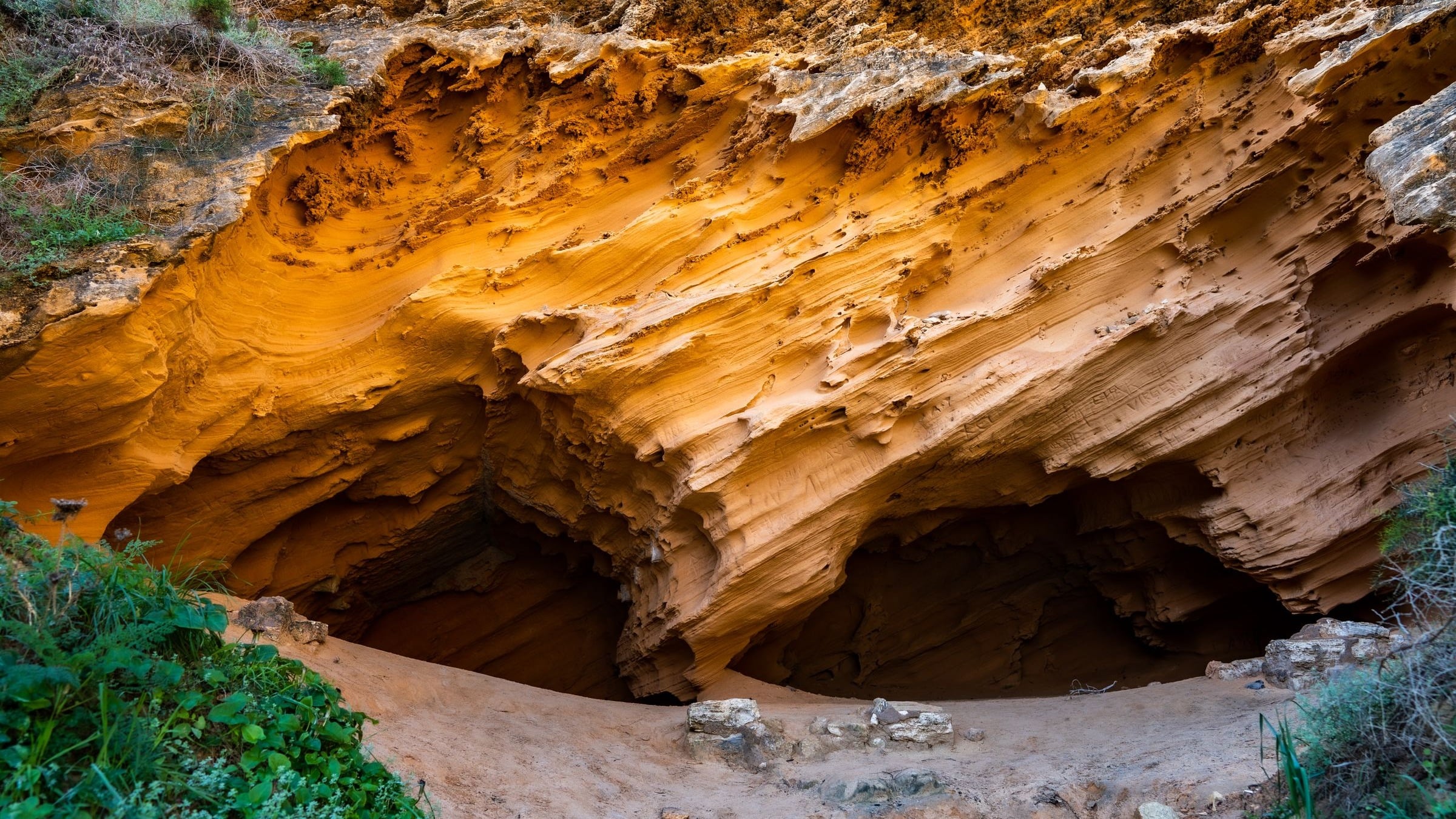
The short answer is yes. Some prehistoric humans really did live in caves.
The longer answer is that the word “caveman” has taken one genuine part of prehistoric life and expanded it into a complete lifestyle. Neanderthals and Homo sapiens used caves for shelter, work, food preparation, burial, art and probably ceremonies. They also lived in open-air camps, beside rivers, on plains and under shelters built from wood, hides, grass, bone and whatever else the local landscape provided.
Most did not spend their entire lives deep underground.
I realised while looking into this that the image in my own head was still basically a childhood cartoon: a family gathered around a fire in a dark stone chamber, with the cave functioning like a permanent house. The archaeology is more mobile and varied than that. It also contains a useful warning about how the evidence that survives can quietly decide the story we tell.
A cave entrance could make an excellent home
For a mobile group without permanent architecture, a well-positioned cave or rock shelter solved several problems at once. A stone roof blocked rain and snow. Walls reduced wind. The interior moderated temperature, and the entrance could provide daylight, ventilation and a view over animals moving through a valley.
Caves were not equally useful. A damp shaft, a narrow fissure or a chamber that flooded seasonally was no home. A broad, dry entrance facing the Sun could be valuable enough for people to return to across hundreds or thousands of years.
The part near the mouth mattered most for ordinary life. It offered the benefits of a roof without the total darkness, stale air and smoke problems of the deeper cave. Archaeologists often use the separate term “rock shelter” for a shallow overhang that provides cover without becoming a long underground passage.
At residential cave sites, the evidence can be unmistakable: hearths, ash, cut animal bones, discarded stone flakes, tools at different stages of manufacture and sediments repeatedly trampled by people. Both Neanderthals and early modern humans left such traces in caves and rock shelters, including sites returned to across many generations.
That still does not make every cave deposit a home. Predators dragged prey into caves. Water moved bones. People entered for brief tasks, left objects, buried the dead or returned seasonally. A human tooth in a chamber proves presence. It does not, by itself, prove that a family slept there every night.
Why caves dominate the story
Caves are unusually good archives.
Caves can shelter remains in conditions rarely found outside. The US National Park Service describes Pleistocene fossils preserved by drying in Grand Canyon caves, including dung, skin and hair tens of thousands of years old. Archaeological bone and other organic material can likewise survive beneath a stone roof after comparable material disappears from exposed sites. Fine layers of sediment can accumulate in the same protected place, recording separate occupations one above another.
They are also easy for archaeologists to notice. A cave is a bounded place that can be mapped, excavated and revisited. An ancient camp on an exposed plain may now be buried beneath metres of sediment, scattered by a river, ploughed apart, covered by a city or eroded away completely.
Michael Jochim made the bias unusually plain in a 2019 review of the limits of Palaeolithic archaeology. Cave sites, he wrote, are overrepresented because they are highly visible, while many open-air sites are discovered only by accident during construction or mining.
This creates a kind of archaeological survivor effect. If one household spends a winter under a rock shelter and another builds a hide tent beside a lake, the first may leave a dense, protected layer of ash, bone and stone. The second may leave a faint scatter that wind, water and later human activity erase.
Thousands of years later, it can look as though only the cave group existed.
Open-air sites change the picture
Enough open-air sites have survived to show that prehistoric people were not tied to stone roofs.
At ’Ein Qashish in northern Israel, archaeologists recovered Neanderthal remains, animal bones and stone artefacts from an open landscape near a river. The site was used repeatedly between roughly 70,000 and 60,000 years ago. The 2019 PLOS ONE analysis of ’Ein Qashish concluded that the setting drew repeated occupations and offered a rare view of Neanderthal mobility outside caves.
The wider pattern is not that caves were homes while open sites were merely workplaces. A separate Scientific Reports study of the Neanderthal remains at ’Ein Qashish describes a habitation context used repeatedly, making the site part of a settlement and mobility system rather than an isolated outdoor visit. Across the wider record, some open sites were hunting stations or places to obtain stone, while others preserved hearths, food processing and repeated activity consistent with camps.
People could also make shelter. Spain’s National Museum and Research Centre of Altamira describes Upper Palaeolithic humans as living in caves, rock shelters and freestanding huts. Archaeologists look for post holes, stone settings, hearths and concentrations of material that may mark the remains of windbreaks or dwellings.
The details are often debated. Wood rots. Hides vanish. A ring of stones can have more than one explanation. Even the frequently illustrated shelter at Terra Amata in France has generated arguments over how much of the pattern was produced by people and how much by natural processes.
Later Upper Palaeolithic sites give clearer examples. At places in eastern and central Europe, hunter-gatherers built dwellings using timber and mammoth bone. Those structures do not mean everyone lived in mammoth-bone houses any more than a painted cave means everyone lived underground. They show that prehistoric housing changed with climate, available material, group size and how long people expected to stay.
Living in a cave usually meant living near its mouth
Popular images often place daily life far inside the darkness because that looks more dramatic. It would usually have been inconvenient.
Beyond the daylight zone, every visit required fuel and a reliable flame. Uneven floors made movement difficult. Smoke from hearths needed somewhere to go. Water could drip or pool, and cave-dwelling bears, hyenas and other animals were not imaginary competitors.
The distribution of remains often reflects this. Jochim’s review notes that activities in caves tended to cluster near the mouth, where usable space, light and airflow were better. A cave could therefore function less like a bunker and more like a deep veranda: a protected edge between the outdoors and the underground.
Occupation was often intermittent. Mobile hunter-gatherers followed animals, plants, stone sources, water and seasonal conditions. A particularly good shelter might become a recurring stop within that wider circuit. One group could use it for weeks, leave, and return in another season. A later population might occupy the same place centuries after everyone connected with the earlier visit was gone.
A thick archaeological layer can compress all of those separate episodes into what looks like continuous residence.
Deep caves had other meanings
Prehistoric people did go far underground. The reasons were not always domestic.
At Bruniquel Cave in southwestern France, Neanderthals broke stalagmites and arranged the pieces into large rings 336 metres from the entrance. A 2016 paper in Nature dated the structures to about 176,500 years ago and documented traces of fire. Whoever built them could organise work and manage light in a place of complete darkness.
There is no good evidence that the Bruniquel chamber was an ordinary living room. Its depth is what makes it so unusual.
Chauvet Cave offers a different example. France’s Ministry of Culture identifies two major periods of human use and 435 animal images, made using engraving, charcoal and red paint. The earliest use dates to roughly 36,500 years ago, with another period between about 30,000 and 31,000 years ago. Its deep decorated chambers record art and symbolic activity, not an ordinary residential floor.
Painted chambers, deliberate constructions and burials tell us that caves could be more than shelter. They might hold memory, danger, identity or shared practices that are difficult to reconstruct from objects alone.
The cave was part of the social landscape, not simply a prehistoric apartment.
Where the caveman image came from
The stereotype has a history. Some of the first ancient human fossils recognised by European science came from caves and rock shelters. The Neanderthal type specimen was found in 1856 in the Feldhofer cave in Germany’s Neander Valley. Later discoveries at sites such as Cro-Magnon, La Chapelle-aux-Saints and Shanidar reinforced the association.
Caves also gave museums and illustrators a convenient scene. Stone walls survive into the present, whereas a hide windbreak on an Ice Age plain does not. Cave paintings supplied an immediately recognisable background. By the time films and cartoons inherited the image, “cave” had become a visual synonym for “prehistoric.”
But “prehistoric humans” covers several human species, millions of years and almost every kind of environment people could enter. In much of Africa, where our lineage spent most of its history, suitable caves were not available everywhere. Humans still moved through grasslands, woodlands, coasts and river systems.
So did prehistoric humans live in caves? Yes, sometimes, and some caves were important homes used repeatedly.
They also camped outside, built shelters and moved between places. The better answer is that prehistoric people used the landscape flexibly, while the cave record survived well enough to make one part of that life look like the whole thing.