

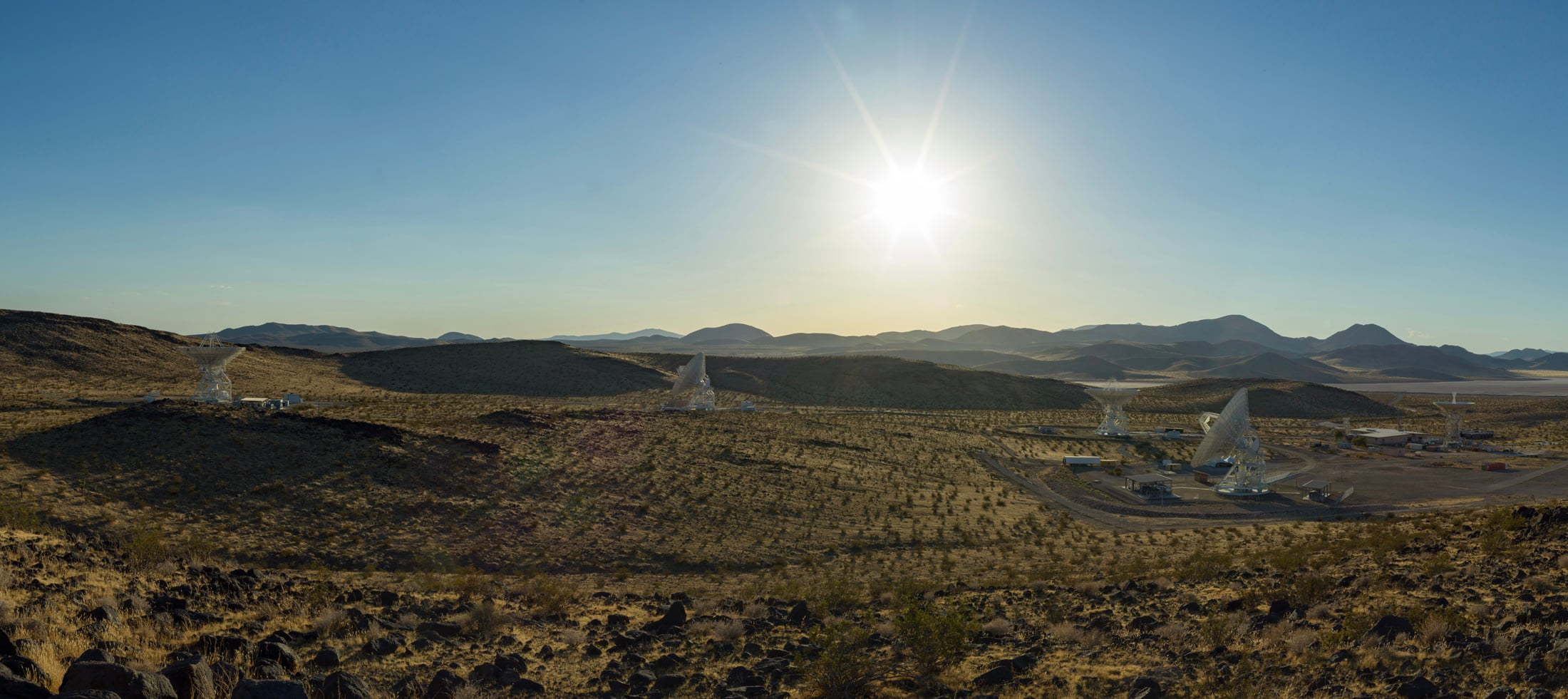
NASA’s new 34-metre antenna at Goldstone began operations on 3 August 2026, tracking the Chandra X-ray Observatory. Its arrival gives the Deep Space Network another working dish as more than 40 spacecraft depend on the system for commands, navigation and returning data.
The addition addresses a shortage that NASA’s network managers were describing five years ago. In 2021, network manager Brad Arnold told a planetary-science planning committee that antenna expansion could not keep up with demand. Missions, he said, should expect less availability. The new dish is progress on that problem, rather than evidence that the competition for contact time has ended.
Three complexes provide opportunities to connect
The Deep Space Network has complexes near Goldstone in California, Madrid in Spain and Canberra in Australia. Their separation by roughly 120 degrees of longitude allows one part of the network to come into view as Earth’s rotation carries another away from a spacecraft.
That geographical arrangement provides coverage opportunities, not a permanent private connection for every mission. Antennas must be available, able to see the spacecraft and equipped for the required radio frequencies and signal strength. Other missions may need the same resource at the same time.
SpaceDaily’s earlier account of how Webb uses the network described the practical negotiations behind those contacts. Mission planners compare visibility windows with the shared schedule. Webb stores observations onboard between passes, then sends them down when a suitable antenna is assigned.
Continuous scientific work therefore does not necessarily mean continuous radio contact.
The warning was about demand exceeding available hours
Arnold’s comments came during a 7 July 2021 presentation to the steering committee of the planetary science decadal survey. In Jeff Foust’s contemporary SpaceNews report, Arnold explained that new capacity was being added but missions should expect to be “getting less availability”.
The distinction is between requested antenna time and the time the network can actually allocate. A mission can remain operational while receiving fewer or differently timed passes than its planners would prefer. Some observations can wait in onboard storage; other activities require a particular window.
NASA’s Office of Inspector General subsequently documented the wider problem. Its July 2023 audit found that the DSN was operating at capacity, with demand at times exceeding supply by as much as 40 per cent. The auditors also identified additional pressure from the bandwidth needs of crewed Artemis missions.
That percentage belongs to the audit’s period and measure of demand. It is not a statement that 40 per cent of spacecraft were disconnected, or a current measurement of the network after DSS-23 entered service.
DSS-23 adds capacity after years of construction
NASA’s 25 August 2026 announcement marked the new dish with a ribbon-cutting, following testing from May through July and the start of operations earlier in August. The antenna is named Deep Space Station 23, or DSS-23.
It uses a multifrequency beam-waveguide design, routing radio signals to equipment in a stable underground room rather than placing all the sensitive electronics on the moving dish. That arrangement makes maintenance and upgrades more accessible.
The construction timescale explains why capacity cannot appear as quickly as a new scheduling request. Work began in February 2020. NASA’s December 2024 construction report recorded the lifting of the dish’s 133-ton reflector framework onto its pedestal. Installation, integration, calibration and testing still stood between that visible milestone and operational service.
The antenna could begin serving missions only after those systems worked together reliably.
Goldstone’s larger antenna remains unavailable
The new capacity arrives alongside a substantial loss of existing capability. Goldstone’s 70-metre DSS-14 antenna has been offline following a September 2025 incident in which it over-rotated while tracking Juno.
In its 5 June 2026 investigation announcement, NASA said damage affected cabling, structural supports and water lines, causing flooding. The agency said the antenna would remain offline for repairs and previously planned maintenance and upgrades expected to finish by October 2028.
NASA also said the network continued to support more than 40 missions despite the incident. Maintaining mission coverage under those conditions should not be confused with having abundant spare antenna time.
As SpaceDaily’s earlier explanation of the DSN’s reception of extremely weak signals described, dish size matters. A 34-metre antenna cannot simply be counted as identical to a 70-metre antenna for every spacecraft and observing task.
Expansion must be judged alongside maintenance and demand
The next planned addition in the enhancement programme is DSS-33 at Canberra, which NASA expects to bring online in 2029. That remains a schedule target.
Assessing whether the network is catching up requires more than counting installed dishes. The relevant questions include how many antennas are operational, which missions they can support, what maintenance removes from service and how many hours spacecraft request.
DSS-23 is now contributing to that schedule. Whether missions receive more of the contact time they seek will depend on the rest of the network’s availability and the demands placed on it.