

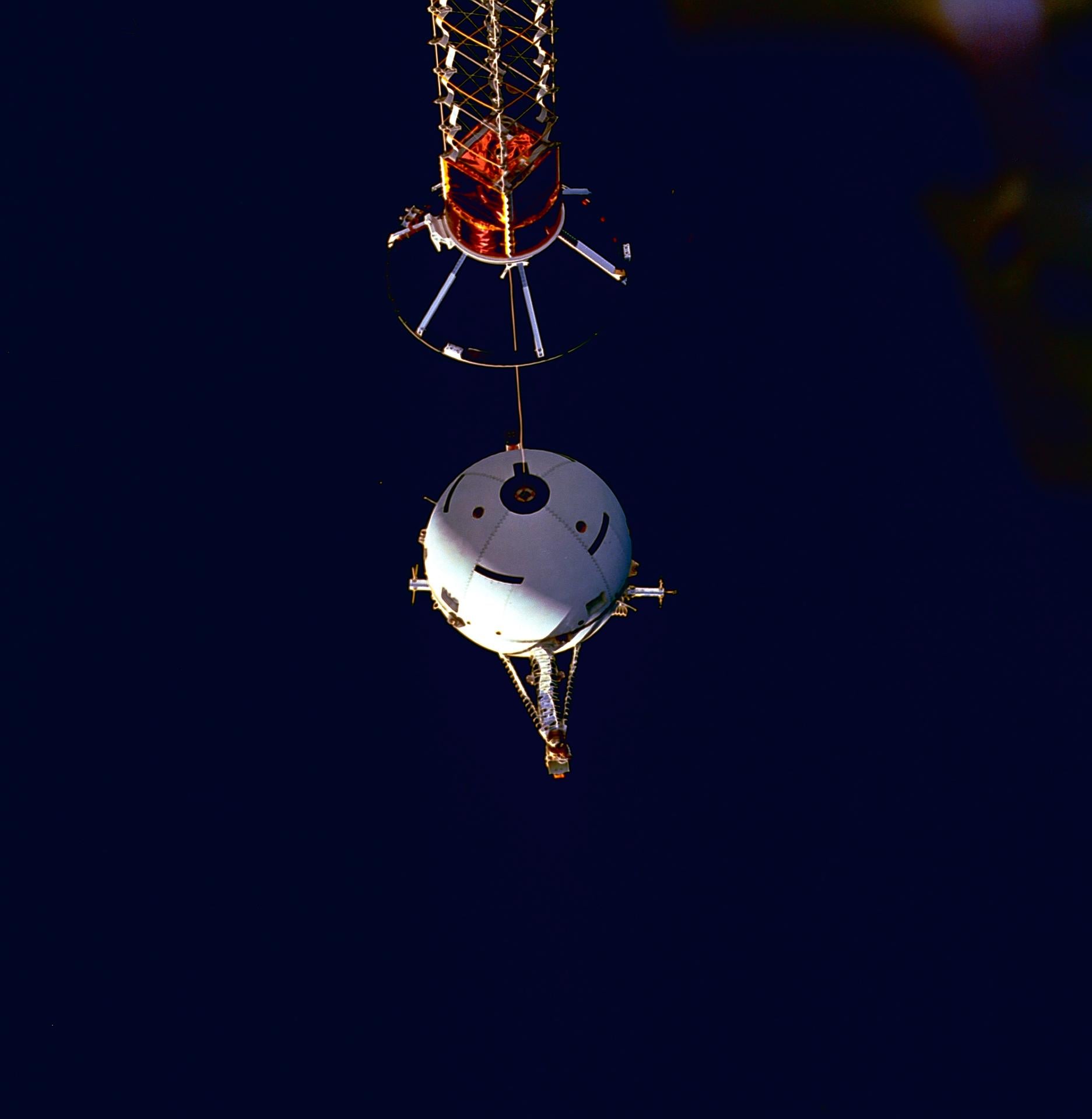
Columbia’s 1996 tether experiment came within about a kilometre of its planned deployment before the connection failed. With 19.7 kilometres of cable paid out, the satellite separated from the shuttle after electrical arcing burned through much of the tether and the remaining strands gave way under tension.
The NASA investigation board’s report places the conductor at a potential of minus 3,500 volts relative to the orbiter’s electrical ground during the passive operating mode immediately before the failure. The break ended the planned tethered operations, but it did not erase the measurements already collected.
A cable moving through Earth’s magnetic field
The US–Italian Tethered Satellite System reflight, TSS-1R, launched aboard STS-75 on 22 February 1996. Italy supplied the satellite, while the tether and deployment equipment were US-built. NASA’s mission account describes a programme intended to investigate the behaviour of a tether system within the ionosphere, the electrically charged region of Earth’s upper atmosphere.
The electrical principle was straightforward even if the hardware was not. A long conductor moving through Earth’s magnetic field develops a voltage along its length. With a suitable path for charge to enter and leave, that voltage can drive current. The surrounding plasma, containing charged particles, can form part of the circuit.
NASA’s explanation of the space tether experiment makes an essential qualification: electricity generated this way comes from orbital motion. Magnetic forces oppose the motion as energy is extracted. Earth’s field enables the conversion; it does not provide an unlimited source of energy without a corresponding change elsewhere.
The satellite was part of a moving generator.
In principle, supplying electrical power and reversing the appropriate current can produce the opposite effect, helping raise an orbit. Generation and propulsion are connected applications of the interaction between a conductor, current and a planetary magnetic field.
The long deployment brought a local failure
The length of the cable makes the accident easy to picture incorrectly. The failure did not require something to strike its distant end. Investigators traced the arcing to the deployment equipment near the shuttle, followed by the damaged section’s passage into the boom.
The board reported intermittent arcing for about nine seconds as the tether moved at roughly one metre per second. Burning removed much of its material, after which the normal load of about 65 newtons, or 15 pounds-force, separated what remained. Inspection of the recovered end found charring and a few Kevlar strands that had finally failed in tension.
That sequence matters. A cable can fail mechanically at the last instant because an electrical event has already destroyed its capacity to carry an otherwise ordinary load. Describing the event only as a snapped line leaves out the initiating process.
Why insulation mattered in the space environment
NASA’s spacecraft charging handbook discusses the incident as an example of sustained arcing. A flaw in the tether’s insulation released trapped gas, which became ionised and helped establish an unintended conducting path. The tether’s own electrical potential supplied the energy that kept the discharge going.
High voltage in orbit therefore involves more than choosing a cable strong enough to survive pulling forces. Insulation, escaping gas, surrounding plasma and nearby hardware all affect where current can travel. Conditions that look like an empty vacuum can still provide routes for an electrical discharge.
The handbook also explains the design trade-off. Restricting current can limit the ability to sustain an arc, but this mission deliberately sought substantial currents to investigate power and propulsion. A protective measure that sharply reduced the current would also constrain the experiment’s purpose.
The failure joined electrical and structural problems in the same component.
The shortened experiment still produced measurements
A scientific account of particle collection during TSS-1R reports more than five hours of deployment data. It gives a maximum electromotive force of 3,700 volts and a maximum current just below half an ampere during the operations it describes. That does not contradict the 3,500-volt figure associated with the failure: they describe different measurements and operating moments.
The same study found collected currents two to four times larger than predictions from the conventional model it evaluated. Although the available observations were fewer than planned, they still helped researchers characterise the system’s relationship between current and voltage.
A later scientific summary emphasised the importance of motion relative to the plasma in explaining current collection. An orbiting satellite is moving through its environment; treating that environment as a static electrical background can miss behaviour that becomes apparent in flight.
These findings are why the mission should be understood as a hardware loss with a scientific return. Successful measurements did not make the broken tether acceptable, but the break did not make the preceding observations worthless.
A satellite departed, while Columbia continued
NASA’s STS-75 account says the satellite moved away under orbital forces and that the crew was not endangered. The astronauts retracted the remaining tether and deployment equipment. Columbia also carried a separate microgravity research payload, and the shuttle returned to Earth on 9 March 1996.
Space Daily’s account of Project West Ford’s copper-needle radio ring describes another experiment that used orbiting conductors in an unconventional way. West Ford scattered radio signals; TSS-1R investigated electrical interactions with the magnetic field and plasma. Their mechanisms were different, but both required the behaviour of material in space to be demonstrated in flight.
For TSS-1R, nearly twenty kilometres of successful deployment ended at a damaged patch of insulation. The lasting engineering lesson lies in that difference of scale: a system stretching far beyond the shuttle could still depend on what happened inside the equipment beside it.